
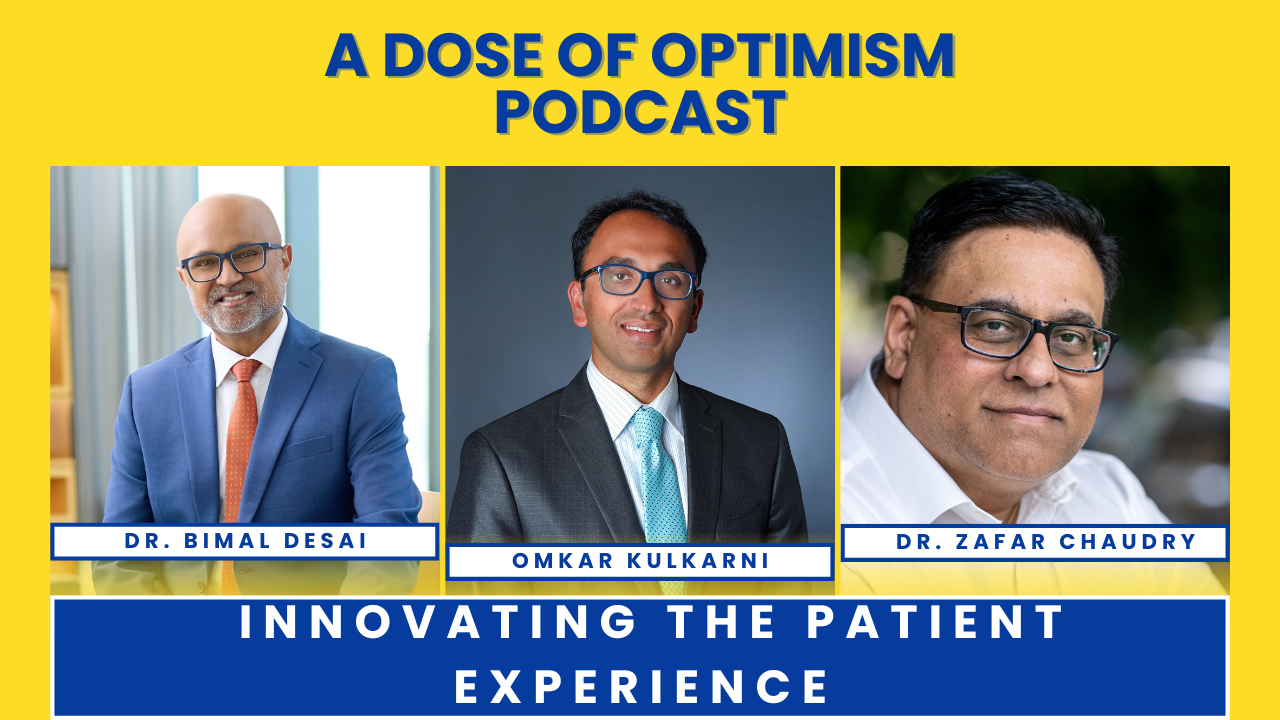
Digital health in pediatrics isn’t about replacing clinicians, it’s about supporting them, while making the experience easier for children and families.
In this episode, we hear from two leaders shaping that future: Dr. Bimal Desai, Chief Health Informatics Officer at CHOP, and Dr. Zafar Chaudry, Chief Digital & Information Officer at Seattle Children’s. Their stories reveal the practical, thoughtful ways technology can help families feel more connected and less overwhelmed.
Supporting Children With Complex Needs at Home
Dr. Desai describes how pediatric care differs from adult care in one fundamental way: each child often comes with multiple caregivers, schedules, and concerns. Digital tools have to work for everyone, not just the patient.
CHOP’s remote patient management programs are tailored specifically for medically complex children. Instead of relying on continuous connected devices, CHOP uses a right-sized model: daily check-ins, digital scales, pulse oximeters, and smart stethoscopes that allow clinicians to listen remotely. These tools help identify changes early, guide families through complex routines, and provide reassurance during the transition from hospital to home.
For some families, even a 30-day window of structured support after discharge brings tremendous relief. It transforms what often feels like “falling off a cliff” into a gradual, supported step-down.
Building Digital Tools That Respect Clinicians’ Judgment
At Seattle Children’s, Dr. Chaudry stresses that digital innovation must begin with culture, trust, and clear communication. AI tools shouldn’t override clinical judgment, they should help clinicians access information faster and more confidently.
One example is Seattle Children’s AI-supported “Pathway Assistant,” which synthesizes thousands of pages of clinical pathways so clinicians can quickly retrieve validated guidance. It’s a learning tool, a coaching tool, and a support tool, not a replacement.
Minecraft, Digital Front Doors, and Meeting Kids Where They Are
Dr. Chaudry also shares a surprising project: a fully built Minecraft version of the hospital. Designed with safety and child protection in mind, it gives young patients a way to explore, play, and regain a sense of control during hospitalization. What began as a simple idea is now a growing world shaped by patient feedback, including requests for therapy dogs inside the game.
Digitally enabled care is expanding in all directions: remote monitoring, AI-assisted decision support, redesigned patient portals, and digital front doors built with parent focus groups.
A Future Rooted in Empathy and Practicality
Both leaders emphasize that innovation only works when it supports real workflows and real families. Whether it’s intercepting changes in a newborn’s health or helping a resident retrieve clinical information safely, the goal remains the same: improving care, not complicating it.
Their work offers a hopeful view of what the next generation of pediatric care can look like, human-centered, thoughtfully designed, and built around the needs of children.
Key Topics Discussed:
- How pediatric care differs from adult digital care
- Remote patient management for medically complex children
- Supporting families during the home transition
- Right-sizing technology for small, high-need populations
- Operational considerations for scaling digital tools
- AI in pediatric healthcare: culture, safety, and trust
- Clinical pathway synthesis with AI (Seattle Children’s + Google)
- Data-driven improvements in opioid stewardship
- Minecraft hospital environment for patient engagement
- Patient and family-centered digital design
About Dr. Bimal Desai:
Dr. Bimal Desai serves as Vice President and Chief Health Informatics Officer at CHOP and is a Professor of Pediatrics at the University of Pennsylvania Perelman School of Medicine. As a practicing pediatrician and clinical informaticist, he and his team lead CHOP’s efforts to use data and digital tools to improve care, empower research, and reduce healthcare provider burden. He leads the programs in healthcare informatics, remote/virtual care, electronic consults, remote patient monitoring, and clinical artificial intelligence.
About Dr. Zafar Chaudry:
Dr. Zafar Chaudry has been Senior Vice President (Chief Digital & Information Officer) of Seattle Children’s since November 06, 2017. Through his role, he provides vision and leadership for the development of technology initiatives and enterprise-wide information systems and services for Seattle Children’s. His goal is to enable clinicians with the best technology to deliver safe and excellent care to our patients. Dr. Chaudry has been nominated as a finalist for the Seattle CIO of the Year ORBIE Awards the last two years (2020 and 2021). He is also a new member of the global elite list Constellation’s Business Transformation 150 (BT150) 2020; that recognizes the top global executives leading business transformation efforts in their organizations. Dr. Chaudry was named to the Becker’s Hospital Review’s 100 Hospital CIOs to Know (2019), CIO magazine’s list of U.K. CIO’s to follow on Twitter (2019) and Becker’s Hospital Review (USA) 105 Hospital and Health System CIOs to Know (2018). He was also named to the CIO.CO.UK’s Top 100 list of the most transformative CIOs in the U.K. (2017) and Government Computing’s top 100 influential technology leaders in the U.K. public sector (2010). Dr. Chaudry, who began his career as a physician, has more than 30 years of experience in all aspects of information technology. His background includes work in both healthcare and corporate settings in the U.S., Australia, Western Europe and the U.K., in enterprise infrastructure development; business intelligence; unified telecommunications; and implementation of health care information and electronic medical record systems. He previously served as Chief Information Officer at Cambridge University Hospitals in the United Kingdom. Prior to Cambridge University Hospitals, he served as Global Research Director at Gartner. He also served as Chief Information Officer at the Liverpool Women’s and Alder Hey Children’s Hospitals in the U.K.; Consulting Editor for Hospital Information Technology Europe Magazine; Information Technology Strategist for the Vision4Children Pediatric Charity in the U.K. and Teaching Faculty at the City Colleges of Chicago. Dr. Chaudry earned his Doctor of Medicine degree from Ross University. He subsequently earned his Master of Science degree in health care policy and management from the University of Birmingham. He also holds a Master of Science degree in information systems management from the University of Salford and his Master of Business Administration from Aston University, all in the U.K.
