
Pediatric healthcare is uniquely complex. Care teams support not just a patient, but entire families, often across long periods of time and multiple care settings. That complexity demands systems designed with intention.
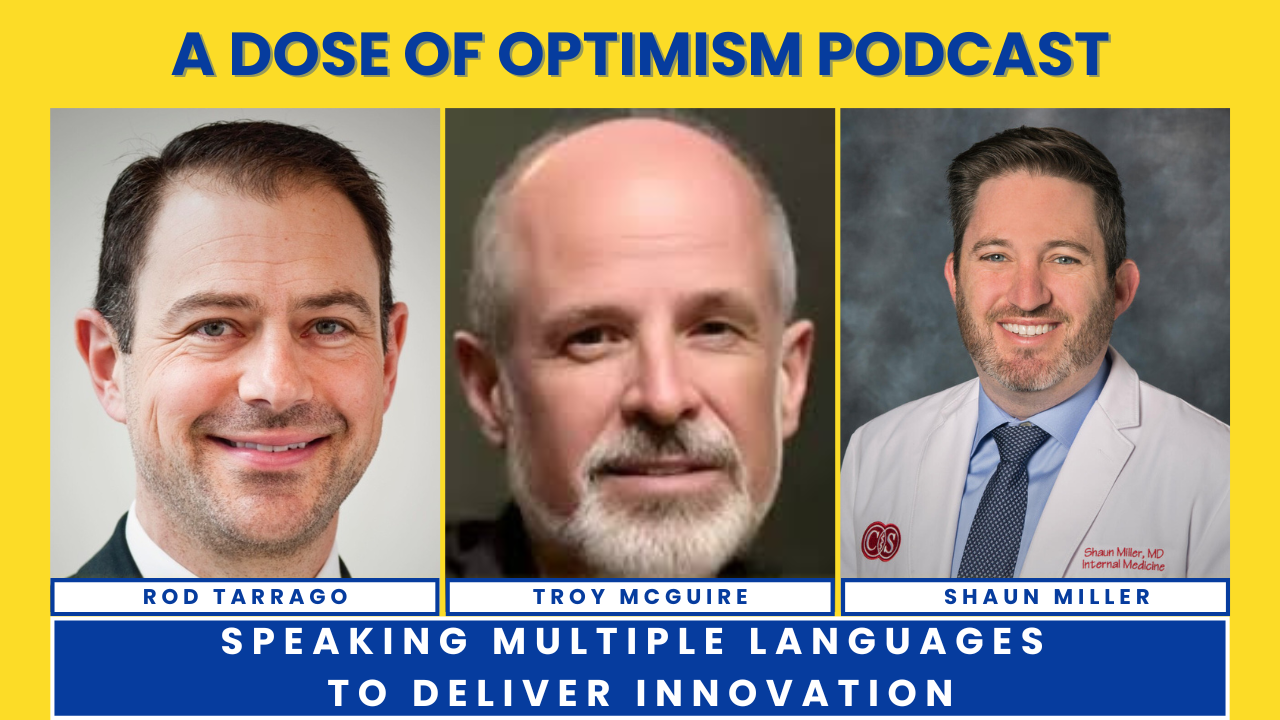
In this episode of A Dose of Optimism, Rod Tarrago, Troy McGuire, and Shaun Miller bring together perspectives from pediatric critical care, informatics leadership, and large health system transformation to discuss how digital tools can better support children, families, and clinicians.
They explore why interoperability matters so deeply in pediatrics, where care often spans hospitals, outpatient clinics, schools, and home environments. When systems fail to communicate, families are left carrying the burden.
The discussion also addresses clinician experience. Documentation demands, fragmented workflows, and poorly designed technology contribute to burnout. The guests share how ambient tools, smarter data integration, and better clinical decision support can give time back to care teams without compromising safety.
At its core, this episode is about designing healthcare systems that respect human effort. Technology does not replace judgment or compassion. When done well, it quietly supports them.
Key Topics Discussed:
- Why pediatric care requires different digital design priorities
- Interoperability and data sharing across care settings
- Reducing clinician burden through better workflows
- Patient and family access to health information
- The responsible use of AI in clinical environments
- Aligning technology with the realities of care delivery
About Rod Tarrago:
Throughout my career, I’ve had a passion for leveraging technology and innovation to improve the care of patients while simultaneously enhancing the experience and efficiency of the clinicians taking care of them. I’ve successfully led implementations of CPOE, clinician documentation, and medication reconciliation and have helped multidisciplinary teams tackle long-standing problems through novel and collaborative thinking. I have combined my clinical skills as an experienced pediatric critical care physician with those as a board-certified clinical informatics specialist to more rapidly and effectively leverage existing and new technologies in our evolving health care system. I now work to use advanced cloud and analytics technologies (AI/ML) to help organizations improve the quadruple aim.
About Troy McGuire:
Board-certified in General Pediatrics & Clinical Informatics with over 25 years of diverse practice experience, including primary care in disadvantaged communities, neonatal and pediatric critical care transport, medical direction of medication safety, and as a pediatric hospitalist in academic settings. As Chief Health Information Officer (CHIO) at the Children’s Hospital of Los Angeles, career emphasis is on the Quadruple Aims in a very large pediatric population. I continue to provide direct inpatient care and resident education 10 weeks per year.
About with Shaun Miller:
Shaun Miller, MD, MBA, serves as Chief Health Informatics Officers (CHIO) at Cedars-Sinai. He completed his medical doctorate and master of business administration degrees at the University of California, Irvine, and first joined Cedars-Sinai as a medical resident. He is board-certified in internal medicine and has subspecialty certification in clinical informatics. Dr. Miller was an early electronic health record (EHR) champion and has played an integral role in the multiyear implementation of the enterprise EHR at Cedars-Sinai. In his current role, he helps lead various strategic initiatives supporting clinical efficiency, population health and quality of care throughout the health system. He has a particular focus in implementing clinical decision support, enhancing EHR clinical workflows, and supporting physician wellness. Additionally, he is helping lead the expansive use of patient-focused digital health solutions and clinical artificial intelligence at Cedars-Sinai.
