
Modern pediatric care is not just about clinical excellence, it’s about environment, preparation, and trust.
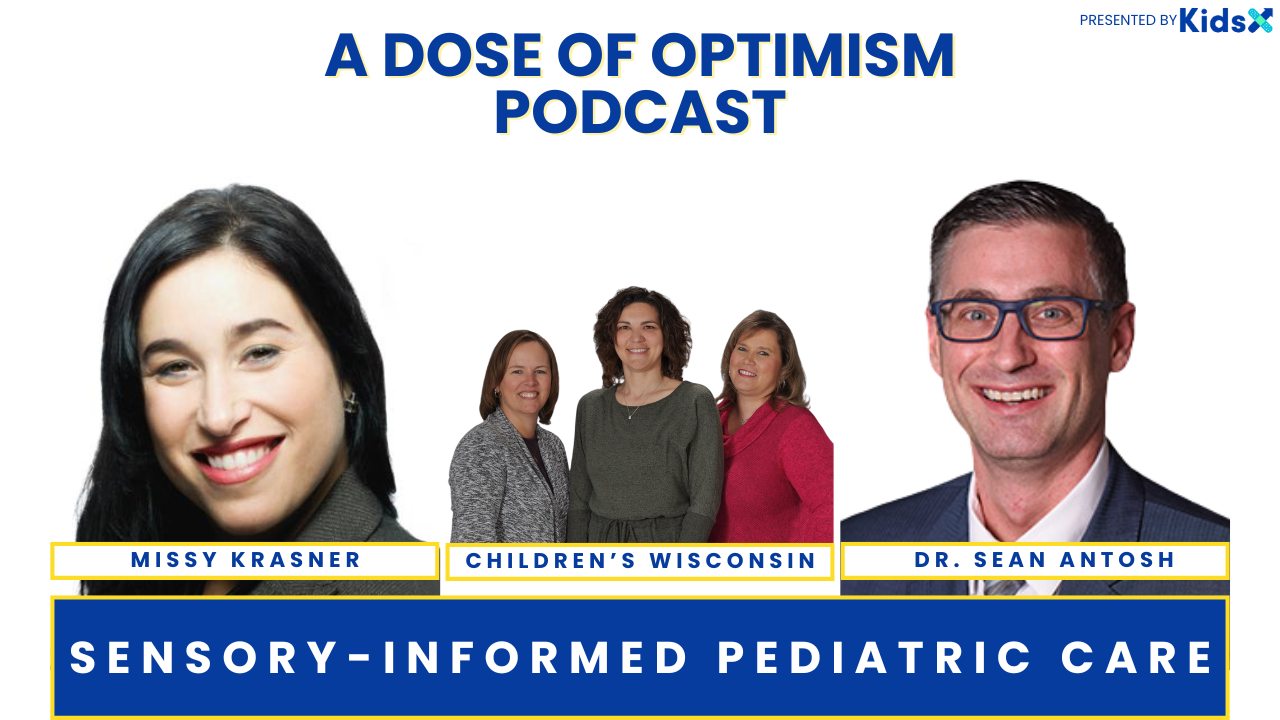
In this episode, Missy Krasner reflects on decades spent navigating healthcare systems from every angle: policy, big tech, startups, and hospitals. Her takeaway is simple but hard-earned, innovation only matters when it works in real clinical settings under real constraints.
At Children’s Wisconsin, that philosophy shows up in practice. Their Let’s Cope Together plans give families a voice before a child ever enters the building. By documenting triggers, preferences, and calming strategies in the medical record, teams can adjust lighting, noise, staffing, and room setup to reduce distress. The impact is not theoretical. Staff report fewer escalations, calmer patients, and families who feel understood rather than judged.
At Dayton Children’s Hospital, Dr. Sean Antosh describes how adaptive sensory rooms, paired with detailed parent input, reduced pre-operative medication use from nearly 90% to under 25%. Children recover faster, families feel more confident, and care teams can focus on care rather than crisis management.
This episode is a reminder that meaningful change in healthcare doesn’t always come from new tools. Sometimes, it comes from asking better questions, and listening carefully to the answers.
Key Topics Discussed:
- Why pediatric care must account for sensory overload and anxiety
- How Let’s Cope Together plans reduce stress for families and staff
- Designing adaptive sensory environments in surgical settings
- Reducing sedation through preparation and environmental changes
- What scalable, human-centered innovation looks like in children’s hospitals
- Lessons from healthcare operators who’ve seen innovation cycles repeat
About Missy Krasner:
Missy is a seasoned healthcare operator with 35+ years in the healthcare and digital health industry. She has worked at large technology companies (Amazon, Google, Box), startups, foundations, the U.S. government, and venture capital.
Prior to working alongside the Penguin Ai founding team to bring the company to market, she was a Venture Chair at Redesign Health, a venture studio that has launched and funded over 70+ healthcare startups. Before Redesign, Missy led healthcare teams at Amazon working across Amazon Care, Amazon Pharmacy, AWS Healthcare & Life Sciences and the Alexa Health & Wellness team.
Before Amazon, Missy served as Vice President of Healthcare & Life Sciences at Box. In that role, she led the company’s first healthcare acquisition and launched the industries division in preparation for the company’s IPO. Before Box, Missy was Vice President at Morgenthaler Ventures (now Canvas Ventures), a venture capital firm with $3B under management. At Morgenthaler, she helped lead Series A and B digital health investments, including: Practice Fusion, Doximity, HealthLoop, Viewics and Vida Health.
Before venture capital, Missy served as one of the founding members of the first Google Health team, where she spearheaded Google’s entry into the healthcare industry. While at Google, she held various positions in product management, marketing and business development. Prior to Google, Missy worked for the government in the U.S. Department of Health and Human Services (HHS) and helped start the inaugural Office of the National Coordinator for Health Information Technology (ONC) where she worked on legislation that led to the HITECH Act.
Earlier in her career, she worked in Product Marketing at CareScience, a digital health startup that went public and developed the first Health Information Exchange (HIE). Before that, she led policy and communications at the Kaiser Family Foundation, a healthcare policy think tank, and worked at Aetna in provider marketing during two corporate mergers.
Missy currently serves as a board member and advisor to several digital health companies and has a M.A. from Stanford University and a B.A. from UCLA.
About Children’s Wisconsin:
Children’s Wisconsin is the region’s only independent health care system dedicated solely to the health and well-being of children. We offer a wide range of care and support for children of all ages. Our services include medical care, dental care, child and family counseling, foster care, adoption, social services, child advocacy and injury prevention.
About Let’s Cope Together program:
For years we wanted to improve our approach to caring for children with autism in the perioperative setting. We took an evidence-based practice approach and reviewed the literature with an interprofessional team. The literature made it clear that making individualized coping plans was a feasible and effective strategy; we just needed to figure out how to implement it in our departments. We created a program in surgical services called Let’s Cope Together.
Anita Norton is a Perianesthesia Clinical Nurse Specialist at Children’s Wisconsin, serving the hospital and outpatient surgery center.
Lisa Boettcher is a Pre-op Nurse Coordinator in the Preoperative Anesthesia Clinic, working in close partnership with our Day Surgery unit.
Jill Wiench is a certified child life specialist who has been at Children’s Wisconsin for 25 years.
About Dr. Sean Antosh:
Dr Antosh is a board-certified pediatric anesthesiologist and the Chief Medical Wellness and Engagement Officer at Dayton Children’s Hospital.
His clinical interests include the perioperative care and patient experience of neurodiverse patients. He has been instrumental in establishing adaptive sensory environments for neurodiverse patients in the perioperative space at Dayton Children’s Hospital through a strong collaboration with a dedicated team of nursing and child life specialists. This program was recognized by Parents Magazine as a “Top 15 Children’s Hospitals in Innovation and Technology – Dayton Children’s Hospital: A Sensory-Friendly Surgery Experience.” He has been recognized as a “Collaborator in Caring” by the division of nursing and most recently as a “Healthcare Hero in Innovation” by the Dayton Business Journal for my continued dedication to neurodiverse patients.
As chief medical wellness and engagement officer, Dr Antosh is responsible for developing a strategic vision and leading efforts to improve wellbeing and engagement of Dayton Children’s physicians, advanced practice providers and psychologists.
