
Sleep affects everything in a child’s life, learning, mood, chronic disease, surgical risk, and long-term health. Yet the way we measure sleep in pediatrics hasn’t evolved much.
Traditional sleep labs:
- Require hospital visits
- Use dozens of wires and sensors
- Can take up to a year to schedule
- May not reflect real sleep patterns at home
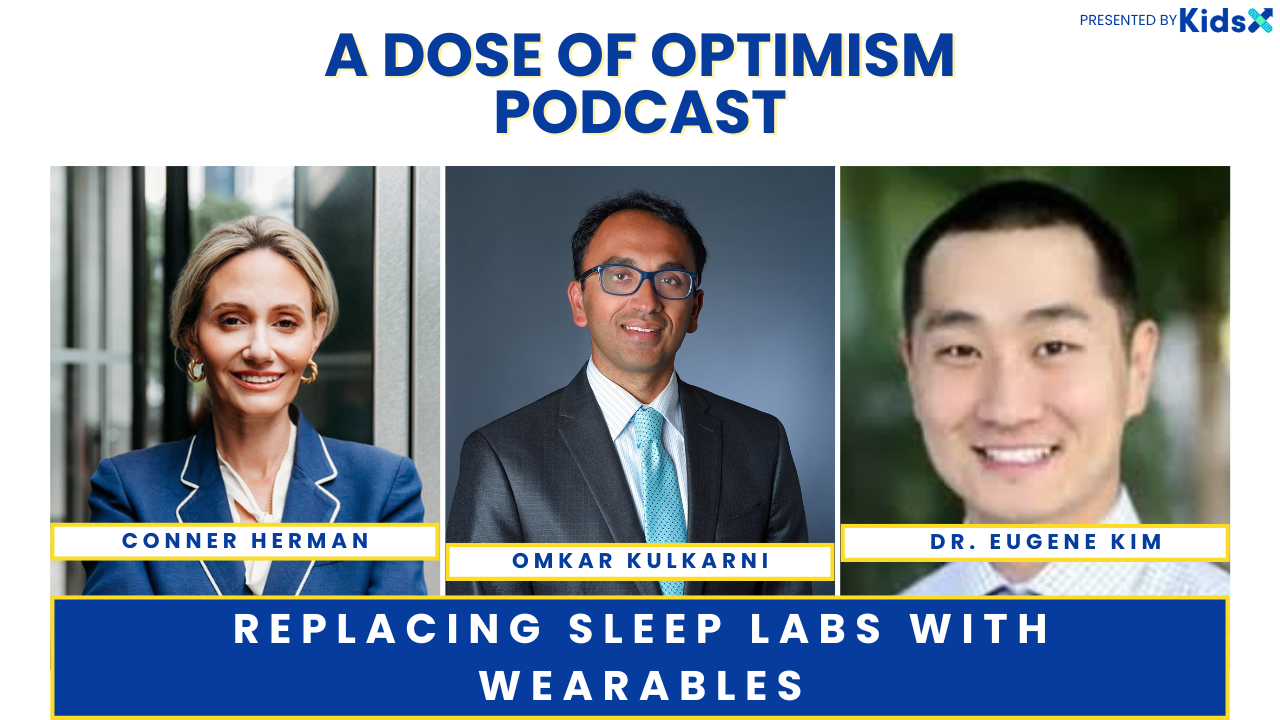
In this episode, two innovators are tackling this problem from different angles.
Dr. Eugene Kim: Using Wearables to Reduce Surgical Risk
Dr. Kim’s project began with a simple question: Can we get better, real-time sleep data from kids at home?
The focus quickly evolved into something bigger, risk stratification before anesthesia. Children with undiagnosed sleep apnea face higher risks of respiratory complications after surgery. But traditional sleep studies can take months to access.
His team is exploring whether Apple Watch–derived sleep data can:
- Identify apnea risk at home
- Reduce wait times for surgery
- Avoid unnecessary ICU monitoring
- Lower stress for families
- Improve care for neurodivergent children
Each night of data can generate:
- 1.7 million data points
- 1.8 GB of movement data
- Millisecond-level accelerometer readings
The goal: validate algorithms so children can wear devices at home instead of undergoing hospital-based sleep studies.
Conner Herman: Fixing the Behavioral Root Causes of Sleep
While Dr. Kim focuses on physiological risk, Conner Herman is tackling behavior. She argues that sleep labs should be the last step, not the first.
Sleep problems often stem from:
- Environmental triggers
- Reinforced nighttime behaviors
- Family interaction patterns
- Unidentified behavioral loops
Self-reported sleep logs are only about 30% reliable long term. Percy uses multi-sensor fusion (without cameras or wearables) to objectively detect:
- Bedtime patterns
- Night awakenings
- Environmental disruptions
- Behavioral cycles
- Episodic vs chronic patterns
The focus right now is autism, where up to 80% of children experience significant sleep challenges. Rather than immediately recommending medication, Percy provides richer behavioral data so clinicians can identify and target root causes.
Sleep is foundational, and pediatric innovation is finally catching up.
Key Topics Discussed:
- Moving diagnostics from hospital to home
- Reducing unnecessary medication
- Identifying risk before crises
- Using data to personalize care
- Improving pediatric anesthesia safety
- Supporting neurodivergent children more effectively
About Dr. Eugene Kim:
Eugene Kim, MD, is responsible for care, quality, research and education in the Pediatric Pain Medicine Division for both inpatient and outpatient settings, as well as providing program visibility, growth and leadership.
Dr. Kim received his medical degree and completed his anesthesiology residency at Stony Brook University School of Medicine in New York. He completed his pain medicine fellowship at Cincinnati Children’s Hospital and subsequently joined CHLA as a pediatric anesthesiology fellow before joining ACCM faculty.
Dr. Kim is Board-certified in anesthesiology, pediatric anesthesiology and pain medicine. Since coming to CHLA he has been involved in the management of patients with acute and chronic pain, and has enabled the outpatient Pain Medicine Clinic to expand to five full days a week on the Sunset campus and an additional half-day in the Arcadia Neighborhood Care Center, becoming the largest comprehensive interdisciplinary pain clinic in Southern California. He has also been instrumental in growing the inpatient pain rehab program promoting functional restoration and expanding our interventional pain service, including becoming the first to use radiofrequency ablation for the treatment of chronic pain at CHLA. He continues to advance his pain research, developing new ways to assess and treat children in pain.
About Conner Herman:
As a board certified behavior analyst, author, and leading children’s sleep consultant, I know that every great journey starts with a good night’s sleep. I founded Percy to revolutionize how families and healthcare providers use behavioral data to create lasting and transformative change in this vital area of our lives.
From my background as an Intelligence Officer and Major in the US Air Force, to my lived experience as mother of four children, I bring focus and stamina to solving problems. My MS in Behavioral Psychology and board certification as a BCBA inform a rigorous and evidence-based approach to sleep behavior change. And my MBA from Kellogg has helped me translate my unique perspective and expertise into a market-changing business proposition.
For much of the last two decades, I’ve run a pioneering sleep consultancy, Dream Team Baby, with my business partner, Kira Ryan. Together, we launched the first overnight sleep consultancy in Manhattan–an offering that paved the way for what has become a $40M sleep consultant industry. Our work was featured in major media outlets including The Today Show, Good Morning America, and Nightline, The CBS Early Show, ParentsTV, Washingtonian Magazine, American Baby, Fatherly, and New York Family, among others. Our book, The Dream Sleeper: A Three-Part Plan for Getting Your Baby to Love Sleep (Jossey-Bass, Inc., 2012) documents our methodology and helps parents and children form healthy sleep behaviors, which leads to a love of sleep.
With the launch of Percy, I’m bringing the full scope of my experience to the table to create a new dawn in sleep technology. We are still in stealth-mode, but will provide updates as we refine our product. Please join our journey at percysleep.com.
