
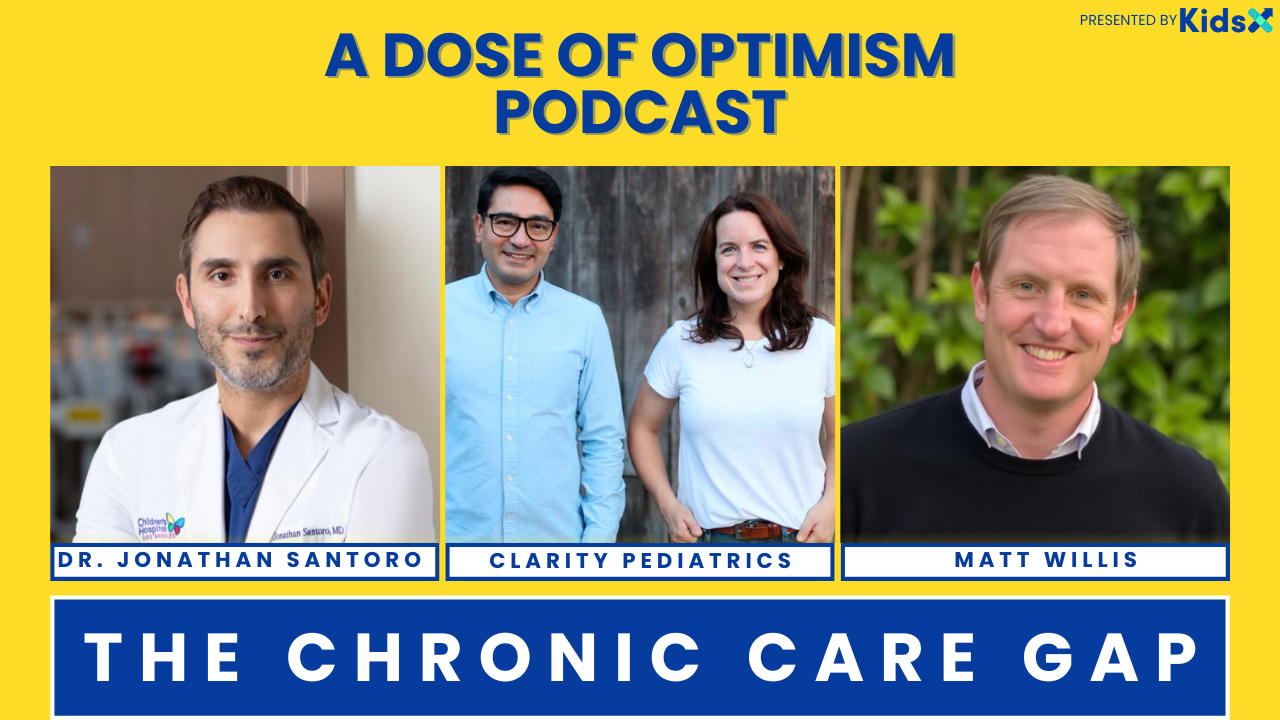
Some of the most significant gaps in pediatric care aren’t in the most complex conditions, they’re in the most common ones. And some of the rarest conditions are only just beginning to receive the attention they deserve.
This episode brings together four innovators working across very different corners of pediatric healthcare, connected by a shared belief that children deserve better access to care, more accurate diagnoses, and systems built to reach them where they are.
A Condition Misdiagnosed for Decades: Dr. Jonathan Santoro on Down Syndrome Regression Disorder
For decades, a pattern of sudden, dramatic regression in teenagers and young adults with Down syndrome was attributed to psychiatric illness. Patients who had been thriving, communicating, feeding themselves, engaging with the world, would fall off a cliff over a period of weeks, losing speech, motor function, and independence.
They were sent to psychiatrists. They were diagnosed with schizophrenia. Some received a diagnosis of early-onset dementia or Parkinson’s disease. The neurologic workup that might have revealed something different simply wasn’t being done.
Dr. Jonathan Santoro, a pediatric neurologist at Children’s Hospital Los Angeles, began encountering these patients during the early months of the pandemic. His background in neuroimmunology research and his clinical experience with Down syndrome turned out to be the right combination. When his team started running standard neuroimmunology workups, EEGs, MRIs, lumbar punctures, they found abnormalities that pointed not to a psychiatric or degenerative disease, but to an inflammatory, potentially treatable process.
They tried immunotherapy. Patients who had been barely responsive began walking down hallways and talking again.
The condition is now recognized as Down Syndrome Regression Disorder (DSRD). An NIH-sponsored clinical trial using immunotherapy is underway, with a new industry-sponsored study repurposing ocrelizumab, a drug used in multiple sclerosis, set to begin. Dr. Santoro estimates the condition affects approximately one to two percent of people with Down syndrome between the ages of 10 and 30, though the true prevalence may be higher given how frequently it is still misdiagnosed.
What excites him most about the path ahead is not just the treatment itself, but what it reveals about a broader pattern: people with Down syndrome have elevated rates of autoimmune conditions across the body. Whether their elevated rates of epilepsy, stroke, and other neurological conditions may also have inflammatory components, and may also respond to immunotherapy, is a question his team is beginning to explore. And beyond Down syndrome, Dr. Santoro sees a coming era of preventive neurology: using genetics, family risk scores, and early screening to stop neurological disease before it starts.
Closing the Chronic Care Gap: Clarity Pediatrics on ADHD, Anxiety, and Obesity
The epidemiology of pediatric health has shifted significantly over the past four decades. Where once infectious disease was the primary driver of pediatric visits, today it is chronic conditions, and among those, behavioral and neurodevelopmental conditions have grown fastest.
ADHD now affects approximately 11.4% of children in the United States, up from under 5% in the 1980s. Anxiety affects a similarly large proportion, and post-pandemic rates are widely expected to be even higher. Pediatric obesity now affects more than 20% of children. All three conditions share a common problem: the supply of trained specialists to diagnose and treat them is nowhere near adequate for the population that needs care.
Dr. Alesandro Larrazabal, a pediatrician and pediatric cardiologist who trained at Stanford Biodesign, and Christina LaMontagne, a health technology executive with deep experience at high-growth companies, co-founded Clarity Pediatrics to address what they call the chronic care gap.
Their model is built around telehealth, group-based care, and close integration with the pediatricians who already know these families. Clarity receives referrals from primary care practices, provides diagnostic assessments, and routes children into evidence-based treatment: behavioral parent training delivered in group sessions, medication management when appropriate, and ongoing programming targeting executive function, emotional regulation, and other specific ADHD-related challenges.
The group-based model is a deliberate differentiator. Evidence supports it, but it also does something individual therapy can’t always replicate: it creates a community for parents navigating stigmatized conditions, where validation and shared experience contribute to engagement and outcomes. Three out of four parents report meaningful behavioral improvement within the eight-week core program.
Medicaid coverage is central to the Clarity model from day one. Services are offered in Spanish by native-speaking clinicians. Copays for Medicaid families are zero. The company now works with thousands of pediatricians across California and Texas, and has reached nearly 25,000 patients.
The next frontier is pediatric obesity, another condition with rapidly growing prevalence and dramatically insufficient specialist supply, and one where the infrastructure Clarity has built for behavioral chronic conditions translates directly.
Answering the Phone: Matt Willis on Attuned Intelligence
Before a patient can be seen, they have to be reached. And in too many healthcare settings, particularly federally qualified health centers and safety net providers, that first step is already failing.
Call abandonment rates of 20% are common. Hold times of ten minutes or more are routine. For a population that is often multilingual, often Medicaid-covered, and often navigating significant barriers to care, an unanswered phone call isn’t just an inconvenience. It’s a care gap.
Matt Willis, Co-Founder of Attuned Intelligence, is addressing this with a multilingual AI voice agent designed specifically for healthcare call centers. The system can handle 100% of inbound call volume from day one, no EHR integration required to start, with implementation timelines measured in weeks rather than months.
At a hospital in New England, Attuned went live in July and within days was handling all inbound calls, offloading 20% of volume immediately through intelligent routing. The roadmap with that partner now extends to 70% automation, including Epic-integrated use cases like appointment confirmation and cancellation.
Matt’s focus on federally qualified health centers is deliberate. These organizations serve more than one in ten US patients, face the most severe staffing shortages, and operate under significant budget constraints. The ROI case is direct: fewer unanswered calls, shorter hold times, reduced burden on staff, and better patient access, particularly for multilingual populations that the system is specifically designed to serve.
Attuned’s business model reflects its focus: the company doesn’t charge for service until it is delivering measurable ROI for its customers.
Key Topics Discussed:
- Down Syndrome Regression Disorder: identification, clinical presentation, and immunotherapy
- Misdiagnosis patterns in neurodevelopmental populations and diagnostic overshadowing
- Repurposing adult immunotherapy drugs for pediatric neurological conditions
- The future of preventive neurology and personalized medicine
- The shift in pediatric chronic disease from infectious to behavioral and metabolic conditions
- The chronic care gap in ADHD, anxiety, and obesity specialist access
- Group-based telehealth therapy: evidence base and engagement outcomes
- Serving Medicaid populations in pediatric behavioral health
- AI voice agents in healthcare call centers
- Federally qualified health centers and safety net providers
- Multilingual patient access and healthcare equity
- EHR integration and implementation timelines for healthcare AI
About Dr. Jonathan Santoro:
Jonathan D. Santoro, MD, is a pediatric neurologist with special training in inflammatory and demyelinating disorders of the brain, spinal cord, and peripheral nervous system. His clinical research is in Down syndrome and the association between autoimmunity and the development of cerebrovascular disease.
About Dr. Alesandro Larrazabal:
I am a pediatrician and pediatric interventional cardiologist with advanced training in medical innovation (Stanford Biodesign Innovation Fellowship). My goal is to combine my passion for medical innovation with my clinical expertise, to improve care for all children.
I characterize myself as an entrepreneur, tinkerer and medical innovator. I’ve taken the step to start a venture-backed pediatric company, collaborating with a strong team that includes pediatric providers, business specialists from the best MBA programs in the US, engineering experts from the medical and digital tech worlds, with the shared goal to revolutionize pediatrics. My goal is to integrate my passion for technical solutions, informatics, innovation and entrepreneurship into my clinical career and thereby creating solutions that will improve people’s lives.
About Christina LaMontagne:
Health technology leader with experience across operations, business development, innovation, investing and M&A. Two-time executive at high growth, venture backed start-ups achieving >$100M ARR and profitability: The Pill Club (acq: Thirty Madison) and NerdWallet (NASDAQ: NRDS). Previously Corporate Development executive at J&J. I am excited about building teams, transforming patient experiences, and finding data-driven approaches to improve health outcomes.
About Matt Willis:
Scaled DocuSign’s industry focused business from ~$0 to IPO and past $1B.
