
The NICU is a life-saving environment. It is also, by design, a difficult one, bright lights, frequent procedures, limited parental contact, and a level of stimulation that the developing newborn brain was never meant to experience.
For the families who spend days, weeks, or months inside one, it can also feel like the hardest part comes after discharge: going home with a fragile newborn and no clinical team down the hall.
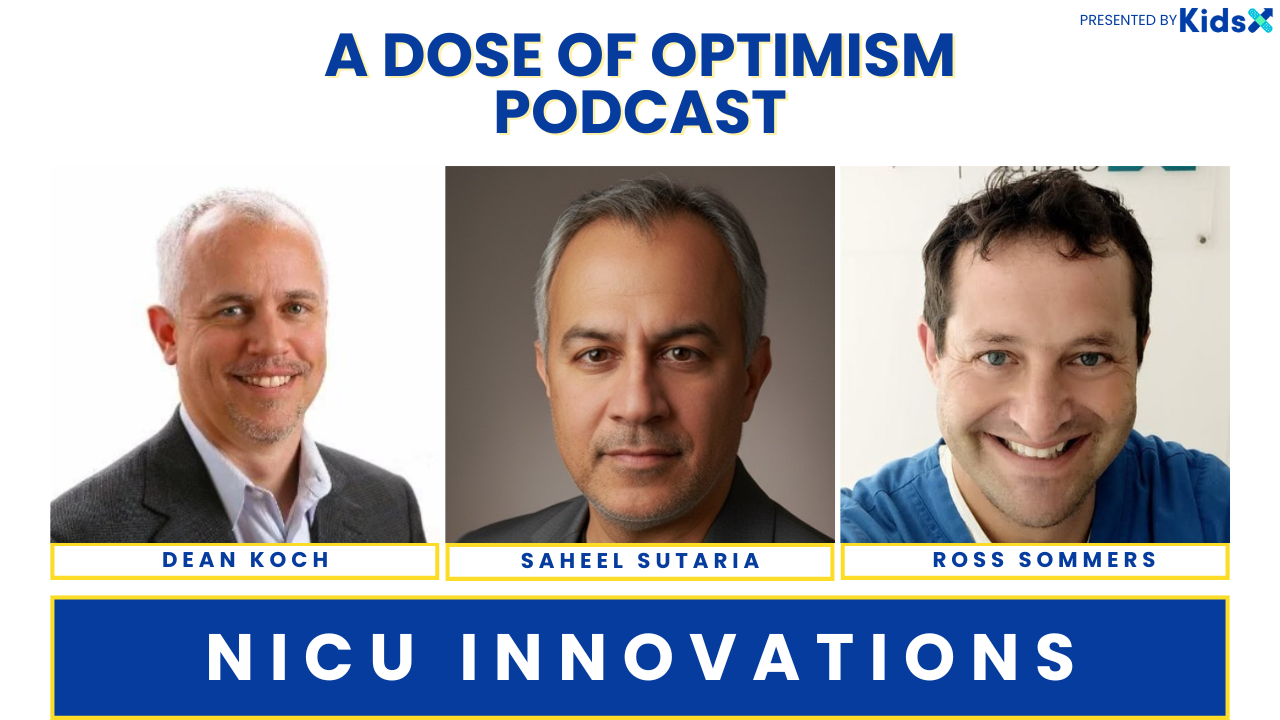
In this episode, three innovators share how they are approaching some of the most persistent challenges in neonatal care, from brain development and feeding safety to what happens when families finally go home.
Supporting the Developing Brain: Dean Koch on Small Talk
Premature infants account for roughly 10 to 12 percent of births globally, but they represent approximately half of all childhood neurodevelopmental issues. That outsized impact, Dean Koch explains, isn’t simply a consequence of being born early. It’s also a consequence of the NICU environment itself.
The neonatal brain is in a critical window of development. And the NICU, with its bright lights, painful procedures, and limited consistent parental contact, is not an ideal setting for it.
One of the most powerful drivers of early brain development is the maternal voice. Parents and clinicians have long recognized this, which is why simply recording a mother’s voice and playing it to an infant was an early attempt at a solution. But passive exposure, Dean explains, doesn’t move the needle much. What the developing brain responds to is interaction, the contingent loop between an action and a response.
smallTalk’s approach is built around that insight. Their system pairs a sensor-equipped pacifier with a small speaker that holds a parent’s recorded voice. During short, structured therapy sessions, the infant controls, through their sucking strength, the only action available to them, when they hear their mother’s voice. That contingent feedback loop is designed to engage the brain in a way that passive playback cannot.
The team measures outcomes directly using a validated EEG biomarker that has been associated with speech and language development outcomes assessed at two and four years of age. It’s an objective marker that allows clinical teams to track early brain responses before an infant ever leaves the NICU.
Looking ahead, Dean sees potential for this type of contingent voice interaction to extend beyond the NICU, into the home environment during the first months of life, and potentially for other pediatric populations recovering from surgery or stressful clinical experiences.
Digitizing the Gut: Saheel Sutaria on Gravitas Medical
Feeding tube placement is one of the most routine procedures in neonatal intensive care. It is also one of the most consequential when it goes wrong.
Nasogastric tubes, thin tubes passed through the nose into the stomach to deliver nutrition to patients who cannot feed themselves, are frequently misplaced. In adults, X-ray is the standard verification method. In babies, where minimizing radiation exposure is a priority, clinicians rely on manual techniques: listening with a stethoscope for bubbles, or drawing back fluid to check its pH. Both methods are imprecise and frequently inconclusive.
The result is a practice that Saheel Sutaria describes plainly: clinicians are placing feeding tubes in the smallest, most fragile patients with limited real-time information about where the tube is going.
Gravitas Medical’s response is a sensorized feeding tube that addresses this problem at the source. Embedded sensors measure temperature, impedance, ECG, and electrogastrogram (EGG) signals from inside the body, giving clinicians continuous, objective information about tube location, tube dislodgement, reflux, gastric emptying, and gut motility.
In partnership with an enteral feeding pump company, Gravitas is working toward a system where this data connects directly to the pump, enabling automatic shutoff if a tube is dislodged mid-feed, or slowing the rate if reflux is detected. The longer-term vision is a closed-loop system: feeding rates adjusted in real time based on the actual status of a patient’s stomach.
Saheel also sees broader research possibilities. Conditions like necrotizing enterocolitis, a serious and poorly understood gut disease in premature infants, remain difficult to diagnose and treat in part because continuous gut data has never existed before. As Gravitas generates novel data streams from inside the GI tract, those data sets may begin to illuminate patterns that simply weren’t visible before.
His path to this work is unusual: he previously applied impedance sensor technology in the oil industry, using it to detect oil through drill bits miles underground. The physics, it turns out, translates.
The NICU Step-Down That Happens at Home: Ross Sommers on Firstday Healthcare
In most acute care settings, the path from intensive care to home involves several intermediate steps: a step-down unit, a progressive care unit, and a period of monitored recovery. Families and patients gradually transition, with clinical support at every stage.
In the NICU, that transition often doesn’t exist. A baby who has spent weeks or months receiving intensive care is discharged, sometimes with oxygen, sometimes with a feeding tube, and parents go home with a box of equipment and, in many cases, a significant amount of uncertainty.
Ross Sommers has been a practicing neonatologist for years. He has also been the person putting that graduation cap on families and wishing them well. And for a long time, he felt like there had to be a better way.
Firstday Healthcare is his attempt to build it: a tech-enabled care model that transitions NICU families into a supported home environment, rather than leaving them to navigate the post-acute period alone.
The model works by introducing families to the Firstday system while they are still in the NICU. They learn how to use a wearable vital sign sensor that connects to a proprietary tablet application. A clinical command center, staffed by neonatologists and following evidence-based protocols, monitors incoming data and supervises the weaning of therapies like supplemental oxygen and nasogastric feeds remotely.
The result, Ross describes, is something like a step-down unit in the home: a layer of clinical oversight that exists between the NICU and full independence, and that allows neonatologists to feel confident about earlier discharge because they know the family isn’t actually alone.
On the business model, Ross is direct: aligning incentives between hospitals and payers is the challenge, but the case is building. For hospitals operating near capacity, earlier NICU discharge creates room for higher-acuity transfers. For payers operating under capitated arrangements, reducing NICU length of stay carries direct financial benefit. And for families, the goal is a care model that looks back in ten years and asks: how were we ever doing it the other way?
Key Topics Discussed:
- Neurodevelopmental risk in premature infants and the NICU environment
- Contingent voice interaction and early brain development
- EEG biomarkers for tracking early language development outcomes
- Safe feeding tube placement in neonatal patients
- Limitations of current enteral nutrition verification methods
- Sensorized devices and the future of continuous gut monitoring
- Necrotizing enterocolitis and the role of novel data streams
- Closed-loop feeding systems and smart pump integration
- The gap in post-NICU care and the transition home
- Tech-enabled NICU-to-home care models
- Reimbursement and incentive alignment for hospital-at-home in pediatrics
- NICU length of stay and hospital capacity
- PTSD and family experience in NICU discharge
About Dean Koch:
An accomplished and versatile Senior Executive with a proven record of leadership and results in both corporate and startup environments. Intuitive, hands on leader with outstanding sales and marketing skills. Operating experience includes product development, regulatory clearance, quality systems, patents, clinical studies, product positioning, pricing and commercial strategies. Demonstrated success in raising nearly $20 million in capital from non-dilutive sources, government programs, seed funds, angel investors, foundations, venture debt and venture capital. Skilled communicator, adept at communicating vision and mission, attracting top tier talent, developing opinion leaders, and nurturing strategic relationships.
About Saheel Sutaria:
Gravitas Medical was founded in 2015 with the goal of saving lives by improving the delivery of enteral nutrition. Led by CEO Jorgen Hansen and CTO & Co-Founder Saheel Sutaria, the company developed the Entarik Platform, a smart enteral nutrition system that uses embedded sensors to collect gut data and assist in safe feeding tube placement. The company is committed to transforming enteral nutrition through digital innovation, aiming to enable ICU clinicians to confidently place feeding tubes, identify complications early, and improve patient outcomes.
About Ross Sommers:
Ross Sommers is the CEO/ founder of Firstday Healthcare and an Ivy league trained Neonatologist and the proud dad of six amazing kids. When not taking care of babies in the hospital or at home he can be found trying to find ways to best utilize technology to bring the care he provides in the NICU to parents homes.
