
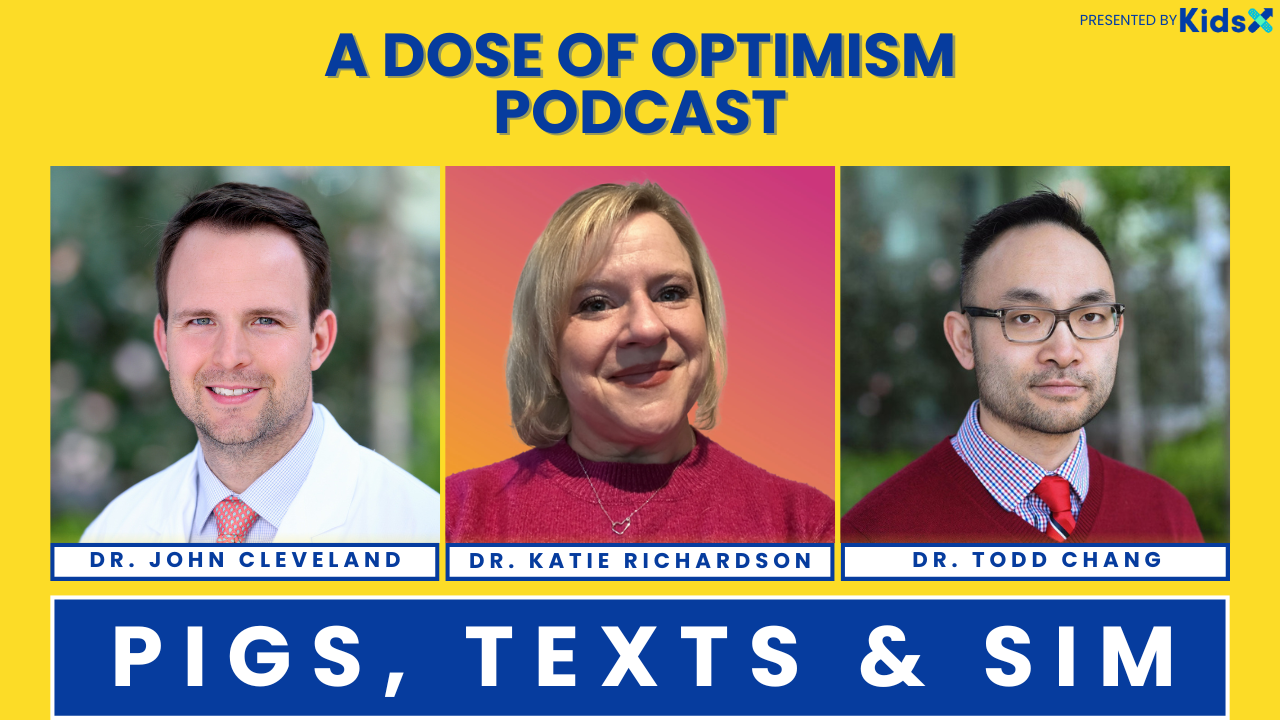
One guest is trying to keep infants alive long enough to get a human heart. One is sending parents text messages with child development tips. One is recreating mass casualty events in a simulation center.
What connects them: a conviction that the next generation of pediatric care will reach children and families in ways the current system doesn’t. Listen here.
The Bridge Organ: Dr. John Cleveland on Xenotransplantation
Infants waiting for heart transplants have the highest waiting list mortality of any age group for any solid organ. The transplant list has grown nearly 50% in the last decade. The transplant rate for infants has fallen by 50% in the same period, because there simply aren’t enough infant donor hearts.
Dr. John Cleveland, Associate Chief of Cardiothoracic Surgery at the CHLA Heart Institute, has spent eight years working on a different path: genetically modified pig hearts as a temporary bridge organ for infants, keeping them alive until a human heart becomes available.
The science works like this: pigs are selected because they have short gestation periods, their genomes are relatively easy to modify using CRISPR-Cas gene editing technology, and they are culturally more acceptable as a donor source than non-human primates. The pig genome is edited, sequences removed and human sequences inserted, to produce an organ that can partially evade the human immune system. The result is placed into a recipient, with the goal of sustaining life while the patient waits for the standard-of-care solution.
Dr. Cleveland’s longest animal model survivor, an infant baboon sustained by a genetically modified pig heart, has now lived over two years. Previous records for any animal model sat at around 260 days. His team has also demonstrated that receiving a pig heart for an extended period does not prevent subsequently receiving a baboon heart, the proof of concept that a human infant recipient could eventually transition to a human organ.
There are active xenotransplantation clinical trials for kidneys in adults, already six patients in the United States. The heart is more complex because there is no equivalent of dialysis if it fails. Every step forward has to be more carefully validated. But Dr. Cleveland believes the right combination of genetic edits, immunosuppression protocol, and care pathway is within reach. His personal estimate: one to two years from a first human application.
The larger frame he offers is worth sitting with: children used to die from simple congenital heart diseases. In the United States, those children mostly survive now. The problems that have resulted from that success, children who live but need transplants that don’t exist, are problems that medicine created. His work is an attempt to honor that obligation.
Instructions Included: Dr. Katie Richardson on Lantern
Most pediatric well visits last about 20 minutes. In that time, a pediatrician is expected to cover developmental milestones, nutrition, sleep, screen time, immunizations, behavioral concerns, and whatever urgent questions a parent brings in the door.
Dr. Katie Richardson, a pediatrician and CEO of Lantern, built her company around a simple observation: 20 minutes isn’t enough. The information parents need arrives unevenly, often too late, and requires them to search, through Google, through apps, through friends, without any reliable way to assess quality.
Lantern sends parents one to three text messages a week, timed precisely to their child’s age and stage of development. Each message is bite-sized and links to deeper information if the parent wants it. The service is free. It is available in English, Spanish, and Arabic. And when a family signs up, they provide a zip code, which Lantern uses to connect them with hyperlocal resources: library story times, immunization clinics, food pantries, free family events in their area.
When Rocky Mountain PBS promoted a free kids festival through Lantern’s Denver-area network, 800 families signed up in the first hour.
The next iteration of the product will allow parents to search and respond, moving from one-way information delivery to genuine two-way engagement. For now, Lantern’s tagline captures the essence of what it offers: because kids don’t come with instructions.
Practice Makes Safe: Dr. Todd Chang on Simulation
Pediatric emergencies are rare. That is mostly a good thing. But it creates a problem that adults healthcare doesn’t face to the same degree: clinicians in pediatric settings rarely see the highest-acuity cases often enough to maintain the skills needed to manage them.
Dr. Todd Chang, Pediatric Emergency Medicine physician and simulation expert at Children’s Hospital Los Angeles, frames this precisely: approximately 10% of ambulance transports are pediatric, and only about 10% of those are truly critical. That means roughly 1% of EMS experience involves critical pediatric care, a fraction that makes skill maintenance through experience alone almost impossible.
Simulation exists to fill that gap. And Dr. Chang works on both of its major modes: teaching (practicing skills in a safe environment before using them on real patients) and latent safety threat discovery (putting expert teams in rare scenarios to find what goes wrong, before it happens in a real situation).
He uses an analogy from Waymo, the autonomous vehicle company: their cars didn’t encounter enough rare adverse events in the real world to train on, so they had to simulate catastrophic scenarios, multi-car pileups in clear weather, edge-case weather events, specifically to build safety behaviors for events that might never happen in a given vehicle’s lifetime. Healthcare simulation follows the same logic.
The technology side of simulation is evolving rapidly. Virtual and augmented reality headsets allow simulation to be deployed in locations that don’t have physical sim centers. 3D printing enables customized tactile feedback, including, as Dr. Chang describes, a custom mannequin built for a child with thoracic abnormalities, to teach their care team how to perform CPR on that specific anatomy. Hollywood-grade production techniques are being borrowed for environmental fidelity.
And AI is opening a new frontier: conversational simulation. Voice AI tools trained on validated empathy scales can now practice difficult conversations with clinicians, delivering bad news, de-escalating in high-tension situations, raising concerns about child abuse with parents. These scenarios were previously the domain of trained standardized actors, who remain the gold standard. But AI is making this kind of communication training more accessible, more scalable, and available outside traditional simulation center settings.
His vision for parent education: simulation fidelity applied at home, so that the parent who can practice an EpiPen injection on a simulated thigh patch attached to their child, rather than an orange, is actually prepared for the moment when it counts.
Key Topics Discussed:
- The infant heart transplant waiting list: 50% growth, 50% drop in transplant rate
- Xenotransplantation: genetically modified pig hearts as bridge organs
- CRISPR-Cas gene editing and the pig genome
- Animal model results: two-year survival milestone
- Active xenotransplantation kidney trials in humans
- Timeline to first human pediatric heart xenotransplantation
- Infant immune advantages for xenotransplantation
- The gap between well visits and parental information needs
- Lantern: age-specific child development guidance by text
- Multilingual delivery (English, Spanish, Arabic) and zip code-based local resources
- Free-to-family model and hyperlocal community partnerships
- Why pediatric emergencies require more simulation, not less
- Simulation as teaching vs. simulation as discovery
- Rare event training: lessons from the Waymo analogy
- Technology in simulation: VR/AR, 3D printing, Hollywood-grade fidelity
- AI for conversational and communication simulation
- Customized simulation for individual patient care needs
About Dr. John Cleveland:
John David Cleveland, MD, is the Associate Chief of the Division of Cardiothoracic Surgery in the CHLA Heart Institute and an Associate Professor of Surgery and Pediatrics at the Keck School of Medicine of USC.
Dr. Cleveland received his medical degree from the University of Alabama School of Medicine. He subsequently completed his residency in Adult Cardiothoracic Surgery at the University of Southern California followed by a fellowship in Congenital Cardiac Surgery at Children’s Hospital of Los Angeles, both under the mentorship of Dr. Vaughn A. Starnes. His clinical and research interests focus on the long-term care of children with congenital heart disease as they progress into adulthood.
About Dr. Katie Richardson:
Katie is a mom, entrepreneur, and Board-Certified Pediatrician. Dr. Katie, as her patients call her, spent the majority of her career leading teams and providing pediatric care at Kaiser Permanente Colorado. She joined Lantern as CEO in 2023. She enjoys partnering with kids, families, and community organizations to get the best outcomes for all. When Dr. Katie is not working, she volunteers her time with local non-profits and enjoys golfing and spending time with her daughter and her dog, Teddy.
About Dr. Todd Chang:
Todd Chang is a board-certified Pediatric Emergency Medicine physician who held faculty positions at George Washington University / Children’s National Medical Center (Washington, DC) and now at the University of Southern California / Children’s Hospital Los Angeles. He works on a daily basis with medical students, residents, and fellows, as well as students in other healthcare disciplines closely and develops, teaches, and utilizes the most current educational technologies and techniques. His research interests in medical educational technology and increasing expertise in distance learning / e-Learning has brought him as a Director of Technology within the International Simulation research network INSPIRE, invited International speaker on the use of distance learning, as well as the Faculty Advisor for the PEMNetwork. Currently, he is the Associate Fellowship Director with Dr. Deborah Liu for the Pediatric Emergency Medicine fellowship at CHLA.
