
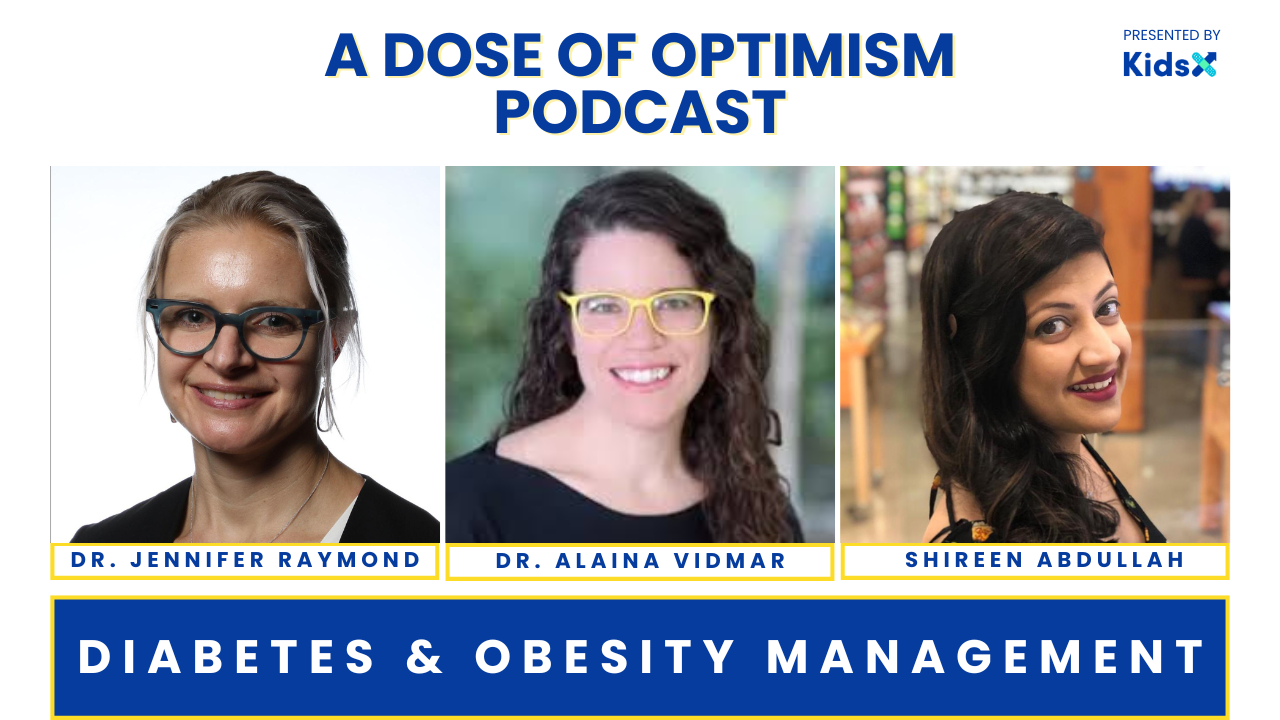
Three guests. Three corners of the same problem. And one shared message: the way we talk about diabetes and obesity in children, who caused it, whose fault it is, and who deserves help, needs to change.
Community, Spirituality, and Guilt: Dr. Jennifer Raymond on Diabetes in Latinx Families
Dr. Jennifer Raymond has spent years researching diabetes care in Latinx communities, and what she has learned goes well beyond clinical data.
The starting point is epidemiological: communities of color, and Latinx communities in particular, are experiencing some of the fastest-growing rates of type 1 diabetes diagnosis. And yet technology adoption, continuous glucose monitors, insulin pumps, the devices most associated with improved outcomes, remains significantly lower in these communities. Understanding why required going to the community itself.
What her research team found in the first phase of their community engagement work, conducted across CHLA, UCSF, and UC Davis, was a set of barriers that clinical interventions rarely address. Language: navigating pharmacies, technology, and healthcare communication is dramatically harder without English as a first language. Community: many families knew no one else with type 1 diabetes and felt profoundly isolated in managing it. And perhaps most striking, spirituality. A strong belief system shaped how families understood the cause of disease, and sometimes carried with it a weight of guilt that made honest engagement with a clinical team nearly impossible.
Dr. Raymond describes a mother who confided, after building sufficient trust, that she believed God was punishing her for being a bad mother. That belief, never surfaced in previous clinical encounters, was shaping everything about how that family engaged with diabetes care.
The response has been a community-centered intervention built around virtual peer groups, conducted in English and Spanish, separately for children and parents, with bilingual and bicultural facilitators drawn from the community itself. Every quarter, in-person gatherings bring families together, to share food, play games, be with one another. The families had asked for that. Researchers had assumed virtual was easier; the community clarified that being together in person, sharing a meal, was part of what they needed.
Results so far: increased technology uptake, improved family communication, and greater team satisfaction. And a growing recognition that diabetes care, especially for communities of color, requires a spiritual and psychological dimension that the clinical system rarely makes space for.
On GLP-1 medications, Dr. Raymond shares one of the most compelling clinical observations in the episode: a young patient with type 1 diabetes and significant insulin resistance whose mental health and relationship with food were transformed within weeks of starting a GLP-1. He joined others at lunchtime at school. His depression and anxiety around food and glycemic management lifted. His A1c fell. His insulin needs fell. This, she suggests, is a dimension of GLP-1 benefit that is underappreciated and worth understanding better.
It’s Not the Child’s Fault: Dr. Alaina Vidmar on Pediatric Obesity
Dr. Alaina Vidmar begins every conversation about pediatric obesity with a statement she says needs to be repeated, explicitly, over and over: this is not the child’s fault. It is not the parent’s fault. Obesity is a complex chronic disease, genetic, epigenetic, environmental, and multifactorial, and the weight of stigma that families carry into clinical encounters is actively preventing them from getting the help they need.
Approximately one in five children in the United States is living in a larger body. Recent data from 2023 shows that preschoolers are among the fastest-growing populations. The science has shifted: the focus is no longer on the number on the scale but on reducing metabolic risk, diabetes, hypertension, hyperlipidemia, and improving quality of life.
The toolkit is expanding. Semaglutide (Wegovy) is now FDA-approved for children 12 and older living in larger bodies, and GLP-1 medications have provided something Dr. Vidmar values deeply: a proof of concept that obesity is a biological condition, not a behavioral failure. If you replace something the body is not producing sufficiently, the condition responds. That same logic applies to insulin in type 1 diabetes. The analogy is powerful.
Bariatric surgery is the other major expansion of the toolkit, and the most underutilized. Over 2 million children in the United States qualify for bariatric surgery. In the year that figure was calculated, approximately 2,000 received it. Dr. Vidmar describes this gap plainly: if these numbers applied to any other chronic disease, they would be considered a crisis. The barrier is stigma, not evidence. The evidence is clear: surgery is the most effective and durable treatment for severe obesity, with a 15-year NIH-funded consortium (Teen Labs) showing sustained outcomes into adulthood, including prevention and treatment of diabetes, fatty liver disease, and cardiovascular disease.
CHLA launched its bariatric surgery program in August 2023. By the time of this recording, it had completed 150 surgeries, with no insurance denials. The procedure, typically a sleeve gastrectomy, a 45-minute surgery with a one-day hospital stay, is widely misunderstood. Dr. Vidmar’s program is designed around education: giving families the time and information to understand what this treatment actually involves before making a decision.
Her message to parents carrying guilt about their child’s weight: the guilt and shame are not only unfounded, they are harmful. They prevent families from seeking care. And the clinical community has a responsibility to say: we got this wrong. Let’s start over.
Culturally Adapted Nutrition Care: Shireen Abdullah on Yumlish
Shireen Abdullah started Yumlish after her own doctor told her to eat healthy and left her without any idea what that meant, as a South Asian woman who cooked South Asian food every day for her family.
That gap, between clinical advice and lived dietary reality, is what Yumlish addresses. The platform provides a web and text-based diabetes prevention program specifically adapted for low-income Hispanic communities in California and Texas, building on the CDC’s Diabetes Prevention Program (DPP), which has an established evidence base for cutting diabetes risk in half but has historically failed to reach the communities that need it most.
Yumlish has achieved CDC Full Plus recognition, the highest level, for its outcomes. At least 60% of program completers achieve weight loss or A1c reduction. And 95% of participants are recruited through federally qualified health centers, the primary care homes for the low-income communities Yumlish is designed to serve.
The cultural adaptation piece, Shireen is clear, cannot be automated. It requires genuine community engagement, incorporating the foods, cooking traditions, and lived experiences of the specific populations being served. The technology layer, web and text-based, deliberately low-barrier, is accessible on the devices these communities already have. The model meets people where they are, in the communication format they use daily, through the clinical relationships they already trust.
The FQHC referral pathway has proven particularly powerful: when a provider at a trusted clinic recommends the program in the context of a prediabetes diagnosis or health conversation, the conversion rate is high. The provider relationship adds accountability and authority that a direct-to-consumer approach cannot replicate.
Key Topics Discussed:
- Rising rates of type 1 diabetes in Latinx and communities of color
- Technology adoption disparities in diabetes care
- Community-based peer support for Latinx families with type 1 diabetes
- Spirituality, health beliefs, and parental guilt in chronic disease management
- Bilingual and bicultural facilitation of diabetes support programs
- GLP-1 medications and their mental health impact in youth with diabetes
- Pediatric obesity as a complex chronic disease, reframing stigma
- GLP-1 medications (semaglutide) FDA approval for pediatric obesity
- Bariatric surgery in children: evidence, access, and the stigma gap
- The Teen Labs Consortium: 15-year outcomes data
- CHLA bariatric surgery program: 150 surgeries, zero denials
- The CDC Diabetes Prevention Program and its access gap
- Culturally adapted diabetes prevention for Hispanic communities
- Web and text-based nutrition programs for low-income populations
- FQHC referral pathways as a driver of enrollment
About Dr. Jennifer Raymond:
Jennifer Raymond, MD, MCR, is the Division Chief of Endocrinology, Diabetes and Metabolism and Chair of the Virtual Care Committee at Children’s Hospital Los Angeles. Additionally, Dr. Raymond is Professor of Pediatrics at the Keck School of Medicine of USC.
Dr. Raymond received her medical degree and completed her residency in Pediatrics at the University of Kansas. She completed her fellowship in Pediatric Endocrinology and Master of Clinical Research at Oregon Health and Science University.
Dr. Raymond had an American Diabetes Association Junior Faculty Award while in Oregon, and then moved to the Barbara Davis Center for Diabetes in Colorado to continue her research with funding from the National Institute of Health. She moved to Children’s Hospital Los Angeles in the Fall of 2016 to continue her research, expand telehealth services, and assume the director position of the diabetes center. Her research focuses on behavioral and clinical care interventions for patients with type 1 diabetes, and she is currently funded by The Leona M. and Harry B. Helmsley Charitable Trust and The Donaghue Foundation. Dr. Raymond’s current work is examining innovative clinical care models for adolescents and young adults with diabetes, including shared medical appointments and use of technology and telemedicine to improve access to high quality diabetes care.
About Dr. Alaina Vidmar:
Alaina Vidmar, MD, is an Associate Professor in Pediatric Endocrinology, a Board-Certified Pediatric Obesity Medicine Specialist, and the Medical Director of the Obesity Medicine and Bariatric Surgery Program at Children’s Hospital Los Angeles. Dr. Vidmar received her medical degree and completed her residency in Pediatrics at the Children’s Hospital of Wisconsin. She completed her fellowship in Pediatric Endocrinology at Children’s Hospital Los Angeles.
About Shireen Abdullah:
After spending most of her career as a project manager and management consultant, Shireen decided to change paths and pursue her passion to become a “nutri-prenuer.” While managing her own illness, she realized the importance of cultural nutrition education paired with an empowering, patient-centered care model to close gaps in health equity for minorities. Her startup is called Yumlish, creating an AI-powered, culturally relevant nutrition therapy platform for minorities with diabetes that addresses socioeconomic barriers to dietary adherence.
