
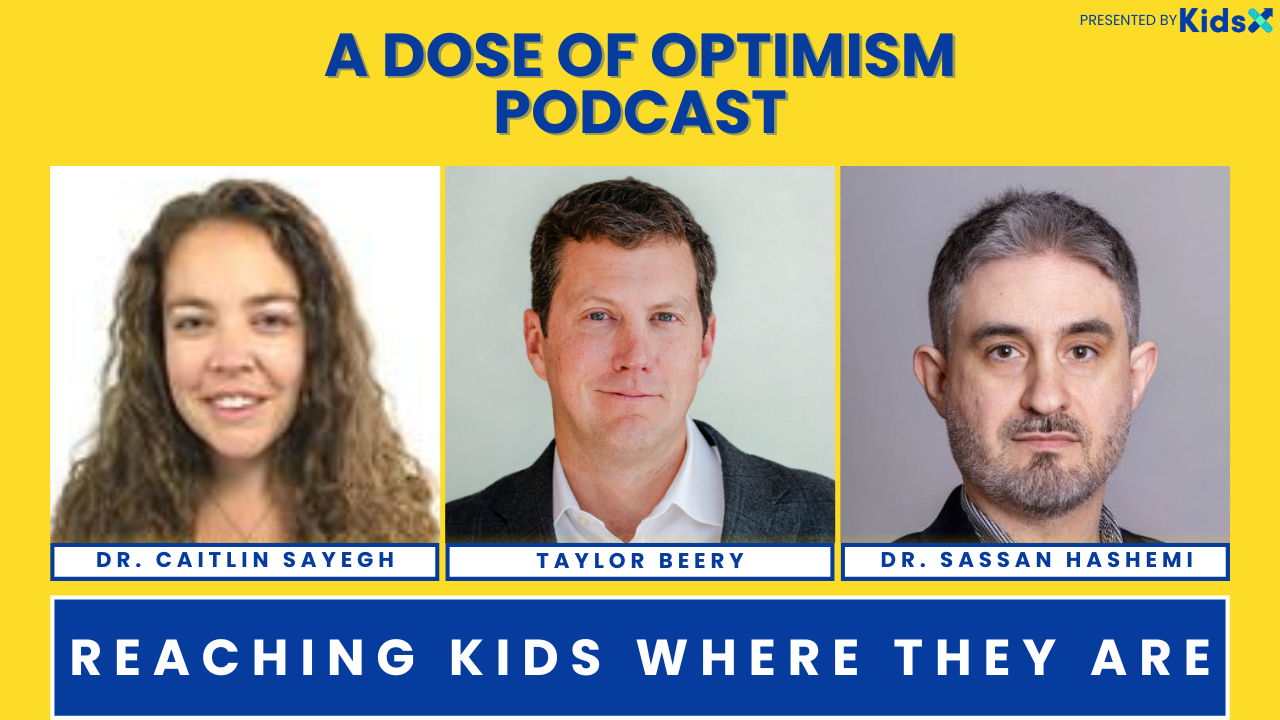
Three guests. Three very different technologies. And one shared conviction: the best pediatric care doesn’t wait for the child to arrive. It goes to them. Listen to this week’s episode here.
A Little Bit Annoying, A Lot Effective: Dr. Caitlin Sayegh on Cell Phone Coaching
Dr. Caitlin Sayegh studies something most researchers wouldn’t think to optimize: the right amount of annoyance.
Her research centers on cell phone support, a coaching intervention originally developed at CHLA’s Division of Adolescent and Young Adult Medicine for teenagers and young adults living with HIV who were struggling to take their medications consistently. The premise was deceptively simple: have a coach call them for a few minutes a day, and use that small dose of human accountability to help them build the habit.
It worked. And over the last decade, Dr. Sayegh and her team have been expanding and refining it.
First came the question of modality. When she joined the team about ten years ago, teens were already telling researchers they didn’t want to talk on the phone, they wanted to text. So the team adapted, allowing participants to choose how they communicated with their coach. The outcomes were similar across both modalities, but with an interesting nuance: the biggest improvements tended to cluster among teens doing phone calls, even though those same teens reported finding the calls more annoying.
That finding became the foundation of a new research question: how annoying should an intervention be? The insight is counterintuitive but rigorous. A text message can be swiped away. A phone call interrupts. It demands presence. And that interruption, pairing the intervention with the behavior that already feels emotionally difficult, seems to be part of what makes it work. The coach isn’t just a reminder. They’re a person who shows up consistently, knows the teen’s life, and makes the experience of managing a chronic condition feel less like something you’re doing alone.
The intervention has now shown promising pilot results across a wide range of chronic conditions, solid organ transplants, type 2 diabetes, sickle cell disease, and Dr. Sayegh’s current study at CHLA removes the condition-specific criteria entirely. If a teenager has a prescribed daily oral medication, they can participate, regardless of their diagnosis. The goal is to understand how this human coaching model works across the full complexity of pediatric chronic illness, including teens managing multiple medications with complex regimens.
What she’s learning from the qualitative data is equally valuable: the intervention gives young people, often for the first time, a structured space to think about why they’re not taking their medication. Not to be judged, but to be supported through a kind of guided self-reflection. That process of being seen as a whole person, not just a diagnosis, may be as important as the accountability itself.
Home Is Where the Care Is: Taylor Beery on Imagine Pediatrics
There are approximately 14.5 million children in the United States with special healthcare needs. For most of them, navigating the system is an experience of fragmentation: different specialists, different platforms, different communication channels, and the constant weight of managing medical complexity while also dealing with school, work, food, transportation, and every other demand of daily life.
Taylor Beery came to this problem as a parent. His son Walker was diagnosed with medulloblastoma, a pediatric brain cancer, at age seven. In the two years that followed, Taylor experienced firsthand what it means to navigate the healthcare system for a medically complex child. On one particular night, Walker’s G-tube came out at 2am. They didn’t have a backup. They drove to the emergency department far from home. The hole had started to close by the time they arrived, and the surgery team had to be brought in. They were admitted.
Walker died on September 4, 2021. A week after his funeral, Taylor came together with complex care experts who had built a similar program at a hospital in St. Louis, and founded Imagine Pediatrics.
Today, Imagine Pediatrics provides integrated medical, behavioral, and social support to medically complex children, at home, virtually, and at no cost to families, through value-based contracts with Medicaid health plans. A full interdisciplinary team includes APPs, RNs, pharmacists, dietitians, licensed clinical social workers, therapists, and home care specialists. The program is available 24 hours a day, 7 days a week. Families can call a crisis line at 2am. A provider will be on the line within a minute. And if a G-tube comes out, there are options that don’t require an ER visit.
The outcomes reflect what happens when you meet families where they are. An NPS score above 86 from the families they serve. Reduced ED utilization. Improved quality measure performance with health plan partners. And a story that Taylor tells that captures it plainly: a child with multiple complex behavioral health diagnoses, whose caregiver had concluded that a skilled nursing facility was the only option and who had been on a waitlist for months, who, after eight months of consistent support from Imagine Pediatrics, declined to go to that facility because they no longer needed it.
Imagine Pediatrics began 2024 serving about 40,000 children across Texas, Florida, and Washington DC. By the end of the year, that number will approach 100,000 across eight geographies. The mission is simple, if ambitious: eventually reach all 14.5 million children in the US with special healthcare needs, with this or a program like it.
Seeing the Heart Before the Surgery: Dr. Sassan Hashemi on Virtual Surgical Planning
For a surgeon preparing to operate on a child with complex congenital heart disease, a two-dimensional image is a fundamental limitation. The heart is three-dimensional. The relationships between its structures, the holes, the valves, the outflow tracts, are spatial. And for the most complex anatomies, no amount of training prepares the mind to reliably reconstruct those relationships from a flat image.
3D printing was the first major step forward: take the imaging data, segment the anatomy, build a physical model a surgeon could hold and study. It helped. But it was slow, expensive, and couldn’t be easily iterated.
Virtual surgical planning is the next step. Dr. Sassan Hashemi leads this work at Cincinnati Children’s Hospital Heart Institute, taking imaging data through a labor-intensive segmentation process that defines each anatomical structure, and then rendering a three-dimensional model that can be explored in virtual reality, manipulated in specialized surgical planning software, analyzed for blood flow through computational fluid dynamics, or printed as a physical model for patient and family education.
The clinical impact is already visible. Surgeons at Cincinnati Children’s are now considering biventricular repair, giving children a normal two-chamber circulation, for complex cardiac anatomies that were previously considered only viable for the single ventricle pathway, which carries significantly higher morbidity and mortality. The 3D model makes the decision visible. Surgeons can plan the patch, create the baffle, and even export a stencil to the operating room so that the shape and size of the repair are known before the first incision.
At once or twice a week, Dr. Hashemi sees virtual planning directly change a clinical decision. That’s not a small number.
On reimbursement, progress is being made: Boston Children’s pioneered the billing pathway for 3D modeling, Cincinnati Children’s has followed, and T-codes for broader reimbursement are expected. In AI, the future is clear but requires collaboration: pediatric congenital heart disease datasets are small and heterogeneous, and the only way to train models with sufficient data is for institutions to share, something the field is beginning to organize around.
The through-line from raw image to virtual model to surgical stencil to potential AI decision support is not just a technology story. It’s a story about what happens when surgeons go into an operating room having already solved the problem once, in a virtual space, before a child’s chest is ever opened.
Key Topics Discussed:
- Cell phone coaching and medication adherence in adolescents with chronic illness
- Phone calls vs. text messages as intervention modalities
- The “right amount of annoyance” in behavioral health interventions
- Nudge theory and persuasive design in health technology
- Medication adherence across HIV, sickle cell, transplant, and diabetes in youth
- Imagine Pediatrics: integrated care model for medically complex children
- Value-based contracts with Medicaid plans in pediatrics
- 24/7 virtual and in-home care for children with special healthcare needs
- Quality measure performance and NPS outcomes at Imagine Pediatrics
- The 14.5 million children in the US with special healthcare needs
- Virtual surgical planning for congenital heart disease
- 3D modeling: from segmentation to virtual reality to the operating room
- Biventricular repair enabled by 3D visualization
- Reimbursement pathways for 3D modeling in pediatric cardiac care
- AI and collaborative data sharing in pediatric cardiac imaging
About Dr. Caitlin Sayegh:
As a clinical scientist, I implement interventions with youth, investigate how treatment promotes change, and disseminate accurate knowledge to providers and consumers alike.
About Taylor Beery:
Mr. Beery manages the daily delivery of our care model and ensures organizational focus on the continuous improvement of our delivery of timely, high-quality, personalized, and empathetic care for the patients and families that we serve, in all the markets we serve. As the parent of a child who lived with medical complexity, Mr. Beery is deeply committed to achieving our vision of a world where every child with medical complexity or special health care needs gets the care and support they deserve. As part of this dedication, in 2021, Mr. Beery worked with his son Walker to launch Kids Join the Fight, a nonprofit founded to cure pediatric brain cancer and provide care to those battling the disease. Walker lived with medulloblastoma, a pediatric brain cancer, for 2 years before ultimately succumbing to the disease. In loving memory of Walker, Imagine Pediatrics is on a mission to reimagine pediatric health care in partnership with parents, caregivers, providers, health plans, and community resources — so kids can spend less time in the hospital and more time at home and in their communities. Prior to Imagine Pediatrics, Mr. Beery served as an executive and operator across a variety of industries. In addition, he served as Policy Director for the White House office established to help rebuild the Gulf Coast following Hurricane Katrina. Mr. Beery earned a degree in Economics from the University of Virginia. He lives in Nashville, Tennessee with his wife and family.
About Dr. Sassan Hashemi:
As a faculty member at Cincinnati Children’s, my work centers on transforming how we visualize and understand complex congenital heart disease. I am passionate about bridging the gap between imaging and the operating room by harnessing 3D modeling, virtual surgical planning, and emerging digital twin technologies. My goal is to help surgeons and cardiologists make better-informed decisions, reduce surgical uncertainty, and personalize interventions for each child.
My interest in this field began early in my training, when I saw firsthand how challenging it was for even the most experienced clinicians to mentally reconstruct complex cardiac anatomy from 2D images. That experience sparked my dedication to 3D visualization as a tool to improve clarity, communication, and ultimately patient care. Over time, this has evolved into a commitment to merging advanced imaging, 3D modeling, and clinical decision-making—transforming data into insight and visualization into action.
I am also exploring how artificial intelligence can accelerate segmentation, automate quantitative analysis, and improve surgical outcomes. I believe that technology is most powerful when it enhances human expertise. My aim is to make advanced visualization—whether through 3D modeling, 3D printing, or AR/VR—accessible and clinically meaningful to the physicians and surgeons caring for children with heart disease everywhere.
