
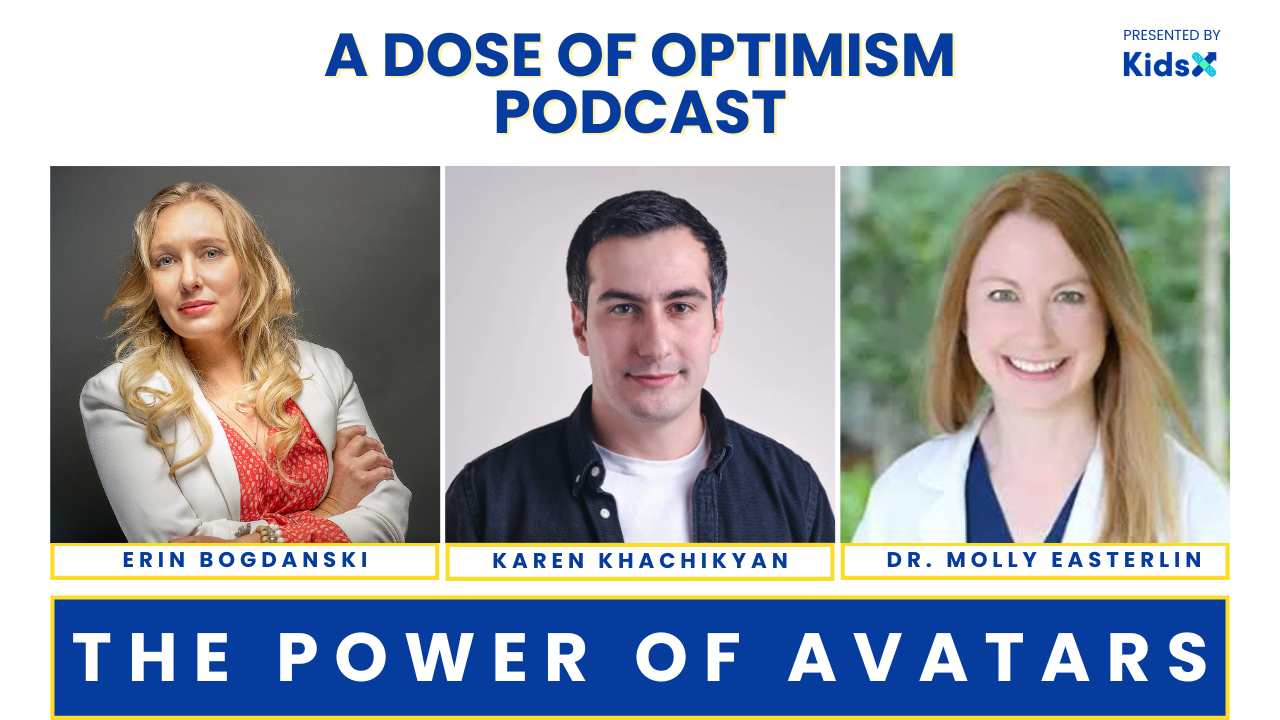
Three guests. Three technologies. And a shared belief that the best innovations in pediatric care don’t replace human connection, they find new ways to make it possible.
Safety Through an Avatar: Erin Bogdanski on THERA VR
Erin Bogdanski traces the roots of her work to two unlikely sources: Jim Henson and Fred Rogers.
Both understood something therapists had long known, that children who are severely traumatized, mute, or too frightened to engage with an adult in a traditional setting will often open up to something that isn’t quite human. Puppets worked because they created a layer of psychological distance that made communication possible. THERA VR applies the same insight through virtual reality.
The technology allows a licensed therapist to appear to the patient as a customizable avatar, a teddy bear, a cartoon figure, whatever the child chooses. The therapist’s voice remains the same. The clinical care being delivered remains the same. What changes is what the child sees, and with it, the psychological dynamic of the session.
Erin shares one case that captures the potential: a ten-year-old girl during the COVID years, being seen remotely for trauma related to domestic abuse. On Zoom, she was disengaged and barely present. Once a VR headset was introduced, her engagement changed completely. Over the course of treatment, she began to open up about the abuse. At one point, she crossed the virtual space to give the therapist’s avatar a hug. They were in different cities.
The next phase of THERA VR adds heart rate variability monitoring, a wearable biometric tool that measures the autonomic nervous system before and after sessions, giving therapists an objective window into a patient’s physiological state that video calls cannot provide. An AI-powered session note tool is also in development, allowing therapists to dictate notes post-session rather than spending time on documentation between patients.
THERA VR is positioned as a tool for prevention as well as treatment, reaching a younger, tech-native generation where they are, and supporting clinicians who want to offer telehealth options that go beyond a Zoom window.
A Friend in the Hospital: Karen Khachikyan on Robin the Robot
Ask a hospitalized child what they miss most, and the answer is often simple: their friends. The clinical environment, however caring the staff, is not a peer environment. A child in a hospital room is surrounded by adults telling them what to do, and largely without anyone their own age to just be with.
Robin the Robot, founded by Karen Khachikyan, was designed to fill exactly that gap.
Robin is a social robot with the personality of a seven-year-old, deployed in more than 40 pediatric facilities across the country, including UCLA Mattel Children’s Hospital, UMass Memorial Medical Center, and HealthBridge Children’s Hospital. Robin talks to children, plays games, explains procedures, and provides something the clinical staff and even parents in a high-stress environment cannot always provide: a peer.
The key to Robin’s interactions is what Karen calls Human Assist AI. Rather than relying on a large language model to navigate the nuanced, high-stakes conversations that happen with scared, lonely, or in-pain children, Robin’s interactions are facilitated in real time by trained human operators with clinical backgrounds. The operators draw on six years of field experience and a data set of strategies that covers roughly 90% of the scenarios Robin encounters.
Two stories illustrate what this creates in practice. A child who had refused to eat for days, until Robin suggested they both recharge their batteries together, and the child started eating to make Robin happy. A child in rehabilitation who needed to walk through pain, who did it because Robin walked alongside them.
Robin is a friend. In a place where friendship is often what a child needs most.
Movement as a Vital Sign: Dr. Molly Easterlin on NICU Wearable Research
Sepsis is one of the most feared complications in the neonatal intensive care unit. It is associated with worse short-term outcomes, including death, and longer-term developmental impairment. And it is genuinely difficult to detect early, because the clinical signs in newborns are non-specific: subtle changes in heart rate, temperature, feeding tolerance, activity level.
Current standard of care involves drawing bacterial cultures, starting broad-spectrum antibiotics, and waiting two days for results. The problem with that timeline is well-documented: even a 30-minute delay in antibiotic initiation is associated with measurable differences in mortality. But early and broad treatment also carries its own risks, antibiotic overuse changes the infant’s microbiome and increases resistance in the NICU.
Dr. Molly Easterlin is part of a multidisciplinary research team exploring whether wearable motion sensors placed on NICU babies could add a new layer of predictive information to that picture. The hypothesis: that movement patterns, or their absence, carry signal about a baby’s physiological state that existing vital signs and lab markers don’t fully capture.
The research has two aims. The short-term aim is to explore whether motion sensor data can improve the sensitivity and specificity of early sepsis prediction, potentially contributing to models that flag infection earlier and with fewer false positives. The longer-term aim is to examine whether movement patterns in the NICU predict neurodevelopmental outcomes at 18 to 24 months, a line of inquiry grounded in existing evidence linking early movement patterns to later developmental trajectories.
The team brings together expertise in neonatology, predictive analytics, physical therapy, and biomedical engineering. The study is early-stage research. But if the data supports the hypothesis, the implications could touch antibiotic stewardship, clinical decision-making, and the standard of care for some of the most vulnerable patients in any hospital.
Key Topics Discussed:
- VR therapy with customizable avatars for traumatized children
- Patient empowerment through therapist avatar selection
- Telehealth limitations of video-only therapy and how VR extends them
- Heart rate variability biometrics in mental health telehealth
- AI-assisted session documentation for therapists
- Social robots as companions for hospitalized children
- Human Assist AI and why full automation isn’t the right approach for pediatric care
- Robin the Robot: use cases, deployment, and clinical observations
- Sepsis in the NICU: clinical presentation and current standard of care
- Wearable motion sensors in neonatal intensive care
- Predictive analytics for sepsis and neurodevelopmental outcomes
- Antibiotic stewardship and the false positive challenge
- Movement as a potential quantitative vital sign in the NICU
About Erin Bogdanski:
I’m a Licensed Marriage and Family Therapist, CEO and Founder of THERA VR Inc. We provide live counseling using virtual reality using customizable avatar technology and biometrics. After working in emerging technologies, I pursued health psychology and neuroscience to counsel specifically with post combat veterans PTSD and traumatized children, specifically with suicidal and self harming youth. I have worked as a practicing psychotherapist in both in private practice, community mental health and acute psychiatric care. Trained in law, education and human rights, I created THERA VR™ to provide live counseling using VR with customizable avatars to disrupt the traditional model based on over medicating, and lack of robust Telehealth practices for prevention. THERA VR supports a younger, tech-native generation to express themselves safely through VR-driven therapy and to train clinicians to be VR providers. Our hope is to bring humanity using virtual reality with the intent of providing “safe” spaces for youngsters to experience tele-health with the mind/body connection of VR and medical extended reality. In my youth, I worked in over 15 different countries, worked with over 50 different nationalities and was trained under the US Coast Guard.
About Karen Khachikyan:
Karén Khachikyan was born and raised in Yerevan, Armenia. He graduated with highest honors from the National Polytechnical University in Armenia with a PhD in Electrical and Electronics Engineering and received consecutive Presidential awards as the Best Bachelor Student, the Best Master Student, then the Best PhD Student of Armenia. During his university years, Karén started working at Synopsys as an Analog Design Engineer – he was the designer of the first-in-market DDR5 memory Synopsys IP. He has authored 11 scientific papers published in industry-leading conferences and journals.
In 2019 Karén founded Robin the Robot with the mission of reshaping patient care through the use of socially assistive robots and making quality caregiving accessible to everyone. Robin the Robot has been recognized as a “2021 Times Magazine Best Invention of the Year”, and an honoree in “Fast Company’s 2021 Innovation by Design Awards”. Robin has been deployed at over 20 medical facilities including UCLA Mattel Children’s Hospital, UMass Memorial Medical Center, HealthBridge Children’s Hospital, and many more pediatric clinics.
About Dr. Molly Easterlin:
Molly Easterlin, MD, MS, is an Attending Neonatologist in the Division of Neonatology at Children’s Hospital Los Angeles and an Assistant Professor of Clinical Pediatrics at the Keck School of Medicine of USC.
Dr. Easterlin earned her medical degree from the University of California, San Diego. She completed her pediatric residency at UCLA Mattel Children’s Hospital and a fellowship in neonatal-perinatal medicine at the University of Southern California/LA County USC Medical Center. Following residency, she also completed a fellowship in health services research through the National Clinician Scholars Program at UCLA, as well as a master’s in health policy and management at the UCLA School of Public Health.
Her research interests include neonatal health services research, neonatal clinical outcomes and the effects of adverse childhood experiences and toxic stress.
