
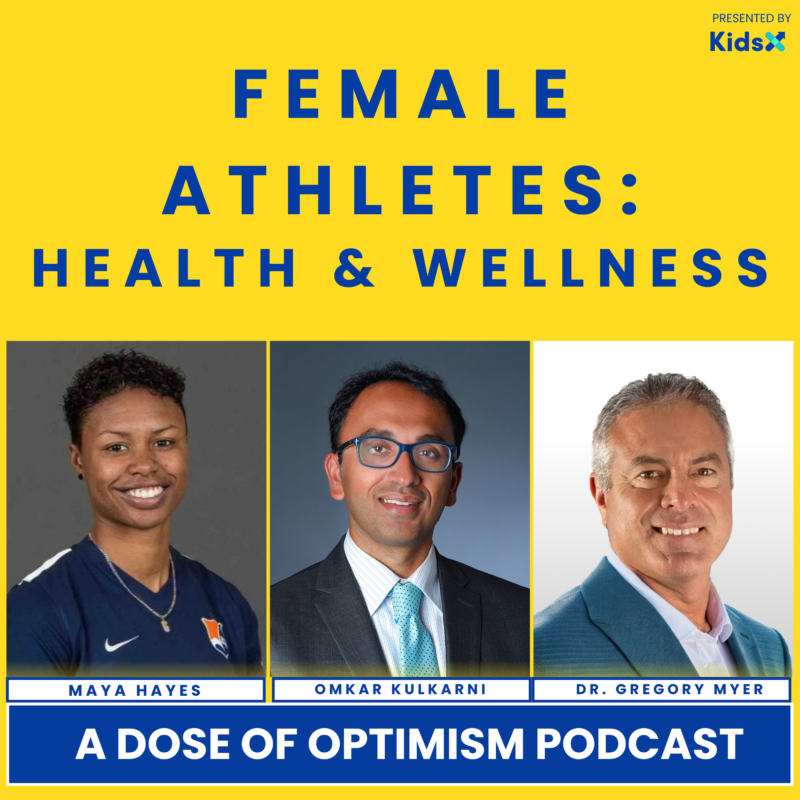
Two people who have spent their careers around female athletes. One who played and coaches. One who measures and builds. Both saying the same thing: girls need better science, better support, and adults who see them as whole human beings, not just athletic assets.
Be a Kid: Maya Hayes on Female Athletes, Balance, and Mental Health
Maya Hayes scored a hat trick in the opening game of the Under-20 Women’s World Cup as a college junior. She didn’t know the youth national team program existed until she got called into the U15 squad her freshman year of high school. Before that, she played basketball, she tried lacrosse, and played baseball with her friends.
She is, by her own description, a huge advocate of playing as many sports as you want, for as long as you can.
The observation she makes about early specialization is not abstract, it’s what she sees in her clinic of a coaching environment, where girls arrive having been told since age 12 that if they don’t devote everything to one sport, they’re wasting everyone’s time. The pressure, she argues, comes from every direction: from parents managing expense and expectation, from coaches who equate commitment with exclusivity, and from a culture that has somehow decided a D1 scholarship is the only acceptable outcome for an eight-year-old’s soccer journey.
The question she keeps coming back to: when does it get to be fun?
On why kids quit sports (particularly girls) her answer is direct: more often than not, it’s the adults. Parents who make a twelve-year-old’s soccer practice feel like a financial obligation. Coaches who communicate that playing more than one sport is a divided loyalty. Adults who have forgotten that the children in front of them are still learning who they are and what their bodies can do.
The mental health piece is where she is most specific. At the University of Minnesota, the support structures are real and actively promoted, and crucially, not framed primarily around crisis or pathology. She describes the high-performing student athlete who comes to the mental health resources not because they’re in distress, but because they want tools for sustaining confidence during a slump. That reframing, mental health support as performance support, not just crisis response, is, she argues, what makes it actually used.
Her magic wand answer is twofold: balance (an eleven-year-old should be allowed to sit on the couch and watch movies sometimes), and more research specifically into female athletes. Not research designed for male athletes and extrapolated, research built from the ground up around how girls’ and women’s bodies actually work.
Why Girls Tear Their ACLs — and What’s Changing: Dr. Gregory Myer
In the same sport, female athletes tear their ACLs two to ten times more often than male athletes. That gap has been documented since the 1990s, when orthopedic surgeons started noticing the influx of young women through their clinics as Title IX expanded access to sport.
Dr. Gregory Myer has spent his career studying that gap, and doing something about it.
His early work involved bringing female athletes into the laboratory for 3D motion analysis: measuring how they moved, tracking which of them got injured, and identifying the movement patterns and neuromuscular profiles that predicted injury. The findings produced a training target, specific, modifiable aspects of how female athletes move that could be corrected through neuromuscular training. Implementing those corrections reduced ACL injury rates by more than 50%.
The problem was implementation. Even knowing what worked, the science wasn’t reaching the gyms, the fields, or the school PE programs where it needed to land. Coaches weren’t comfortable teaching movement corrections. Parents didn’t feel equipped to implement training programs. The lab results stayed in the lab.
The next phase of Dr. Myer’s work has been solving the implementation problem through technology. His team developed a self-guided biomechanics system that uses virtual and augmented reality to give athletes real-time biofeedback on their movement, teaching them to correct their mechanics on their own, without a trained clinician in the room. A federally funded NIH clinical trial showed it worked. But it still required access to a biomechanics lab to run.
Then computer vision changed the equation. What once required a million-dollar lab, a full 3D motion analysis of how a young athlete moves, can now be approximated on an iPhone. That means the technology that was validated in the lab can now be deployed on a field, in a gym, in a school. A coach with a tablet can give an athlete movement feedback that previously required a specialist. A parent in a backyard can access it.
The research program at Emory, including the Georgia Initiative for Virtuality and Education and Sport (GIVES), funded by the Arthur Blank Family Foundation, is focused specifically on implementation: getting evidence-based movement correction technology into schools and into the hands of coaches and athletes statewide.
On the menstrual cycle and ACL injury: Dr. Myer ran a detailed study tracking female athletes across different phases of their cycles, measuring performance and laxity. The findings were illuminating in their negativity. There was evidence of slightly increased joint laxity and injury rates around ovulation, but hormonal variation across the cycle was not found to be a primary driver of ACL injury risk. The more significant conclusion: the risk factors that matter most are neuromuscular, and they’re modifiable. That’s a more actionable finding than if hormones were the driver. It means training interventions can actually change the outcome.
Key Topics Discussed:
- The value of multi-sport participation and when specialization is appropriate
- Why early specialization leads to burnout, overuse injury, and dropout
- The role of adults (parents and coaches) in pushing kids out of sports
- Mental health as a performance tool, not just a crisis response
- High-performing athletes and the specific pressures they carry
- The need for more research specifically in female athletes
- Title IX, access, and the ACL injury gap
- 3D motion analysis and neuromuscular risk identification
- Reducing ACL injuries by more than 50% through neuromuscular training
- The implementation gap: why lab-proven interventions don’t scale
- VR and AR for self-guided biomechanical feedback
- Computer vision and the democratization of biomechanical analysis
- The smartphone as a movement assessment tool
- GIVES: the Georgia Initiative for Virtuality and Education in Sport
- Menstrual cycle research and its implications for ACL prevention
- The Wu Sai Human Performance Alliance and implementation science
About Maya Hayes:
Maya Hayes enters her sixth season on staff with the Gopher soccer program heading into 2026, having assumed her current duties in July 2020 while working primarily with the forwards. Hayes was promoted to associate head coach in 2024 after spending four seasons as an assistant.
Since 2020, Hayes has helped coach 13 Gophers to earn All-Big Ten honors. Notably, in 2024, she helped guide forward Khyah Harper to one of the most successful seasons a Gopher forward has had to date. Harper finished 2024 with 40 points and 17 goals, naming her a United Soccer Coaches Second Team All-American. Harper was selected as Big Ten Forward of the Year, and a semifinalist for the prestigious MAC Hermann Trophy, Minnesota’s first-ever semifinalist. Harper now competes for Gotham FC in the National Women’s Soccer League (NWSL).
About Dr. Gregoryory Myer:
Gregoryory Myer, PhD, is director of the Emory Human Performance Institute and professor of orthopaedics at Emory University School of Medicine. He is internationally recognized for his research in athletic injury biomechanics, particularly ACL injury prevention, and for translating laboratory discoveries into real-world approaches to injury prevention and performance. His research includes biomechanics, advanced movement screening, virtual reality and data-driven methods to identify athletes at risk of injury and improve athlete health at every level of sport.
