
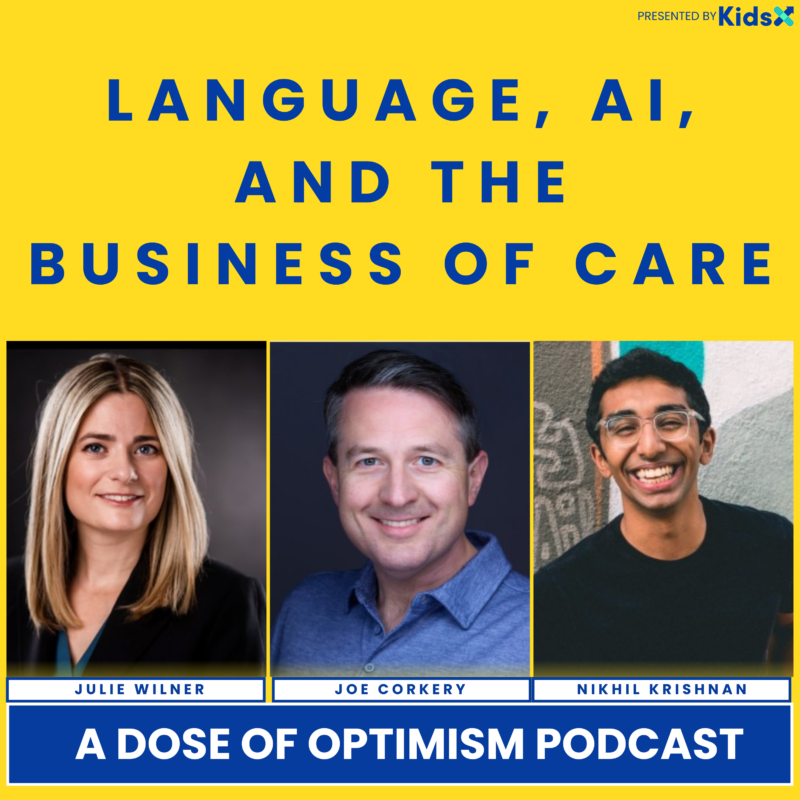
Two conversations about the same underlying problem: a healthcare system that is not quite working for the people it’s supposed to serve, and the tools, business models, and mindset shifts that could change that.
HIPAA-Compliant Google Translate for Hospitals: Jaide Health
When a patient who speaks Cantonese is discharged from a hospital with instructions written in English, what happens next is largely left to chance. Maybe an interpreter translates it on the spot. Maybe the patient nods and takes the paper home without understanding it. Maybe they come back to the emergency room three days later because they didn’t know what warning signs to watch for.
Jaide Health, now part of AMN Healthcare, was built to close that gap. Julie Wilner, a pediatric ICU nurse turned Google product leader, and Joe Corkery, a physician and technologist, spent their time at Google fielding a remarkably consistent request from healthcare executives: can you make Google Translate work for healthcare?
When they left Google, they built the answer. Jaide is, in Julie’s words, “a HIPAA-compliant Google Translate for hospitals”, an AI-driven platform for real-time medical interpretation and translation, enriched specifically for healthcare terminology, integrated into clinical workflows, and compliant with the privacy and security requirements that consumer tools cannot provide.
The distinction between interpretation (spoken) and translation (written) matters in how the product is used. For complex conversations, family meetings, goals of care discussions, end-of-life planning, human interpreters remain essential, and Jaide’s model is designed to support them, not replace them. But for the brief, spontaneous exchanges that happen constantly in clinical settings (wayfinding, checking in, “would you like lunch”) those conversations often simply don’t happen when a third-party interpreter has to be arranged, and AI fills that gap naturally.
Where the impact has been most dramatic is in written translation. At Children’s Hospital Los Angeles, producing a translated discharge summary used to take a language services team member 90 minutes or more. With Jaide, the AI produces a draft; the team member reviews, edits, and finalizes(on the unit, not back at an office) in about five minutes. Patients go home with documentation in their own language. That’s not a marginal improvement; that’s a transformation in the care experience for a population that was systematically underserved.
The decision to sell to AMN Healthcare reflects a strategic reality: serving hospitals that don’t have large in-house language services teams requires human linguists for review and escalation, and AMN had the scale and workforce to provide that. The acquisition means Jaide’s technology can reach a significantly broader population than it could as a standalone startup.
The regulatory tailwind is real too. ACA Section 1557 includes requirements for translated written materials, requirements that, as they are more rigorously enforced, make AI-assisted translation not just a nice-to-have but a compliance necessity at scale.
The Business of Pediatric Healthcare and What Comes Next: Nikhil Krishnan
Nikhil Krishnan has built something unusual in healthcare: a media brand, Out-Of-Pocket, that uses humor, clarity, and genuine intellectual curiosity to explain how the business of healthcare actually works. His conversations tend to be more candid than most, and this one is no exception.
On pediatrics as a business, he is direct: it’s not where the money flows. Pediatrics is not a well-funded specialty, margins are tight, tech purchasing budgets are limited. And yet, the parent-as-engaged-consumer dynamic creates a distinctive opportunity for differentiated care models, direct primary care practices focused on pediatrics, consumer-facing experiences that are accessible and responsive, and hybrid models that meet parents where their expectations actually are. The Tribeca Pediatrics example he offers is telling: multiple locations, shared patient context across them, and accessible appointment availability. Not a complex model, but a responsive one.
On the next wave of clinical AI, he sees the documentation-first wave (AI scribes) naturally converging with clinical decision support, literature review, and revenue cycle management, four pillars that are already beginning to collapse into each other as vendors compete for the same clinical workflow real estate.
Beyond that convergence, he is most interested in two things:
First, autonomous agents in patient-facing workflows: autonomous prescription refills (already happening), lab ordering before the visit, smarter intake that routes lower-acuity patients away from in-person appointments.
Second, a fundamental rethinking of what an in-person clinical visit is for, if AI can handle more of the routine, what’s left should be higher-value and more relational. The in-person visit becomes worth more precisely because the routine is handled elsewhere.
His observation about the growing tension between AI-empowered patients and the health systems they interact with is one of the most interesting moments in the conversation: patients who have waited four months for a PCP appointment have found that Claude or ChatGPT will answer their questions now. Whether that’s “more trust” or simply “any access vs. no access,” the effect is similar, the health system is losing its position as the only credible source of medical information, and the transition is already happening faster than most provider organizations realize.
On prevention, he and Omkar land on the same conclusion: it’s the most obvious opportunity in healthcare and the most chronically underfunded, because the payment model for prevention doesn’t really exist. Until that changes, the system will keep treating problems it could have prevented, and that’s a loop AI alone can’t break.
Key Topics Discussed:
- Medical interpretation vs. translation: definitions and clinical applications
- Why Google Translate can’t be used in healthcare settings
- The role of AI vs. human interpreters in different clinical scenarios
- Discharge documentation in patients’ preferred language
- CHLA use case: 90 minutes to 5 minutes for translated discharge summaries
- ACA Section 1557 and the regulatory case for AI translation
- Jaide Health’s acquisition by AMN Healthcare
- Pediatrics as a business: funding gaps and consumer engagement dynamics
- Direct primary care in pediatrics
- Cell and gene therapies and the payer coordination problem
- AI scribe convergence with CDx, literature review, and RCM
- Autonomous agents in clinical workflows: prescribing, labs, intake
- Rethinking the in-person clinical visit
- Patients using AI instead of waiting for providers
- Prevention as the most underfunded opportunity in healthcare
- Payment models as the binding constraint on healthcare transformation
About Julie Wilner, RN:
I am a builder, operator, and clinician driven by a singular mission: bringing intuitive, easy-to-use technology to frontline clinicians and patients. Our startup journey with Jaide Health was born from that exact philosophy. We didn’t just build a company; we built intentionally for the unique, human complexities of healthcare—proving that advanced AI can seamlessly support a clinician’s workflow rather than disrupt it. Now at AMN, I am focused on scaling that same deliberate, clinician-first approach across the entire care continuum.
Before Jaide, I spent fifteen years at Google leading early-stage product teams across Ads, Commerce, and Google Health — including Google Shopping Express, Seller Ratings, the Google Cloud Healthcare team, and a Google incubator’s first healthcare product. Earlier, as Director of Product at Basis, I led the launch of the first watch with optical heart rate monitoring and helped take the company from a $9M Series A to a $150M acquisition by Intel.
I started my career as a pediatric ICU nurse after graduating from the University of Michigan School of Nursing in 2005, and I’ve spent the two decades since building products at the intersection of clinical practice and technology. I still hold an active California RN license, which I put to use as a volunteer vaccinator during Covid.
In May 2026, I had the distinct honor of returning to my alma mater, the University of Michigan School of Nursing, to deliver the commencement address to the Class of 2026.
About Joe Corkery, MD:
As a physician, software engineer, and executive, I focus on bridging the gap between emerging technology and real-world clinical delivery. That conviction led us to build Jaide Health. We developed our AI-driven medical translation platform specifically to fit the nuance and speed of patient-provider interactions, ensuring language is never an obstacle to quality care. Joining AMN Healthcare allows us to take that vision nationwide, embedding intelligent language services into care settings everywhere.
Prior to Jaide, I spent more than eight years as a product management executive at Google. I co-founded Google Cloud’s Healthcare & Life Sciences group—building the Cloud Healthcare API, Healthcare Data Engine, and Healthcare NLP from scratch—and served as Acting COO for Google Cloud’s COVID-19 operational response. In Google’s Area 120 incubator, I launched and led their first healthcare effort, using operations research to solve complex clinical scheduling challenges.
My earlier career spans 15+ years at OpenEye Scientific Software across engineering leadership, European executive operations, board governance, and global business development, alongside foundational work in computational science at Vertex Pharmaceuticals and AT&T Labs Research.
I hold an MD from Harvard Medical School, a BSE in Computer Science from Princeton University, and serve on the Board of Trustees at Lahey Clinic.
About Nikhil Krishnan:
I’m trying to make healthcare more accessible by using memes and humor to explain it. Check it out at outofpocket.health.
- A newsletter that will teach you how healthcare works AND talk about interesting trends at the edges of it
- Courses and workshops to get your people up to speed on skills (e.g. AI tool, claims data analysis, etc.)
- Healthcare events for people that ACTUALLY want to learn
- Healthcare coworking spaces to work alongside other builders
