
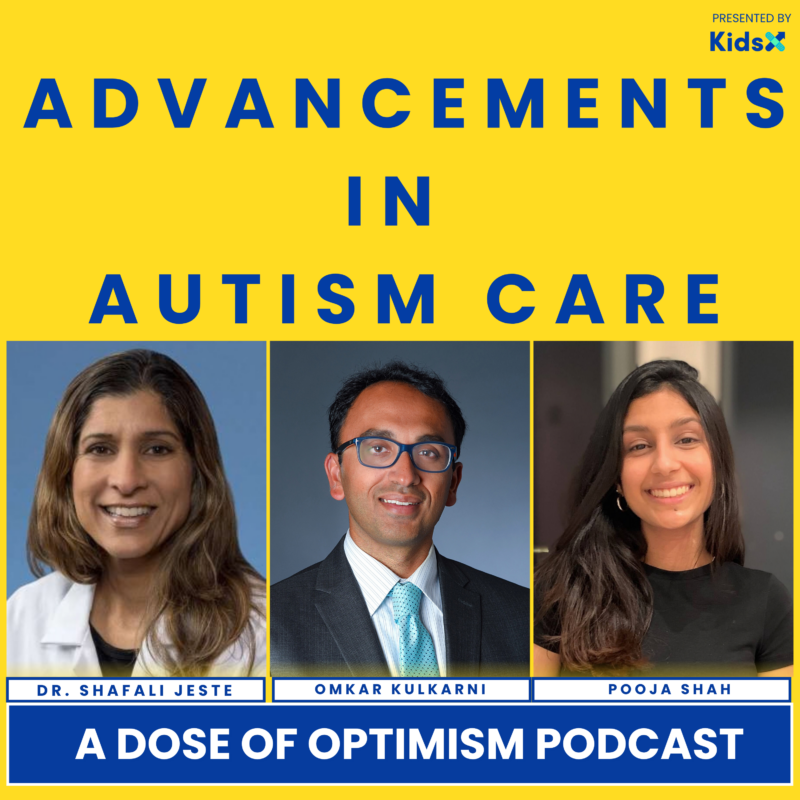
Two guests. Two very different angles on the same problem: that autism care, despite decades of growing prevalence and clinical attention, still leaves too many families without answers, without coordination, and without the tools they need to support their children effectively.
One Diagnosis, Many Causes: Dr. Shafali Jeste on the Science of Autism
Shafali Jeste is a behavioral child neurologist who has spent her career at the intersection of autism science and clinical care. She is currently a professor at UCLA, where she leads the Children’s Discovery and Innovation Institute and maintains an active clinical practice seeing some of the most complex children on the autism spectrum.
Her starting point is a clarification that matters enormously: autism is a behavioral diagnosis. It is defined by a set of observable symptoms, social impairment, repetitive behaviors, restricted interests, sensory differences, not by a biological cause. That means any number of different biological pathways can lead to the same behavioral presentation. And understanding those pathways is where the field is now moving.
When Dr. Jeste was in training, approximately 5% of autism cases had an identifiable genetic cause. That figure is now approximately 20%, and rising by the day. In the subgroup of children with profound autism (those with the most significant support needs, intellectual disability, and limited language), the figure is higher still: more than half of those individuals likely have an identifiable genetic cause.
Why does this matter? Because identifying a genetic cause doesn’t just give families an answer. It opens the door to precision treatments. Angelman syndrome is one of the clearest examples: an autism-associated genetic condition for which three Phase 3 randomized controlled trials of antisense oligonucleotide treatments are now underway, treatments that target the underlying genetic mechanism rather than just managing symptoms. That is a different category of intervention entirely. And as more and more genetic causes of autism are identified, the possibility of similar precision treatments expands.
Genetic diagnoses also shape the monitoring and counseling of families. If a child has a specific genetic condition associated with epilepsy, the clinical team can watch for that proactively rather than reactively. If a condition is associated with a particular developmental trajectory, parents can be counseled more specifically about what to expect. The uncertainty that makes autism so difficult for families isn’t just emotional, it’s clinical. Genetic clarity reduces it.
On early detection, Dr. Jeste is both cautious and hopeful. In research settings, brain differences can be observed as early as three months in babies who will later be diagnosed with autism, through EEG and MRI tools used to study groups, not to screen individuals. Behaviorally, early signs in social communication, eye contact, gesture, attention to faces, can be observed by age one in babies considered higher-likelihood (those with older siblings with autism).
She is equally clear about the role of parents. Parent concerns about development, raised as early as six months, have been shown to be quite predictive of later autism diagnosis. And she describes the frustration she hears repeatedly from families: being told “he’s a boy, he’ll talk late,” or “we can’t diagnose until age three”, reassurances that delay intervention and are simply not supported by the evidence. Autism can be reliably diagnosed by age two. In children with clear symptoms, by 18 months.
Care That Connects Every Dot: Pooja Shah on Mindly
Pooja Shah studied cognitive science and data science at UC Berkeley. She spent two years in an autism research lab at Stanford. And what she kept encountering, in conversations with parents, educators, and clinicians, was the same problem: what happens in one room doesn’t travel to the next.
A child with autism typically has a large, fragmented care team: a behavioral therapist, a speech-language pathologist, a school special education teacher, a pediatrician, and parents who are trying to hold all of it together. Each of these people observes the child. Each of them forms impressions. Almost none of that information flows reliably between them. The result: delayed interventions, duplicate intakes, faulty medication prescriptions, and parents who are doing multiple layers of translation work that should be happening in the system.
Mindly is Pooja’s response. The platform connects providers, educators, and parents in a shared environment where behavioral observations, what was seen in the therapy session, what happened at school, how the child slept last night, can be captured, shared, and analyzed. The parent platform is free. The clinical and school versions are sold directly to private clinics and private schools.
The video component is particularly significant. In autism care, behavioral observation is the primary clinical tool, but current documentation is almost entirely note-based: pen and paper, Google spreadsheets, three-to-six month retrospective reviews of written descriptions. Notes cannot capture nuance. They cannot capture the frequency, duration, or intensity of a behavior. They cannot capture the small shifts in progress that matter enormously to a family and to a treatment plan.
Video can, and Pooja’s vision for AI on top of that video layer is to automate the detection of behavioral patterns, triggers, and consequences, the things that happen in a session that a human observer might miss or not think to document, and that a well-trained model could identify consistently across settings and time.
The problem Mindly is solving isn’t just a technology problem. It’s a fragmentation problem that the technology makes addressable. The care is already happening. The people who care about these children are already doing their jobs. What’s missing is the connective tissue that lets their observations build on each other. Mindly is building that connective tissue.
Key Topics Discussed:
- Autism as a behavioral diagnosis: core features and the importance of the diagnosis for accessing services
- The heterogeneity of autism: “If you’ve met one child with autism, you’ve met one child with autism”
- The genetic landscape: from 5% to 20% of cases with identifiable genetic causes
- Profound autism: what it is and why genetic testing matters most here
- Angelman syndrome and Phase 3 antisense oligonucleotide trials
- Precision medicine and clinical trial readiness in autism genetics
- Early detection: behavioral signs by age one, brain differences by three months
- The Baby Sibs Research Consortium and early identification research
- Parent instinct as a clinical signal, and why dismissing it is wrong
- The RISE battery for home-based developmental screening
- AI and video analysis in autism detection research
- The fragmentation problem in autism care
- Mindly: platform design, care team connection, and behavioral tracking
- Video vs. note-based observation in autism documentation
- AI-powered behavioral pattern detection
- Free parent platform and school/clinic business model
About Dr. Shafali Jeste:
Dr. Shafali Jeste is Professor and Mattel Executive Endowed Chair of the Department of Pediatrics at the David Geffen School of Medicine at UCLA, Executive Medical Director of Pediatrics in the UCLA Health System, and Executive Director of the UCLA Children’s Discovery and Innovation Institute. A behavioral child neurologist specializing in autism and related neurodevelopmental disorders, Dr. Jeste completed her undergraduate studies at Yale University, her medical degree at Harvard Medical School, and her residency and fellowship in child and behavioral neurology at Boston Children’s Hospital. Her research focuses on early identification and intervention for children with autism and genetic neurodevelopmental disorders.
About Pooja Shah:
My mission is to transform how we understand and treat neurological conditions—by bridging the gap between clinical care, education, and technology.
As the founder of Mindly, I’m building a digital health platform that unites providers, educators, and families to deliver smarter, data-driven neurological care. We use AI-powered video analysis and automated documentation to track behavioral patterns, treatment progress, and real-world outcomes—helping care teams make faster, more informed decisions that improve lives.
Having spent years researching autism at Stanford University and working closely with clinicians and families, I saw firsthand the fragmentation in care and data. That experience shaped my mission: to create an ecosystem that turns disconnected observations into connected insights—and to make personalized, holistic care accessible for every child.
I’m passionate about leveraging technology to create a more empathetic, efficient, and inclusive healthcare future.
