
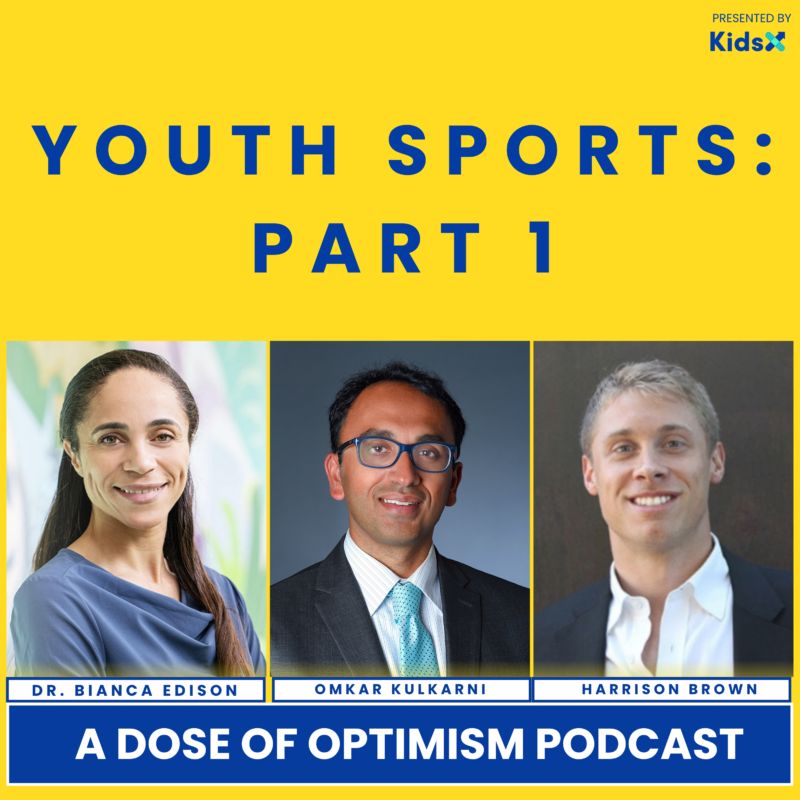
Youth sports give children so much: time management, leadership, the experience of working toward a common goal with people different from themselves, and a relationship with movement that tends to last a lifetime. They also, when the culture around them goes wrong, extract so much: sleep, joy, variety, physical health, and mental wellbeing.
In this episode, two people who see youth sports from very different angles share what they’re watching, and what they’re doing about it.
The Case for Variety: Dr. Bianca Edison on Pediatric Sports Medicine
Bianca Edison is a pediatric sports medicine and orthopedic physician at Children’s Hospital Los Angeles. She grew up playing taekwondo, swimming, volleyball, dance, tennis, and track, and attributes the breadth of that experience to the way she approaches movement as an adult. It’s not an accident that her clinical message to families looks a lot like her own childhood: play a lot of things, specialize later.
The data and the culture are moving in opposite directions. Early specialization, choosing a single sport at an early age and committing to it year-round, is increasingly the norm, particularly in places like Southern California where the weather allows year-round outdoor training. And what Dr. Edison sees in her clinic is the predictable result: repetitive use injuries in one part of the body, underdevelopment in others, and children in their early adolescence sustaining injuries that were once associated with professional athletes. Kids as young as 11 presenting with UCL tears (the ligament associated with Tommy John surgery), because they’ve been pitching year-round since they were six.
Her vision for sports medicine is explicitly preventive. She dreams of a clinic filled not with injured athletes but with healthy ones who have come in to understand how they move, to identify small patterns that could become big problems, and to leave with a plan for getting stronger and more efficient. She’s building toward that through the John C. Wilson Motion Analysis Center at CHLA, where CGI-like motion capture technology allows her to show athletes what they’re actually doing, the knee that’s collapsing inward during a squat, the landing pattern that increases ACL risk, and give them something to take to their coach, their trainer, or their physical therapist.
The mental health dimension of her work is equally important. She doesn’t see a sprained ankle. She sees a 15-year-old soccer player who wants to play college soccer, is taking three AP classes, sleeping four hours a night, and has stopped doing anything except soccer and studying. The injury in front of her may be the first signal that something larger is wrong. And her approach is to make space for that, not to replace the therapists and sports psychologists she refers to, but to ensure the conversation gets started.
She also gives kids an out. For athletes who feel that stepping back from training will be seen as a weakness, she offers a simple phrase: “My doctor said.” If you don’t remember anything else from our conversation, remember that. It gives young athletes a way to protect themselves without having to be the one to admit they need it.
The Compliance Problem: Harrison Brown on HEADCHECK Health
Harrison Brown played rugby and studied neurophysiology. He spent years in a concussion research lab at the University of British Columbia. And what he concluded, after all of that, was that the biggest problem in youth sports concussion management isn’t the quality of the tests. It’s whether the protocols get followed at all.
Every youth sports organization in America is legally required to have a concussion protocol, a written policy describing what happens when a player is suspected of having a head injury. These laws are typically named after young athletes who were mismanaged after a concussion and suffered severe or lasting consequences. The protocols exist, but the problem is compliance.
HEADCHECK Health digitizes those protocols end-to-end. Rather than offering a single test or assessment tool, it provides a single platform through which an organization can run its entire concussion protocol, from initial injury recognition, through sideline assessment, through the return-to-play process, through clearance. What test is performed depends on who is on the sideline: an athletic trainer with clinical training might run a full SCAT6 assessment; a volunteer coach running a youth league would follow a lay-person protocol focused on recognition and removal.
The platform maintains baseline data, flags when protocol steps are missed, and gives administrators at the organizational level a real-time dashboard showing protocol status across all teams and locations. That visibility is the point: it transforms concussion protocols from documents that exist into processes that are demonstrably being followed.
The insurance angle is increasingly important. As concussion lawsuits have increased, insurers are raising rates and, in some cases, adding neurodegenerative injury exclusions to policies. HEADCHECK’s data can be used in conversations with underwriters to demonstrate protocol compliance, making it possible to negotiate coverage that organizations would otherwise be unable to obtain.
At the professional level, the platform now integrates with live video spotter programs: an injury is flagged by a video analyst, a notification is pushed to the sideline medical staff, the sideline assessment is conducted and documented through the app, and the athlete’s status is tracked through every stage of the return-to-play process. It’s a closed loop from spotting to clearance.
The longer arc of Harrison’s vision is research: once concussion protocols are being consistently followed at scale, the resulting data (clean, structured, high-volume), becomes a research resource that could accelerate the field’s understanding of concussion prevention, incidence, and outcome optimization by years or decades compared to the current grant-funded academic model.
Key Topics Discussed:
- The value of sports for child development: physical, cognitive, and social
- Early specialization: what the data shows and what Dr. Edison sees in her clinic
- Tommy John surgery in pre-adolescent athletes
- Preventive sports medicine vs. reactive injury care
- Motion analysis technology at CHLA: CGI-like movement assessment
- ACL risk patterns identified through movement screening
- The mental health burden on young athletes
- How sports medicine physicians approach mental health in clinical encounters
- The “my doctor said” framing for athlete self-advocacy
- Concussion protocol compliance as the primary gap in youth sports safety
- What a concussion protocol is and why state law mandates it
- HEADCHECK’s digital protocol platform: medical and lay-individual versions
- Real-time dashboard for organizational concussion management
- Video spotter programs at the professional level
- Insurance and liability implications of protocol compliance
- Accelerating concussion research through improved data quality
About Dr. Bianca Edison:
Bianca Edison, MD, MS, FAAP, FAMSSM, is an attending physician in the Jackie and Gene Autry Orthopedic Center, and is a clinical associate professor of Orthopedics at the Keck School of Medicine of the University of Southern California. Dr. Edison’s clinical interests and experience include orthopedic conditions affecting young children and athletes, such as dance injuries, sports-related concussion, injury prevention, and biomechanics.
Dr. Edison is a team doctor for various sports teams throughout Los Angeles. She brings a personal understanding to the challenges facing young athletes, as she grew up with a passion for sports and participated in ballet, tennis and track, and currently enjoys tennis, swimming, skiing, hiking, running and yoga.
Dr. Edison is on the Positive Coaching Alliance-LA Chapter Board.
About Harrison Brown:
HEADCHECK Health CEO and co-founder Harrison Brown is an athlete with a background in contact sports and an interest in brain injury.
A rugby player in his early years, Harrison played on the Hong Kong National Team and University of Guelph Varsity team while pursuing his Bachelor of Science degree.
In University, Harrison began to specialize in Neurophysiology, leading him to pursue Masters of Science and PhD studies in the University of British Columbia’s Sensorimotor Physiology Lab.
Supported by his thesis advisors and mentors, Dr. Jean-Sébastien Blouin, Dr. Gunter Siegmund, and Dr. Michael Koehle, Harrison was involved in a wide variety of concussion-related research. These included head impact monitoring, diagnostic accuracy of commonly used concussion tests, utility of baseline testing, and the identification of concussions through objective balance error measurement.
