
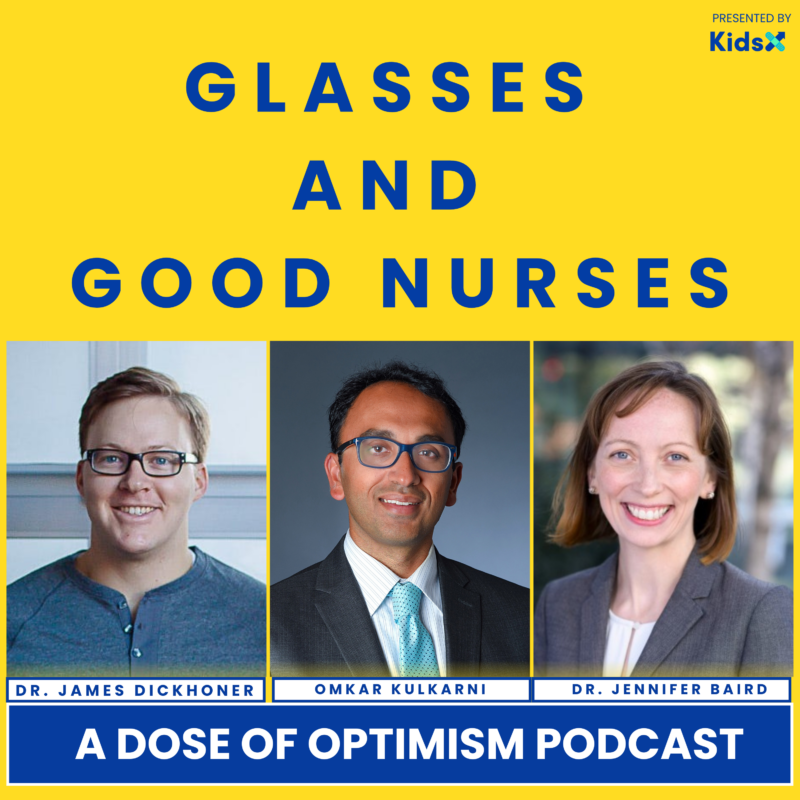
Two problems. Both are foundational. Both hiding in plain sight.
A child who can’t see the board won’t learn as well as one who can. A nurse who has spent three shifts in a pediatric unit won’t be ready for the complexity of one who has spent a year. Neither problem is new. Both have been underinvested in for decades. Listen to the episode here.
Two to Four Million Kids Who Need Glasses: Dr. James Dickhoner on Vision to Learn
James Dickhoner is not an eye doctor. He is a systems thinker and entrepreneur who came to Vision to Learn as its first Chief Medical Officer, and set himself a clear mission: figure out how to get glasses on the faces of the two to four million children in the United States who need them and aren’t getting them.
The need is startling in its simplicity. Between a quarter and half of school-age children need vision correction, depending on age. Medicaid provides vision benefits for children under 18. And yet, an estimated two to four million kids who qualify are not accessing that care, because they can’t find a provider who takes their benefit, because they don’t know how to use it, or because the Medicaid reimbursement rate is so far below the cost of providing the service that there aren’t enough optometrists willing to take it.
Vision to Learn fills that gap with a mobile clinic model. The organization screens approximately 500,000 children per year across 15 states. About 120,000 of those children need a full eye exam; a mobile clinic with an optometrist returns two to four weeks later to provide it. Of those, 85 to 90% need glasses, and the glasses are provided free. Last school year, Vision to Learn gave out just over 100,000 pairs.
The academic impact is real. A Hopkins study, often cited by Vision to Learn, found that getting a child wearing glasses for two years is equivalent to approximately six additional months of learning. Compared to the cost of after-school tutoring or individualized instruction, eye care is, in James’s framing, extraordinarily compelling from an investment standpoint.
The barriers are specific and solvable. Dilation, the gold standard for a thorough eye exam, is logistically challenging in school settings and increases resource requirements. Consent models vary dramatically by state: opt-in states see 30% or less of students covered; opt-out states see 90% plus. And the optometry workforce is actually contracting: retiring doctors work at a 1.2 FTE equivalent, while new entrants work at 0.7 to 0.8, meaning total capacity is flat or declining even as the population grows and myopia prevalence increases.
James’s response is care model innovation: find ways to provide higher-quality exams with fewer resources, push for school-based healthcare funding codes, and work at the policy level, as Vision to Learn recently did with the Governor of Ohio to establish the state’s first statewide school-based vision program. The organization now operates in 15 states, with 18 expected this school year.
The political argument, he notes, is easier than almost any other in healthcare. Eyeglasses have no culture war. You can frame it as equity. You can frame it as economic productivity. Either way, everyone agrees that kids need to see the board to learn.
A Deeper Rotation: Dr. Jennifer Baird on the Pediatric Pathway Program
Dr. Jennifer Baird describes a problem that medicine largely solved decades ago but nursing has not: how do you give a student meaningful immersion in a specialty before they enter the workforce?
In medicine, rotations give students deep exposure to different specialties, months at a time, before they choose a residency. In nursing, the model has historically been generalist: a little bit of everything, not much of anything. In pediatrics specifically, a nursing student might complete as few as three shifts in a hospital setting, 30 hours, which the California Board of Nursing recognizes as the minimum for specialty requirements. At best, that becomes observational rather than experiential.
The Pediatric Pathway Program, now in its third year at CHLA, is an attempt to change that. The program partners with three schools of nursing, each of which has agreed to stretch and restructure their curriculum to allow dedicated, intensive time in pediatric settings. The result: three to four times the clinical hours in pediatric environments compared to the standard curriculum. Students rotate through inpatient units, ambulatory spaces, and community health settings. Simulations are developed by pediatric nurses with actual pediatric expertise, not by generalist faculty who’ve never worked in a children’s hospital.
The program runs two years. The first cohort has just graduated. Many are applying to CHLA’s RN Residency Program, their first job out of school. The organization has hired approximately half of those who applied, and is tracking outcomes carefully: retention rates, time to independent practice, and the financial impact of shorter onboarding timelines.
The parallel to medical school rotations is one Dr. Jennifer embraces: if you want a nurse who is truly prepared for the complexity of pediatric care, a child in medical crisis, a family under enormous stress, the social and behavioral dimensions that compound clinical challenges, you have to give them time to experience it before they’re responsible for it.
She is also direct about the case for pediatric nursing as a career: the holistic family approach, the constant innovation, the variety of patient presentations, and the culture of the people who choose this work. “The type of people who tend to end up in pediatrics,” she says, “just are really fun and passionate about the work that they do.”
Key Topics Discussed:
- The two to four million children in the US who need glasses and can’t access them
- Vision to Learn’s mobile clinic model: screenings, exams, and free glasses
- Medicaid reimbursement as a barrier to optometry supply
- Hopkins study: two years of glasses equals six months of additional learning
- Myopia prevalence and rising rates in school-age children
- Dilation, consent models, and care model barriers in school-based vision
- Optometry workforce contraction and the implications for supply
- Policy-level work: Ohio’s first statewide school-based vision program
- The generalist vs. specialist tension in nursing education
- The three-shift exposure problem: 30 hours in pediatrics
- Pediatric Pathway Program: design, partners, and structure
- Tripling and quadrupling clinical hours in pediatric settings
- Simulation in specialty nursing education
- First cohort outcomes and tracking plan
- The financial impact of faster time to independent practice
- Why pediatric nursing is a compelling career choice
About Dr. James Dickhoner:
James William Dickhoner, MD, is Chief Medical Officer at Vision To Learn, where he serves as the organization’s first CMO. He also advises the Armenia Digital Health Program at Children’s Hospital Los Angeles, supporting school-based vision screening and retinopathy of prematurity initiatives, and previously directed international digital health efforts there. His career spans clinical leadership, global health, and health technology, including co-founding the digital health startup Orderly Health. He operates Portage Advisory LLC, a consulting practice focused on digital health strategy. He lives in Denver, Colorado, with his family.
About Dr. Jennifer Baird:
I’m a pediatric nurse leader with a passion for professional development and clinical inquiry! I love to create new opportunities for professional growth, and I’m a champion for innovation and change within the healthcare system. I’m also an advocate for family engagement in our care delivery processes, and my research focuses on the family’s experience of care and the connection between communication and patient safety. I’m proud to lead our fantastic CHLA Patient Care Services Education and Research Department, which encompasses our transition to practice and clinical education programs, the Institute for Nursing and Interprofessional Research, our role development and collaborative partnership teams, the Las Madrinas Simulation Center, the Magnet program, Professional Governance, and the Patient and Family Education team and Family Resource Center. We support education and professional development for nurses and their interprofessional colleagues across the organization, ensure the highest standards of nursing professional practice, create mechanisms for improving the quality and safety of care through simulation, and support access to resources and education for families within the hospital and in our community.
