
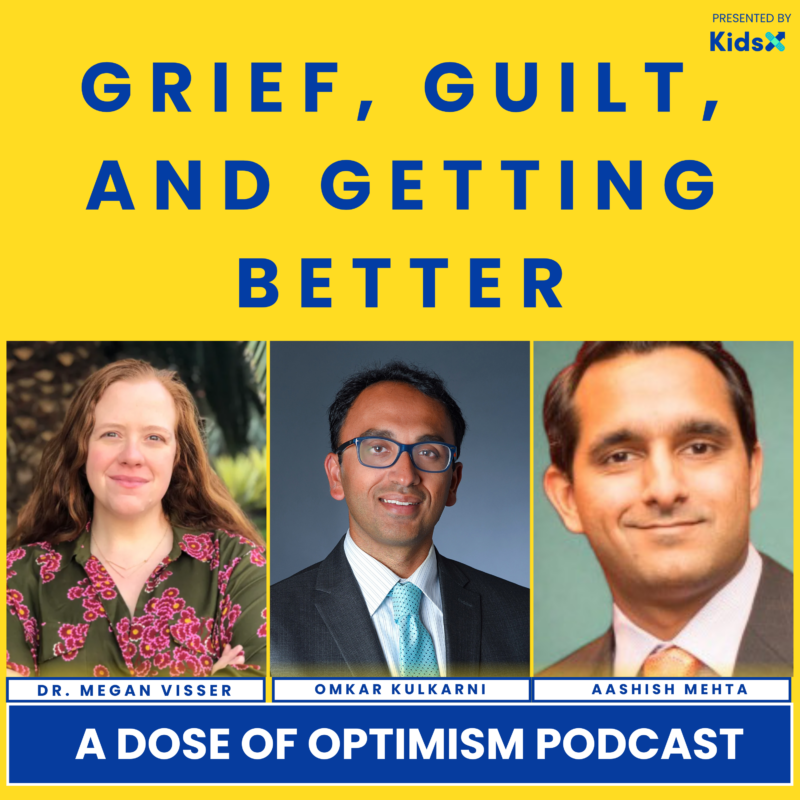
Two conversations. Two very different technologies. And a shared premise: people are carrying things that the healthcare system doesn’t always see, and seeing them earlier, more clearly, and with more support could change outcomes.
What Chaplains See That Clinicians Miss: Dr. Megan Visser
Megan Visser is a hospital chaplain and a sociologist, a combination that is rarer than it should be in clinical settings, and one that gives her an unusual perspective on what happens inside a family when serious illness arrives.
Chaplaincy, she is careful to explain, is not just for the dying. It’s for the whole continuum: from the family in acute crisis to the teenager learning what it means to have a chronic condition that will be with them for the rest of their life. Her current research at CHLA focuses on two areas: interprofessional end-of-life care for hospitalized children across sociodemographic categories, and spiritual needs and coping for youth with diabetes from historically marginalized groups.
What surprises her most is resilience, particularly among parents. Parents who have lost someone to diabetes in their own family history, and who use that memory not as a source of fear but as spiritual fuel for their child. “If you’re having a hard day, think of Grandpa, he dealt with some of the same things.” That reframing, she says, is genius: taking something already survived, and transforming it into an active resource for the present.
On grief, she draws an important distinction between three forms that show up in chronic illness settings. There is the immediate grief of diagnosis: everything changes at once, information floods in, families process loss of the life they thought they had. There is the ambiguous, harder-to-name grief that comes later: the slow accumulation of adjustments and limitations. And there is anticipatory grief, the pre-grieving of challenges that haven’t happened yet but feel inevitable.
In all three, the act of naming matters. Most families have already survived grief before. Most have coping resources, a religious community, a cultural tradition, a family network, already there, waiting to be reconnected to. What they often need is a clinical encounter where they are given permission to say: this is a loss, and I am grieving it.
Parental guilt is another recurring theme. Across conditions, diagnoses, and cultures, families will say: if I had only done this differently. And even when they are told, correctly, that they could not have caused this, the feeling lingers. Chaplaincy’s role, Dr. Visser argues, is not always to change the belief, but to sit with the feeling, help families trace its roots, and find their way toward self-forgiveness. Which, she adds from personal experience as a parent, has to be a daily practice.
The access challenge is real. Chaplains are not routinely embedded in outpatient chronic illness programs. Families receive a diabetes diagnosis in a clinic visit and go home, without a space to process what they’re carrying. Dr. Visser sees technology as a potential bridge: programs and products that could help families access some of what chaplaincy provides, without requiring a chaplain to be present in every room.
A Sensor That Reads the Body: Aashish Mehta on TacnIQ
Aashish Mehta’s company builds wearable devices that detect how a body moves, and flag when that movement is putting it at risk.
Backy™ is a small sensor worn on the body that detects high-risk postures and movement patterns in real time. When a problematic posture is identified, the device delivers vibrational feedback, a tactile prompt to correct, adjust, or stop. The data is captured and available to the individual and, in clinical or occupational settings, to a supervising team.
The initial deployments have been with hospital nursing staff. Nurses are one of the most physically burdened groups in healthcare: patient handling, extended standing, awkward postures, and high-frequency movement put them among the professions with the highest rates of back injury. Two hospital deployments in Singapore, at Woodlands General Hospital and Sengkang General Hospital, have generated strong early feedback, with nurses expressing not just satisfaction but enthusiasm for more data. They want to track more movement types: twisting, lateral bending, backward extension. Aashish notes that nurses are among the most movement-conscious of any professional group he has encountered, the awareness is already there. The technology is catching up.
The pipeline extends in several directions. A program with the National University Hospital in Singapore is running Backy™ with pregnant women experiencing back pain, exploring both the identification of movements that cause pain and behavioral change elements to help women modify them. Post-surgical recovery is another active application: helping patients and their care teams understand how movement patterns are changing after surgery, and whether early warning signs of re-injury can be detected before a second procedure becomes necessary.
Consumer and patient-facing applications are in development. The usability bar for individual consumers is higher than for professional settings, the hardware and app need to be simpler, the onboarding frictionless. The B2B hospital deployments are helping the product mature in ways that will make the consumer version more viable.
Key Topics Discussed:
- What hospital chaplaincy is, and what it isn’t
- Spiritual care in chronic illness: diabetes, pediatric illness, disability
- How families use grief and loss from their own history as a spiritual resource
- The three forms of grief in chronic illness: immediate, ambiguous, and anticipatory
- Naming grief as a clinical and spiritual intervention
- Parental guilt across diagnoses and cultures, and the path toward self-forgiveness
- Access gaps in chaplaincy for outpatient and chronic illness settings
- Technology as a potential bridge to spiritual and psychosocial support
- Wearable tactile sensors for movement and posture monitoring
- Backy™: real-time high-risk posture detection and vibrational feedback
- Nurse back injury risk and hospital occupational safety
- Pregnancy-related back pain and behavioral change
- Post-surgical recovery monitoring
- Consumer and patient-facing wearable roadmap
About Dr. Megan Visser:
Dr. Visser is a postdoctoral research fellow in the Institute for Nursing and Interprofessional Research (INIR) and The Saban Research Institute, sponsored by the Association of Diabetes Care and Education Specialists. She is also a professional hospital chaplain, trained at Cedars-Sinai Medical Center and Children’s Hospital Los Angeles. She completed her doctoral training in sociology in the Department of Social and Behavioral Sciences at University of California San Francisco. As a spiritual care professional, her clinical experience has focused on offering care to children and youth with long-term and critical illness, and their families. Her current research projects focus on two areas of interest: (1) interprofessional end-of-life care for hospitalized children and their families across sociodemographic categories; and (2) spiritual needs and coping for youth with diabetes from historically marginalized groups and their families. As a postdoctoral fellow, she is pleased to work with Dr. Rebecca Barber from INIR, Dr. Jennifer Raymond (Center for Endocrinology, Diabetes and Metabolism), and Dr. Caitlin Sayegh (DASHLab).
About Aashish Mehta:
Aashish Mehta is an accomplished innovator and entrepreneur with extensive experience in leading regional teams within high-tech companies. As the co-founder of TransferFi, Aashish successfully raised seed funding and played a pivotal role in the company’s early growth. At SGInnovate, he spearheaded commercialization efforts, driving the adoption of cutting-edge technologies.
Currently serving as the CEO of TacnIQ, Aashish is at the forefront of developing advanced multimodal AI models that integrate tactile data to revolutionize the fields of healthcare, robotics, and sustainability. His expertise spans product-market fit, system design, and manufacturing, all fueled by a passion for bridging AI with real-world applications to create meaningful impact.
