
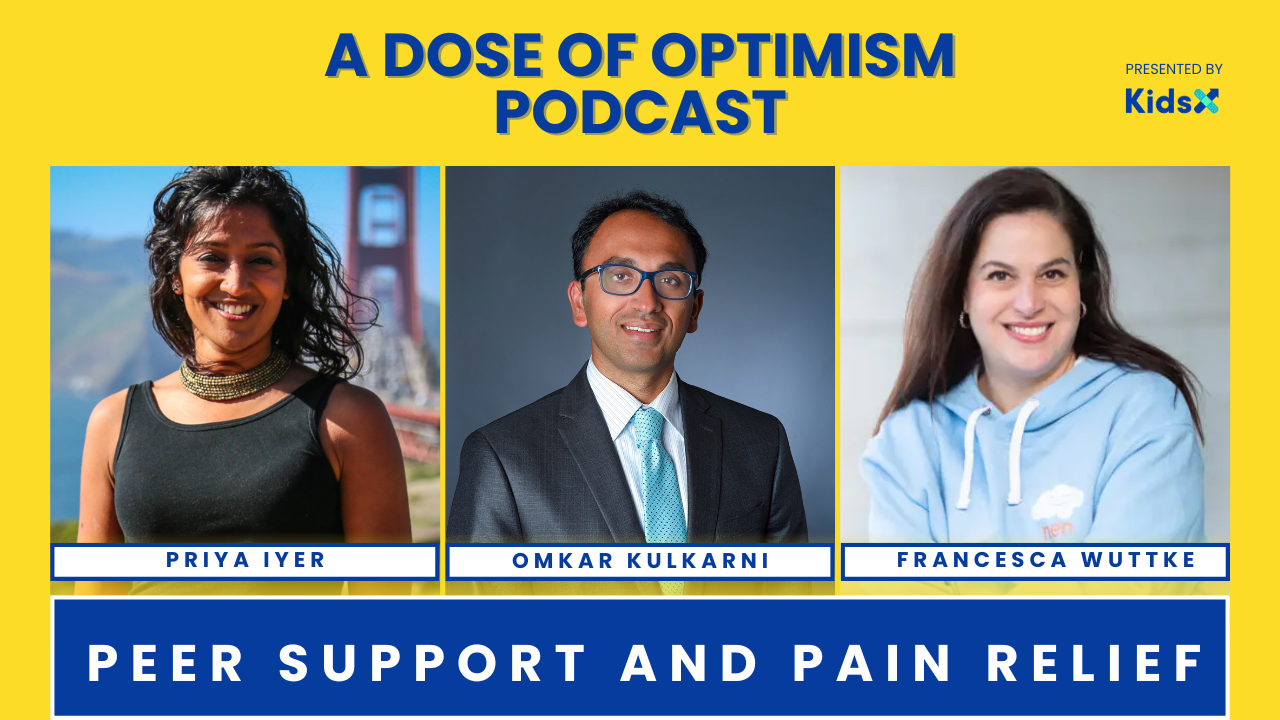
Two very different problems. Two founders who refused to accept the status quo. And a shared belief that the children and families most overlooked by the healthcare system deserve innovation just as much as, perhaps more than, anyone else. Listen to the episode here.
Generations of Impact: Priya Iyer on Our Roots
Priya Iyer spent years as an epidemiologist in maternal and child health, working across four continents in under-resourced settings. She saw resilience, cultural assets, and what happens when systems fail to recognize either.
In BIPOC communities in the United States, perinatal mood disorders occur at twice the rate of their white counterparts. And yet those same communities face the steepest barriers to care: language, geography, stigma, and the near-impossibility of receiving concordant care from a provider who shares their background and lived experience. A mother might finally be referred to a therapist,and then wait months to get off a waitlist, by which point the acute need may have passed, or worsened.
Our Roots work upstream of that system failure. The platform connects perinatal women, from pregnancy through postpartum, and through experiences of loss, with peer coaches who share their lived experiences, language, and cultural background. The interface is deliberately simple: a HIPAA-compliant platform that shows up as a text message on the participant’s phone. No app to download, no unfamiliar portal to navigate. Just a message from someone who has been where they are.
The platform is integrated with federally qualified health centers and Medicaid plans, currently in and around Oakland in the East Bay, with referrals coming through clinic partners and integrated behavioral health directors. Our Roots screens participants for depression and anxiety, shares data back to the clinic so providers have a full picture, and connects higher-need participants to therapists and psychiatrists when warranted. Peer coaches are not replacing clinical care, they’re filling the gap between it.
The outcomes data is striking: a 65% reduction in depression and anxiety scores from program entry to exit. But Priya is equally invested in the stories. A mother who came to Our Roots after leaving an abusive situation, still pregnant, with no housing and no support, who, over 12 weeks of peer coaching, found housing, reunited with her older child, and navigated the medical system on her own terms. That, she says, is the program working.
The reimbursement pathway is also real. Through CalAIM, Medicaid covers the Our Roots peer coaching model, making them, to Priya’s knowledge, the first provider offering virtual peer coaching specifically for maternal mental health through a Medicaid managed care plan.
What makes Priya most optimistic is the long view. Investing in a mother today doesn’t just change her life. It changes the trajectory of her children, and potentially, three generations down the line.
Gamifying Pain: Francesca Wuttke on nen
Francesca Wuttke spent 25 years in pharmaceutical drug development before doing a scan of the digital health landscape and noticing something that stopped her cold: almost nothing was being built specifically for children.
Children represent a quarter of the population and 100% of the future. Pediatric innovation is dramatically underfunded. In oncology, many standard treatment guidelines are dosing-down adult protocols rather than programs designed for pediatric physiology and development. And in pain management, the area nen addresses, children with complex medical conditions are routinely placed on 12 to 18-month waitlists for access to a pain psychologist.
That gap has consequences. Children who undergo repeated painful medical procedures develop negative pain memories that can be remarkably persistent, surviving through cancer survivorship into adulthood. A Lancet paper estimated that 59% of cancer survivors experience pain with no physical cause, because no psychological intervention was available at the time of their medical trauma to help them process and manage it.
nen’s solution is to bring cognitive behavioral therapy for pain, a clinically validated approach — into a game. Children interact with virtual companions: Dolores (whose name means “pain” in Spanish, reflecting the company’s Barcelona base), who delivers CBT for pain; Sarah, focused on anxiety through serotonergic pathways; and Tony, who addresses depression. The characters explain what’s happening in the child’s body, lead games that reinforce understanding, and equip children with coping skills they can draw on when pain or anxiety strikes.
The approach is deliberately game-based because children don’t need to be in pain to play. They build the skills before they need them, and can access them when they do.
A clinical trial has just launched with collaborators at the University of Notre Dame’s Harper Cancer Research Center and a partner center in Puebla, Mexico, a residential facility where children with cancer and their families live together during treatment. What began as a planned trial of 150 children has grown dramatically: the Mexican Minister of Health, having seen the program, is working to extend its reach to an estimated 80 to 90% of all children with cancer in Mexico, expanding the trial to approximately 600 participants.
The outcome measures mirror those used in validated in-person CBT studies: the Wong-Baker Faces scale, the FACT-S survey, the Pain Catastrophizing Scale. The goal is to digitize what works in the clinic and the scientific literature, and make it accessible to any child, anywhere.
The long-term vision is to make nen freely available through a foundation and NGO network, partnering with UNICEF and grassroots organizations, to reach children in places that have no access to pain psychologists, child life specialists, or play therapists. For every solution purchased, one will be provided to a family that can’t afford it. Francesca calls it the TOMS Shoes of digital health.
Key Topics Discussed:
- Racial disparities in perinatal mood disorders and access to care
- Virtual peer coaching as a model for maternal mental health support
- HIPAA-compliant text-based engagement for under-resourced communities
- Reimbursement of peer support through Medicaid and Cal AIM
- Depression and anxiety outcomes in the Our Roots program
- Cultural concordance and lived experience in peer coaching
- Peer coach workforce development and career pathways
- Loneliness as a predictor of perinatal depression
- The generational impact of investing in mothers
- The pediatric innovation funding gap
- Negative pain memories in children with complex medical conditions
- Gamified cognitive behavioral therapy for pediatric pain
- The nen clinical trial in Mexico and scale to 600 children
- Validated outcome measures in digital CBT
- Democratizing pain management for children globally
About Priya Iyer:
Priya is the founder of Our Roots, a lifelong advocate for the healing, health, and wellness of overlooked and historically undervalued pregnant and postpartum people. She’s also the proud mama of 2. Our Roots is a virtual peer education and support platform for mental wellness created with BIPOC women and birthing communities impacted by poverty.
After working as an epidemiologist in maternal and child health across four continents in under-resourced settings, Priya saw the resilience and assets mamas bring to overcoming challenges from the U.S. to India. As a mother, and as the daughter of immigrants, her life’s work has become to elevate these cultural practices to radically improve the health of birthing people, their children and the generations to come.
She’s used the lessons she’s learned to advise Promise Venture Studio’s network and aspiring social entrepreneurs at Stanford University’s Graduate School of Business in human-centered design, fundraising for early-stage social enterprises, product management, product analytics, systems thinking, and building founding teams and advisory boards.
Her work has been featured in publications such as Scientific American, the Kansas City Star (her hometown paper), NextBillion and ideo.org’s Notes from the Edge of Design.
About Francesca Wuttke:
Broad drug development expertise with over 25 years of commercial, strategic and transactional experience from private equity, management consulting, BD&L and technology licensing and from co-founding Asten BioPharma Advisors, a New York City based healthcare consultancy. PhD in Pharmacology from Weill Cornell Graduate School of Medical Sciences and a BA from Cornell University College of Arts and Sciences.
Experience in both science and business has provided proficiency in multiple areas of the pharmaceutical and biotechnology industry including opportunity assessment and selection, product diligence, primary and secondary market research, sales forecasting, market access clinical trial management, regulatory affairs and intellectual property. Worked with global companies of various sizes on their strategic assessments and plans as well as specific opportunity assessments in addition to M&A and licensing advisory work. Demonstrated ability to distill scientific and clinical data into commercial value generation and plan program strategy accordingly.
Track record reflects a strong history of structuring and completing successful business deals from the perspective of big Pharma (Novartis), as a licensing/M&A consultant to small biotech (Asten BioPharma Advisors), from academia (Mount Sinai) and as an investor (Symphony Capital) providing transactional experience with the insight of various stakeholders. Responsible for prospecting and evaluating hundreds of BD&L/M&A opportunity assessments throughout my career with extensive experience in opportunity identification, asset valuation, financial modeling, deal structure, contract drafting and term negotiations. Successfully negotiated over 150 academic and commercial agreements.
