
The conversation about teenagers and technology has been dominated by fear. Fear of social media. Fear of AI. Fear of what screens are doing to developing brains and fragile identities.
That fear isn’t unfounded. But it’s incomplete.
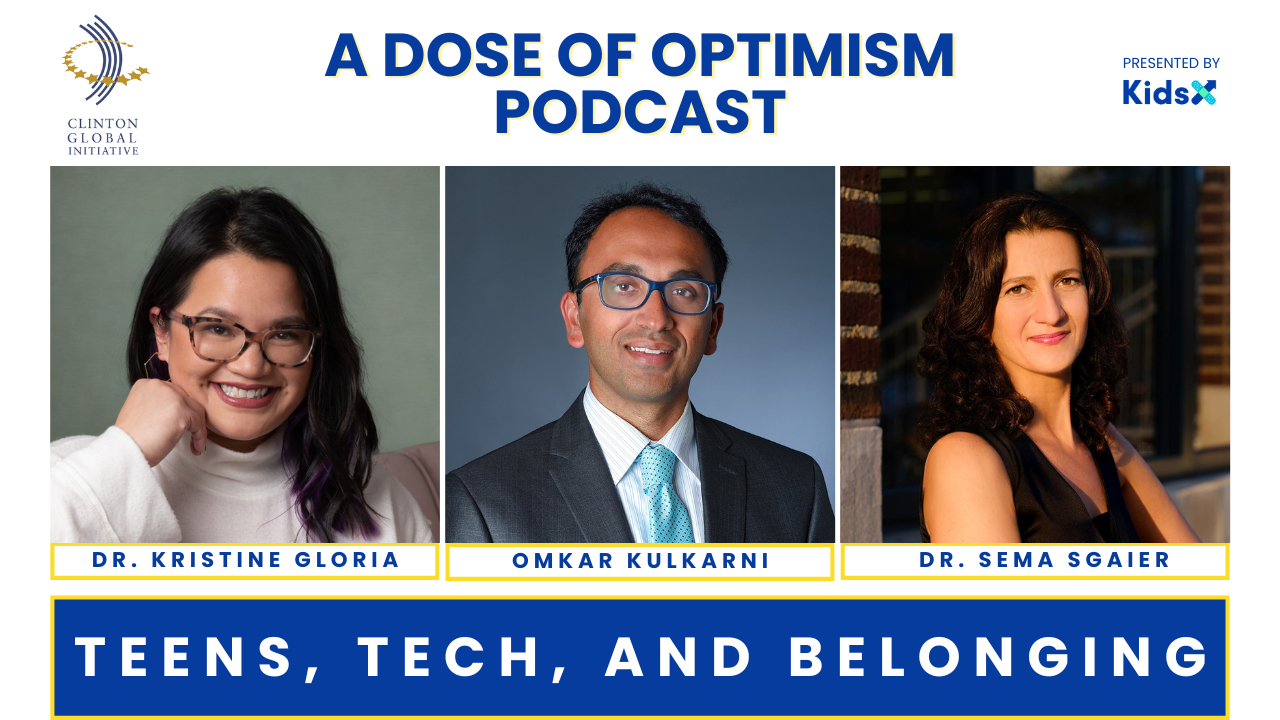
In this episode, two researchers share what a more data-driven, solution-oriented picture of youth well-being actually looks like, and why the answer to helping teenagers navigate technology starts with understanding what they’re actually experiencing, and what they actually need.
Solutions Exist: Dr. Kristine Gloria on YoungFutures
Dr. Kristine Gloria has spent more than a decade working at the intersection of AI, youth development, and well-being. She’s also a parent of two daughters, one of them just entering the age range her organization serves, which gives her work a particularly personal dimension.
What she notices most about teenagers today is not that they are uniquely fragile. It’s that the baseline of pressure they navigate has shifted. The expectations set for young people arrive earlier. The devices and platforms that amplify those expectations are always present. And the line between online and offline life, which older generations could draw more clearly, is genuinely porous for today’s teens. Telling a teenager that their online life and their real life are separate isn’t just ineffective. It’s asking them to reconcile something their generation doesn’t experience as separate at all.
YoungFutures exists, in part, to change the narrative. Not to minimize the challenges teens face, but to insist that solutions exist, in boys and girls clubs, in library programs, in community organizations across the country doing work that doesn’t get covered because it isn’t alarming.
The organization functions as a central node in the youth well-being ecosystem: funding promising organizations through competitive challenges, connecting leaders so that a solution working in rural North Carolina can reach a small town in Montana, and amplifying the field so that effective programs get visibility and resources.
To date, YoungFutures has launched five funding challenges and supported 51 grantees since its 2024 launch. The approaches that rise to the top, consistently, are peer-to-peer interventions, where a 20-year-old Gen Z-er with lived experience of navigating social media and smartphones is far more credible to a 16-year-old than an adult telling them what to do, and programs that bring caregivers and educators into the conversation with genuine empathy.
The newest funding challenge, the Express Yourself Challenge, is focused on gendered experiences and technology, with three tracks: one for young girls and women, one for young boys and men navigating technology and masculinity, and one for gender-expansive and LGBTQ youth. Applications are due May 19.
Dr. Gloria’s core argument is simple: young people are not passive victims of technology. They know they need support. They’re asking for it. The adults around them just have to show up with empathy, and fund the programs that do.
The Data Behind Youth Well-Being: Dr. Sema Sgaier on Surgo Health
Dr. Sema Sgaier co-founded Surgo Health to build what she calls the behavioral intelligence layer in healthcare, the data and analytical infrastructure that captures what happens outside the clinic: beliefs, trust, social context, decision-making biases, and the invisible upstream factors that determine whether a person engages with healthcare at all.
For youth mental health specifically, Surgo has been building a tracker designed to measure not just mental health challenges, but the community, family, and individual factors that drive thriving, a more expansive frame than risk alone.
One of the most striking findings from Surgo’s recent work on AI and youth cuts against the dominant anxiety narrative. How young people use AI, the data shows, is more a reflection of their lives than something categorically harmful. Different groups of teens are using AI for very different purposes:
One in ten youth use AI purposefully for jobs and education, upskilling themselves with a tool that gives them access to resources their environments otherwise lack. These tend to be teens from lower-income backgrounds and a notably higher proportion of Black youth.
Another one in ten use AI primarily for social connection and community, finding online belonging that isn’t available in their physical lives. This group skews more Hispanic.
A similarly sized group actively avoids AI out of genuine concern about privacy and safety, a pattern more common among LGBTQ+ youth, for whom digital safety is a lived concern.
What the data doesn’t show is a uniform story of harm. What it does show is that different young people are bringing different needs to the same technology, and that understanding those differences matters enormously for the policies and interventions designed in response.
The other through-line in Surgo’s youth research: across virtually every outcome they study, the relationship between young people and their parents and trusted adults is central. That’s true for healthcare access, for mental health outcomes, and, as the AI data shows, for whether technology becomes a tool for growth or a source of harm. The lesson Dr. Sgaier draws from the social media era is clear: don’t wait until the damage is documented. Build the scaffolding for healthy AI use now, with parents and caregivers as the foundation.
Beyond youth mental health, Surgo is also working on clinical trial equity and diversity, addressing the dropout and recruitment challenges that make trials unrepresentative, and on women’s health data, filling the behavioral intelligence gaps that affect how women engage with healthcare across the lifespan.
Key Topics Discussed:
- The changing baseline of pressure for teenagers in a digital world
- The porousness of online and offline identity for today’s teens
- Community programs as the underreported solution to youth well-being
- Peer-to-peer interventions and why lived experience beats advice
- The role of parents and trusted adults in youth technology navigation
- YoungFutures: funding model, grantees, and funding challenges
- The Express Yourself Challenge: gendered experiences and technology
- Behavioral intelligence as a missing layer in healthcare
- Surgo Health’s youth mental health tracker
- How different groups of teens are using AI, and what it reflects
- The importance of purpose-driven framing in AI and youth policy
- Clinical trial equity, diversity, and retention
- Women’s health data and behavioral drivers of care engagement
About Dr. Kristine Gloria:
Entrepreneur, public servant, former academic, researcher, and advocate in pursuit of enhancing the human condition with tech. Experience in operations, communications/marketing, behavioral research, and system design. And for those pattern matching, yes, I can ship code.
About Dr. Sema Sgaier
Sema Sgaier is a serial entrepreneur with close to 20 years of experience in healthcare. She co-founded and led Surgo Foundation and Surgo Ventures, where she pioneered the development of analytic products that solve health problems with greater precision. She was Initiative Lead at the Bill & Melinda Gates Foundation, where she brought innovations in data, consumer insights, and product introduction into large-scale health programs globally. She has over 60 publications and is a frequent OpEd contributor to The New York Times and prestigious media outlets. She is an adjunct assistant professor at the University of Washington. She completed her fellowship in Genomics at Harvard University, Ph.D. in Neuroscience from New York University, and M.A. in Neuroscience from Brown University. Sema is a member of the Board of Directors of the United States of Care. She was selected as a rising talent by the Women’s Forum for Economy and Society.
