
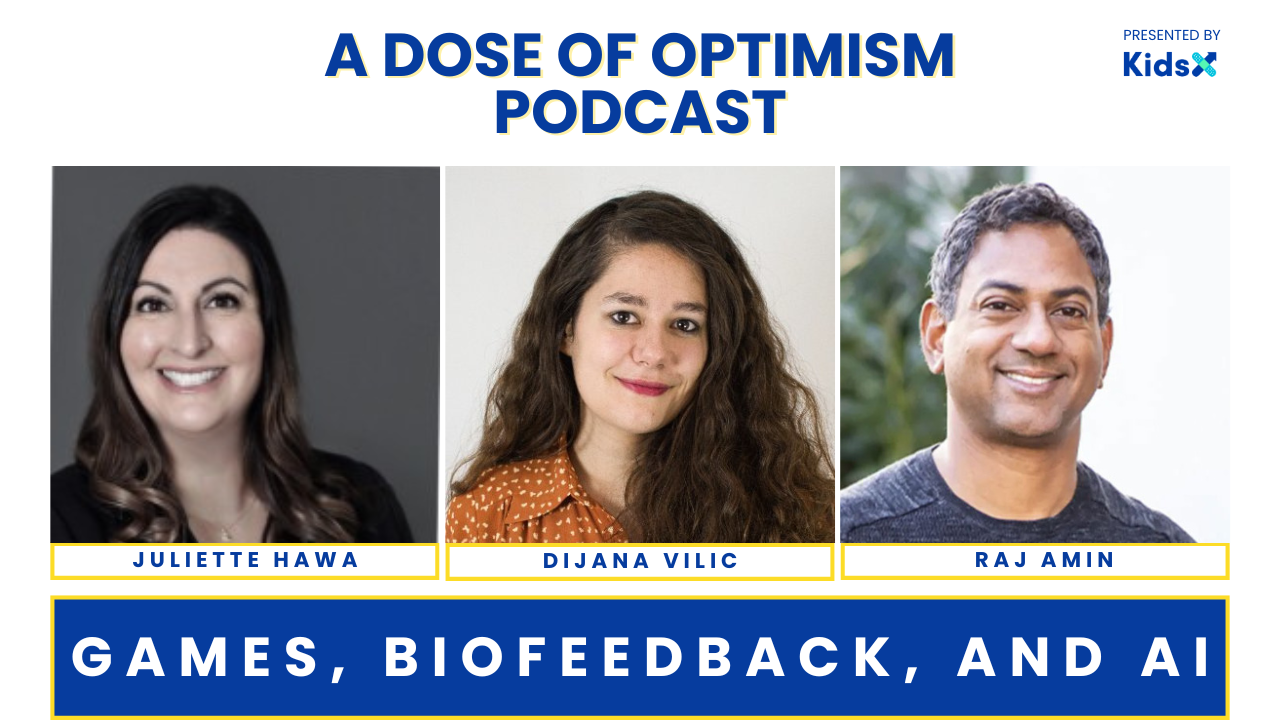
Three guests. Three very different products. And a shared conviction that reaching children with effective care sometimes means throwing out the clinical playbook entirely. Tune in to this week’s episode here.
A Video Game for the Pelvic Floor: Juliette Hawa on PFRx
Approximately 10 million children in the United States experience pelvic floor dysfunction, a condition that can cause constipation, urinary and bowel incontinence, abdominal pain, and pelvic pain. It is underdiagnosed, underdiscussed, and until now, undertreated at home.
Juliette Hawa has spent 20 years as a pediatric physical therapist. Working with Children’s Hospital Colorado and CU Innovations, she built PFRx: a gamified biofeedback device specifically designed for children.
The device uses external electrodes and a Bluetooth connection to a smartphone or tablet. A child wears the device and plays a video game, and the game responds to the electrical signals from their pelvic floor muscles. Contract the muscle, and the character responds. Relax it, and the character responds differently. Over eight weeks, across eight levels of games, children learn to recruit, strengthen, and relax a muscle group most of them have never been asked to think about.
The clinical target is straightforward: fewer accidents, better bowel movements, less pain, and better body awareness, the building blocks of a child feeling in control of their own body. The device is used five to seven times a week, from home, with periodic clinical check-ins.
What Juliette has built is essentially a clinical biofeedback tool, the kind that normally lives in a therapy office and requires a trained clinician to operate, redesigned from the ground up for independent home use by children as young as five. And because the pelvic floor doesn’t care about age, the device is potentially useful for anyone who has one.
Building AI From the Inside: Dika Vilic on the NHS
Dika Vilic runs an in-house AI team at Guy’s and St Thomas’ NHS Foundation Trust in London, one of the few hospital systems in the world that has chosen to build clinical AI internally rather than procure it entirely from vendors.
The distinction matters more than it might appear. When a hospital builds its own AI, it owns the regulatory pathway, the clinical safety checks, and the deployment decisions. It also learns, in ways that external procurement rarely teaches, exactly what the gap is between a promising algorithm and a tool that actually works at the bedside.
Her team has seen both sides of that gap up close. A project to detect bowel perforation in neonates from mobile X-rays was abandoned when the data proved too variable and too sparse. An epilepsy lesion detection tool developed with an external team is close to regulatory approval as a software medical device. And a drug calculator that a clinical team quietly put online, a non-AI tool for emergency medicine dosing, accidentally accumulated 10,000 users before anyone realized it needed to be taken offline for proper regulatory compliance.
That last example captures something important about clinical software: the line between a useful internal tool and a regulated medical device is not always obvious until it’s already been crossed.
On pediatric AI specifically, Dika is direct about the challenges. Every pediatric population is by definition a vulnerable population. Pediatric data is sparse, variable, and often lower quality than adult data, children move during MRI scans, radiation limits rule out CT in many cases, and the population spans from newborns to 18-year-olds with enormous physiological variation. The market for pediatric AI products is also thin compared to adult medicine, which means teams building for children have fewer external benchmarks to learn from.
Her observation about children’s hospitals is worth noting: they tend to produce more innovators and researchers than adult hospitals, she says, because their patient populations are smaller and their problems are less well-served by the commercial market. The innovation instinct is there. What’s often missing is the institutional support to match it.
Anxiety as a Game: Raj Amin on Arcade Therapeutics
Anxiety is one of the most prevalent mental health conditions affecting children and adolescents. Cognitive behavioral therapy is among the most effective treatments. And yet CBT is time-intensive, therapist-dependent, and inaccessible to the majority of young people who could benefit from it.
Raj Amin and his co-founder, neuroscientist Dr. Tracy Dennis-Tiwari, built Arcade Therapeutics around a different model: a subconscious, game-based approach to anxiety treatment rooted in a neuroscience mechanism called attention bias modification.
The concept is based on NIH-funded research. People with anxiety have a systematic cognitive bias toward negative information, they notice threats faster, dwell on them longer, and struggle to redirect attention toward neutral or positive stimuli. Attention bias modification trains the brain to do the opposite, not through conscious reflection, as in traditional CBT, but subconsciously, embedded in gameplay.
StarStarter for Anxiety, the company’s released product, is a mobile game in which a ship moves across a game board collecting stars. The game mechanics subtly train players to orient attention away from negative stimuli and toward positive ones, through six-minute sessions that don’t feel like therapy at all. A published study in the Journal of Anxiety Disorders showed a 68% reduction in anxiety symptoms within 30 days.
The game is available for ages 13 and up and is finding an unexpected audience: parents of teenagers who play alongside their children. At $4.99 a month on a direct-to-consumer basis, it represents one of the most accessible entry points into evidence-based anxiety treatment currently available.
A depression version, using similar methodology but optimized for depressive symptoms, is now in clinical trials at the University of Texas Austin, funded by an NIMH grant. And the broader platform is being adopted by healthcare partners and universities as a first-line triage tool, helping identify which patients need to be escalated to higher levels of care.
Key Topics Discussed:
- Pediatric pelvic floor dysfunction: prevalence, causes, and impact
- Gamified biofeedback for home-based pelvic floor training in children
- External EMG sensors and muscle training through gameplay
- In-house AI teams in NHS hospitals: model, rationale, and challenges
- Pediatric AI data challenges: sparsity, variability, and quality
- Software as a medical device: regulatory pathways and compliance
- Why children’s hospitals produce more innovators
- Clinical AI projects: what works, what fails, and why
- Attention bias modification and subconscious CBT
- StarStarter for Anxiety: mechanism, gameplay, and clinical outcomes
- Mobile games as a platform for mental health intervention
- NIMH-funded clinical trials for a depression therapeutic game
- AI-enabled triage in behavioral health
About Dika Vilic:
I began my NHS journey in 2015, completing the Scientist Training Programme in 2018 and later working as a clinical scientist in nuclear medicine for two years. During this time I met so many inspiring, good-natured and kind people, both staff and patients, and I learned about the pains and joys of interacting with clinical services.
In 2020 I joined Guy’s and St Thomas’s NHS Foundation Trust as a senior clinical scientist in artificial intelligence. It has been little short of a whirlwind since then. I’ve become experienced in niche topics, such as data anonymisation, AI evaluation and software-as-a-medical-device; and one of the most important ones: the power we hold as healthcare workers to advocate for our patients and service users, their rights, their experiences, and their wellbeing. This is how the AI Fairness Working Group came into existence.
About Raj Amin:
I enjoy building new products and ventures that yield positive societal impact.
I am passionate about great user experience, thoughtful use of AI, and creating products that engage and delight users.
Currently I’m CEO/Co-Founder at Arcade Therapeutics, where we’re transforming mental health treatment with science-backed therapeutic brain training that drives real clinical outcomes. Our flagship product, StarStarter for Anxiety, has demonstrated a 68% reduction in symptoms within 30 days, as published in the Journal of Anxiety Disorders. We combine our therapeutic products with an AI-enabled behavioral health triage platform, combining scalable treatment with the intelligence to help people get the care they need.
I’m also Founding Partner at Teem Ventures, an advisory firm that works with corporate partners and startups on new product strategy and product execution. In prior roles was Co-Founder/Chairman at Mana Health (now Comcast), CEO/founder at HealthiNation (now GoodRx), led global mobility ventures for Avis Budget Group, led media products for N2 Broadband (now Ericsson), and had product roles at ReplayTV and Scientific-Atlanta. I’ve led dozens of successful product launches across healthcare, media, transportation, and tech-enabled services.
To support entrepreneurship, I mentor and guest lecture at University of Pennsylvania (my alma mater) and Montclair State University, and do my best to give advice to upcoming entrepreneurs when I can be helpful. I try to be honest that it’s not always an easy path but it can be incredibly rewarding.
