
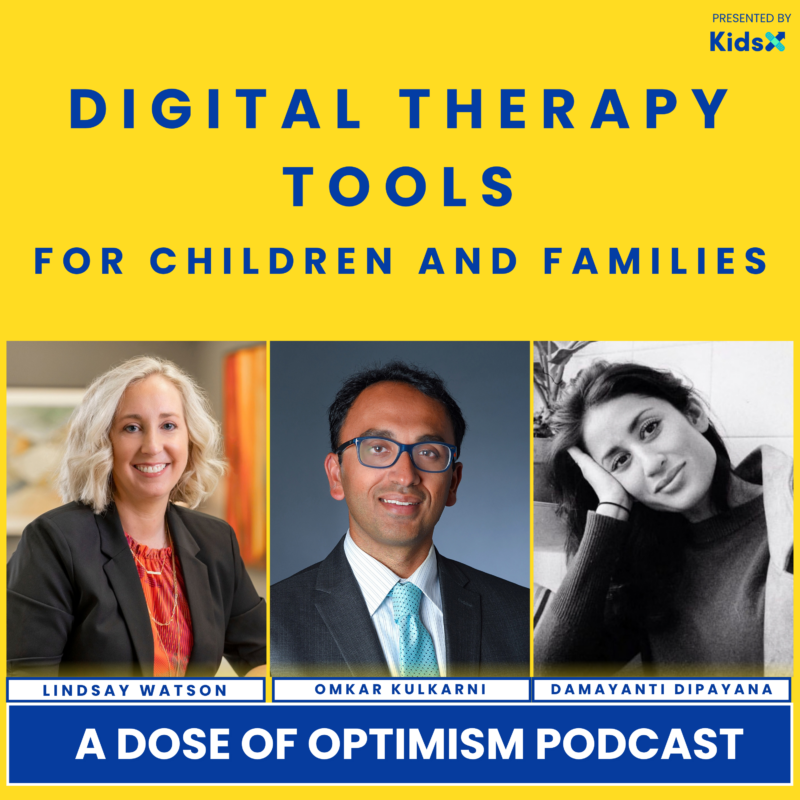
Two founders who built from the inside out, one who spent 25 years watching children disengage from therapy before deciding to do something about it, and one who looked at the data showing 93% of pediatric mental health care excludes parents and built an entire clinical model around fixing that. Different problems, but the same underlying insight: the current system isn’t built around how kids and families actually experience care. Both are doing something about it.
Body-Powered Games: Lindsay Watson and Augment Therapy
Lindsay Watson became a physical therapist and spent the next 25 years mostly in pediatric and outpatient orthopedic environments. Long before she became a founder, she was accumulating a very specific kind of frustration.
The treatment model for a child with a chronic diagnosis was predictable: bring the child to us twice a week. Here are paper handout exercises. Do them at home. The paper handouts, she notes, invariably went undone. Everyone felt like a failure. Cancellation rates were high. Dropout was common. Children who needed care for years on end were disengaging from the system that was supposed to serve them.
Her observation was direct: the technology being built for rehabilitation was built for adults. It wasn’t working in pediatric populations, and especially not in populations with chronic conditions where the therapy relationship was measured in decades, not weeks.
The idea she couldn’t stop thinking about was turning the camera around. Instead of bringing a child into a clinical environment with handheld controllers or a VR headset, she wanted to put the child on the screen, immerse them in a digital world powered by their own body movements, and make therapeutic exercises feel like a video game they were actually part of. She didn’t have a technical background. She hired her son, then twelve, to help build her first pitch deck. She created an early prototype by commissioning a video company to film what the product would look like, before any actual code existed. She pitched it. She got enough funding to bring in her co-founder. They started building.
What Augment Therapy has become is the true expression of that original video: a mixed-reality platform where children embody characters, complete therapeutic exercises through body-powered movement, and don’t notice the therapy because they’re too busy playing. The platform includes recognizable characters, Elmo, Cookie Monster, and the evidence for why that matters has come from the field. Watson describes children admitted for sickle cell pain crisis, immobilized by pain, who would not get out of bed, until a therapist offered them the chance to embody Cookie Monster and help him find cookies. They got out of bed.
The research has followed. Augment Therapy has been published in peer-reviewed journals and presented at conferences, proving efficacy not just in pediatric populations but across adult populations with neurological and chronic conditions. The engagement data makes the case for why this matters commercially as well as clinically: 20% of patients on therapy wait lists never make it to a first appointment, 30% drop out within three visits, cancellation and no-show rates hover around 30%, and only 30% of patients adhere to exercise programs. Engagement is the problem everywhere in this population, and it is a problem with a financial dimension: every disengaged patient is a billing loss for a clinic and an outcome failure for a payer.
The business remains challenging to build. Medicaid funding shifts affect the entire ecosystem. Reimbursement structures create misaligned incentives that work against faster, better outcomes. Getting evidence-based technology through procurement processes in health systems that require extensive proof of efficacy takes time and persistence. But the door, she says, is a little easier to open than it was. The evidence is there. The stories from patients and parents are there. The work of getting it into the hands of the children who need it continues.
The Whole-Family Model: Damayanti Dipayana and Manatee
Damayanti Dipayana is a repeat founder with 15 years in startups, three children, and a clear-eyed view of what the pediatric mental health system gets wrong. Her company, Manatee, is built around a simple clinical truth that the system has systematically failed to operationalize: when you include parents in a child’s mental health care, kids get better.
The statistic she leads with is striking. 93% of pediatric therapy treats the child in isolation, the parent is excluded, waiting in a lobby, handed a handout at the end of the session. The evidence that this produces poor outcomes is not new. The reason it persists, she argues, is operational: it is genuinely hard to coordinate care across an entire family, to figure out who needs to be involved when, and to build a platform that holds all of it together. That is what Manatee has built.
The care model is structured: 12-week care plans, assessments of the full family every four weeks, parent sessions every four weeks, and full family sessions every six weeks, pre-built and coordinated through a technology platform that wraps around every caregiver in the family. The outcomes data reflects it: families at Manatee complete four times as many sessions as in traditional care, and 87% of children show improved symptoms at discharge.
The primary pathway into Manatee is through a child’s presenting problem, typically what she calls the three A’s: anxiety, anger, and attention. The sweet spot is eight to twelve years old, the age when social relationships, academic performance, and external evaluation of behavior all converge for the first time. Pediatrician referrals are a major source of patients, and the referral design matters enormously. Her observation about activation: the moment you put the burden on the parent or the pediatrician, it doesn’t happen. Manatee’s QR code referral routes directly to a care coordinator via text message, the family doesn’t fill out a form or navigate a website. The line of communication opens the moment the QR code is scanned.
When parents are asked to be part of care, she is careful about framing. The model isn’t that you need help, it’s that we want to help you be the best parent you can be. Every parent says yes to that. For 10 to 20% of the population, individual parent care is eventually pulled out of the family model and pursued separately, often at the parent’s own initiative once they recognize their role in the family dynamic.
On working with health plans, she is direct about what she has learned. Positioning Manatee as a partner in solving the payer’s problems, fraud, waste, and abuse in ABA services, high-cost at-risk populations, gaps in parent behavior therapy referrals, has driven collaborative contracting. Standing her ground on rates, including closing panels and declining to sign contracts with inadequate reimbursement, has driven better outcomes in negotiation. She did not do the latter early enough and is clear that getting in network at any rate does not lead to renegotiation.
On AI: she sees the administrative layer of healthcare as the first and most impactful area for AI deployment. Manatee has invested in AI for eligibility checks, scheduling, coordination, and AI fax agents that read incoming referral faxes, enter the information into the EHR, and trigger automated outreach without a human in the loop. For clinical AI, she is more deliberate: therapy is relationship-based, and the human element is non-negotiable, especially with children. What she is building toward in Q1 is a clinical copilot for supervisors, AI that surfaces trends, flags patterns across case notes, and gives clinicians insights that would otherwise require reading every note by hand.
Key Topics Discussed:
- How chronic pediatric diagnoses create years-long therapy journeys, and why engagement fails those families
- Turning therapeutic exercises into body-powered mixed-reality gameplay with Augment Therapy
- Building evidence: from prototype to peer-reviewed research
- Why 93% of pediatric mental health care excludes parents, and what Manatee does instead
- Whole-family structured care plans: the clinical model and the outcomes behind it
- AI in administrative healthcare: eligibility, faxes, and what’s coming next in clinical copilot tools
About Lindsay Watson:
Physical therapist for over 25 years working in outpatient orthopedics and pediatric environments; turned tech entrepreneur with a passion to drive change in the rehab industry by integrating innovation and immersive technology into treatment. Co-Founder/CEO of Augment Therapy Inc, a company which combines the best of augmented reality,telehealth, and remote monitoring to improve the delivery of physical therapy. She has led her company to win many awards, participate in multiple tech accelerators, and receive recognition such as “Most Promising Startup” and “A Company to Watch,” by Inc. Magazine. In 2019, she was named one of Cleveland’s Notable Women of Technology. She is passionate about driving change in the healthcare and physical therapy industry by automating more precise data collection, making therapy more widely accessible, and better engaging for today’s tech savvy patients.
About Damayanti Dipayana:
I’m the CEO and founder of Manatee: the operating system for family mental health.
The problem: 93% of pediatric therapy excludes parents. Kids get treated in isolation, outcomes are terrible.
Manatee is built to treat the whole family with structured care plans. Families complete 4x sessions vs in traditional care and our outcomes at discharge are 3x better (87% of children show improved symptoms).
We’re the preferred pediatric provider for the largest national health plans and pediatricians across the US refer directly to us. We do not pay for acquisition.
I’m a mom of 3. Repeat founder. 15 years in startups. LBS. Raised $86M from VCs in my life.
