
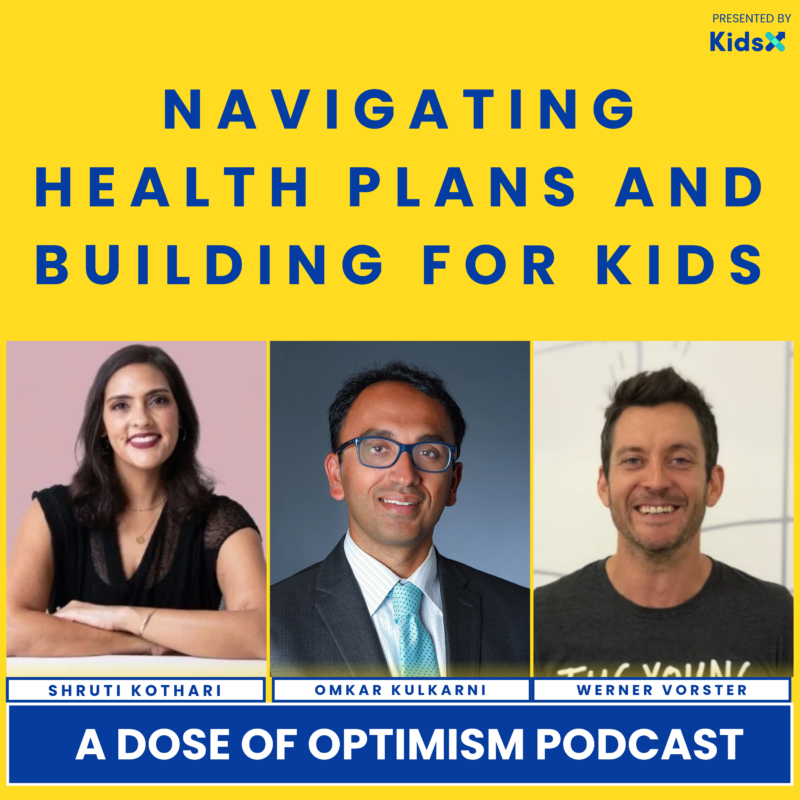
This week’s episode brings together two innovators solving very different problems in pediatric healthcare: one navigating the payer ecosystem, one building hardware for the smallest and most vulnerable patients. Together, they paint a picture of just how demanding it is to build for children, and how much more complex the path to adoption becomes when the patient population is kids.
Navigating Health Plans: Shruti Kothari
Shruti Kothari opens with a statement worth writing down: a solution can be clinically compelling and still fail to get adopted.
The reason, she argues, is not that health plans don’t care about outcomes. It’s that outcomes alone are not the unit of decision-making. The real questions are: what specific problem is this plan trying to solve right now? Who inside the organization is accountable for it? And who actually owns the budget to act on it? A solution that maps to great evidence but lands in a department without operational accountability and multi-year funding will not move.
Her fertility coverage example makes this concrete. Coverage expanded not because plans decided it was clinically important, it expanded because employers started pushing for it as a recruitment and retention benefit. The driving force was the employer-plan relationship, not the member-plan relationship. Understanding who the actual client is, who bears the risk, and who captures the savings changes every conversation a startup should be having.
On the pediatric space specifically, she points to specialty care access, behavioral health, and care coordination for kids with complex needs as areas where plans are actively looking for solutions. But she immediately adds: not all plans are the same. Southern California looks different from Northern California. What a Medicaid plan is solving for in one state may be entirely different from a commercial carrier in the same state. Knowing where a plan is bleeding, and where they’ve already tried to innovate but gaps remain, is the work that comes before the pitch.
Finding the Right Front Door
The most actionable section of Shruti’s conversation is her breakdown of how startups should approach navigating internal health plan structure, and why getting this wrong is as costly as a weak pitch.
Her candid assessment: there is no magic title. There is no single department that is the right entry point across all plans. This is the bad news. The good news, she says, is that it’s not a black box, it just requires work most companies aren’t doing.
She uses Kaiser Permanente as her central example, and her advice is pointed: she actively tells companies to steer away from KP as a first client. KP is a layered organization, national, regional, medical group, health plan, operating teams, innovation teams, and getting a pilot started in a department that can’t actually scale the innovation wastes resources and can crush a startup. The goal isn’t to get a pilot anywhere, it’s to land in a department with budget, operational accountability, and the mandate to scale what works.
Her framework: follow the money, and follow the accountability. In every early conversation, ask whether the person you’re talking to has a budget, not just team resources, but actual funding committed to solving this problem. Ask who all the decision makers are. Ask who would assess whether a pilot succeeds, and pay attention to whether those people are in the room early.
The Scale Problem
One of the most important practical warnings in this episode is about scale. Health plans cover tens of thousands, sometimes hundreds of thousands, of lives. When a plan becomes interesting, the natural next question is whether a startup can cover the whole population. Both Shruti and Omkar name what they’ve seen: companies that say yes when they shouldn’t, overextend, and crash. The honest answer, “we’re not at that stage yet, but here’s what we can do”, is harder to give in the moment but far less costly later.
Building Vitls: Werner Vorster
Werner Vorster’s origin story is personal. His eldest son had febrile seizures as a baby, triggered by fast-rising or high temperature. When he and his wife went looking for a wearable they could use to monitor their son safely at night, nothing existed that would actually work for a small child. So he built one.
What started as a temperature and heart rate monitor has expanded over the last decade into a five-vital-sign wearable patch, body temperature, respiration, pulse rate, SpO2, and now blood pressure, FDA-cleared for use in pediatric patients and designed specifically for them.
Building for Children, Not Shrinking Adults
Werner describes the core principle of pediatric device development: you cannot reason with a sick child. A device that irritates a baby will be pulled off. It has to disappear from the child’s awareness, built around them, not built for adults and reduced in size.
The adhesive alone took extensive testing. Newborn and premature infant skin is highly sensitive, and finding an adhesive that would hold reliably without causing irritation required testing through what Werner estimates was close to a hundred options before finding one that worked. The product now in use has had no adhesive-related skin sensitivity issues, but the path to get there was long and resource-intensive.
The FDA Clearance Path for Pediatric Devices
Vitls received its first FDA clearance using optics, and critically, it was cleared for ages two and up. Werner notes that ECG-based devices, by contrast, often are not cleared for use under 18 at all, making Vitls a rare option in its category for pediatric patients.
Adding blood pressure as the fifth vital sign requires a new clinical study, 85 subjects across defined age ranges, three visits per subject over seven days. That is a capital-intensive study, and for a startup that is not generating revenue while running it, time and money are the two scarcest resources.
The Reimbursement Catch-22
The hardest structural challenge Werner describes is the data-reimbursement loop. To get reimbursement approved for pediatric remote monitoring, you need a large clinical data set. To collect that data, you need hospital partners willing to run the studies, and the required sample size is not ten or twenty patients, but hundreds. Multi-site trials across multiple geographies are necessary because the volume of eligible pediatric patients at any single site is limited. For a startup, that is a significant undertaking, and one that is fundamentally more demanding in pediatrics than in adults.
Key Topics Discussed:
- Why clinical outcomes alone aren’t sufficient for health plan adoption
- How health plan incentives work, and the employer’s outsized role in driving change
- How plans think about pediatric and maternal populations, and where the gaps are
- Finding the right internal front door, and why there is no magic title
- Why scaling too fast is how startups crash when working with health plans
- Building a medical device for children versus shrinking an adult product
- The adhesive challenge: why pediatric skin sensitivity shaped Vitls’ entire development
- FDA clearance in pediatrics, and why Vitls is cleared where ECG devices often aren’t
- The reimbursement catch-22: needing data to get funded, and needing partners to get data
About Shruti Kothari:
I’m a health care transformation and community engagement leader with more than 15 years of cross-sector experience spanning health plans, health systems, startups, venture, and public affairs. I help organizations turn insight into execution by building coalitions and strategic partnerships, translating local and stakeholder needs into enterprise action, and designing high-impact programs that advance care transformation, policy, and growth.
About Werner Vorster:
I’m the co-founder and CEO of Vitls, where we’ve developed the only clinical wearable to incorporate the 5 vital signs needed to assess a patient. Tégo is an unobtrusive patch that monitors core temp, SpO2, respiration, heart rate and blood pressure.
