
When a child is admitted to a hospital, so much of what happens to them is out of their control. Doctors come and go. Medications arrive on a schedule. Procedures happen whether the child wants them or not.
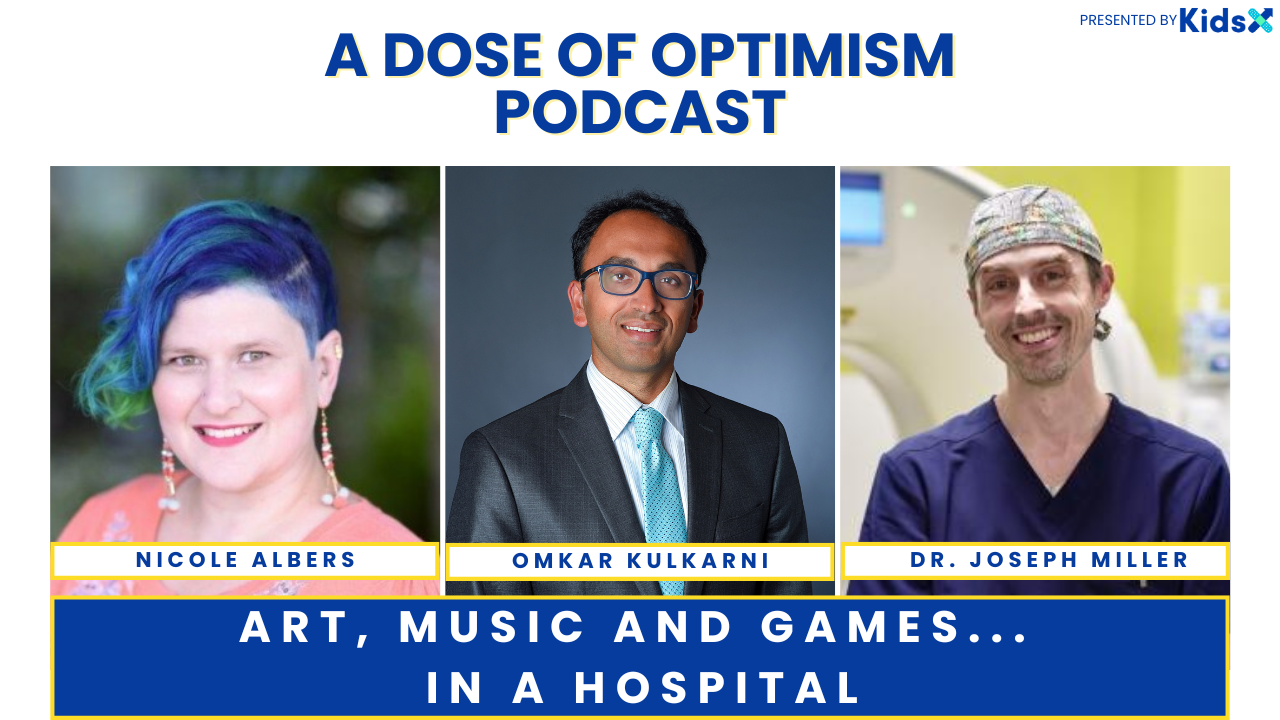
In this episode, two practitioners at Children’s Hospital Los Angeles share how creativity, in the form of art therapy, music therapy, and virtual reality, is being used to give children back a measure of agency, reduce anxiety, and make the hospital experience more human.
Power, Control, and the Whole Child: Nicole Albers on Art and Music Therapy
Nicole Albers has been an art therapist at Children’s Hospital Los Angeles for 14 years. She leads the Mark Taper – Johnny Mercer Artists Program, overseeing a team that uses art, music, dance, and drama to support patients across the hospital, from the tiniest babies in the NICU to teenagers navigating eating disorder treatment.
The through-line, she says, is simple: in a hospital, children lose control over almost everything. Art therapy gives it back.
It might look like choosing between white paper or colored paper. Markers or colored pencils. Those small decisions add up. And for a child who has had no say in their treatment, medication schedule, or which doctors walk into their room, that accumulation of micro-choices matters.
The work takes many forms. For younger children, it often lives in metaphor, a narrative therapy session where a child who can’t say “I’m afraid” can tell a story about a tiny mouse who’s afraid of being squished. The feelings get processed through the story, without the vulnerability of having to name them directly. For teenagers, it looks different: collage, affirmation work, the creation of a guiding quote for a hospital stay. For adolescents in eating disorder treatment, Nicole leads an art group alongside a psych social worker, meditations about rooting and strength, visual explorations of identity and resilience.
Music therapy runs alongside it. CHLA’s music therapists work in the NICU, where specialized training allows them to read overstimulation cues in premature babies and apply music in ways that support calm and restorative sleep. One music therapist, Sarah, asks parents to share their Spotify playlists, and creates custom lullabies from whatever she finds there. Drake. The Weeknd. Guns N’ Roses. The playlist doesn’t matter. The connection does.
For older patients, the music therapists work on mood vectoring, the idea of starting in the emotional state you’re in and creating a playlist that gradually moves you toward where you want to be. And throughout, they can watch it work in real time: heart rate and oxygen levels visible on the monitor, changing in response to the music.
Nicole’s vision extends to families too. She describes parents sitting beside their children, doom-scrolling through worry, disconnected from the child lying in the bed. She invites them to the bedside. They draw together. Families who have never made art together find themselves doing it in a hospital room, and sometimes, for the first time in weeks, a parent gets to see their child just being themselves again.
VR in the Procedure Room: Dr. Joseph Miller on Virtual Reality at CHLA
Dr. Joseph Miller is an interventional radiologist, a specialist who uses ultrasound, X-ray, and CT guidance to perform minimally invasive procedures that would traditionally have required surgery. In adult patients, many of these procedures are done awake or with light sedation. In children, that’s rarely an option. The anxiety is too high, the cooperation too uncertain.
The result: procedures that take five or ten minutes of a radiologist’s time require a full anesthesia team, 60 to 90 minutes of resource consumption, and all the risk and recovery that comes with general anesthesia, including fasting for 12 hours beforehand. VR changed that calculation for a specific set of cases.
Dr. Miller and his team began identifying procedures where VR could plausibly replace the need for anesthesia, starting with thyroid biopsies, which use a very fine needle and are uncomfortable but not typically painful, and expanding to lumbar punctures and other similar procedures. Patients are identified in advance, offered the option, and given the choice between the traditional anesthesia pathway and the VR-supported awake approach.
As the program has grown, so have the indications. Dr. Miller now treats patients in their early twenties, patients who have aged out of the hospital’s pediatric anesthesia protocols, using VR to manage anxiety and discomfort during injection sclerotherapy for vascular anomalies. Without VR, he would have had to transfer them to adult facilities. With it, he can continue providing the specialized care they need.
The broader implication is a more efficient procedural pipeline: more patients seen, less anesthesia resource consumed, and a patient experience designed around comfort rather than sedation.
Key Topics Discussed:
- Art therapy as a tool for restoring agency and control in hospitalized children
- Narrative therapy and the use of metaphor with younger patients
- Music therapy in the NICU: lullabies, overstimulation, and restorative sleep
- Mood vectoring and playlist-based music therapy for older patients
- Real-time biometric feedback during music therapy sessions
- Family-centered art and music therapy at the bedside
- Virtual reality as an alternative to general anesthesia for specific procedures
- Procedural resource constraints in pediatric interventional radiology
- Expanding VR indications: from thyroid biopsies to vascular anomaly treatment
- Treating young adults who have aged out of pediatric anesthesia protocols
- The whole-child approach to pediatric hospital care
About Nicole Albers:
Nicole Albers is a licensed Marriage and Family Therapist (LMFT) and Board Certified Art Therapist who serves as the Team Lead for the Mark Taper – Johnny Mercer Artists Program at Children’s Hospital Los Angeles (CHLA). She leads a therapeutic program that utilizes art, music, dance, and drama to support patient healing, reduce stress, and improve coping skills.
About Dr. Joseph Miller:
Joseph Miller, MD MS, is an Interventional Radiologist at Children’s Hospital Los Angeles. Dr. Miller graduated from the University of California at Riverside, completing his Bachelor of Science in Biological Sciences in 2004 and a Master of Science in Biochemistry and Molecular Biology in 2005. He attended the Chicago Medical School at Rosalind Franklin University of Medicine and Science, graduating in 2010 with both his Doctor of Medicine and a Master of Science in Healthcare Administration and Management.
Dr. Miller completed his internship in Surgery and his residency in Diagnostic Radiology at Cedars-Sinai Medical Center. He then completed his fellowship in Interventional Radiology at the University of Colorado at Denver, where he focused much of his time on the treatment of vascular malformations, particularly arteriovenous malformations (AVMs).
