
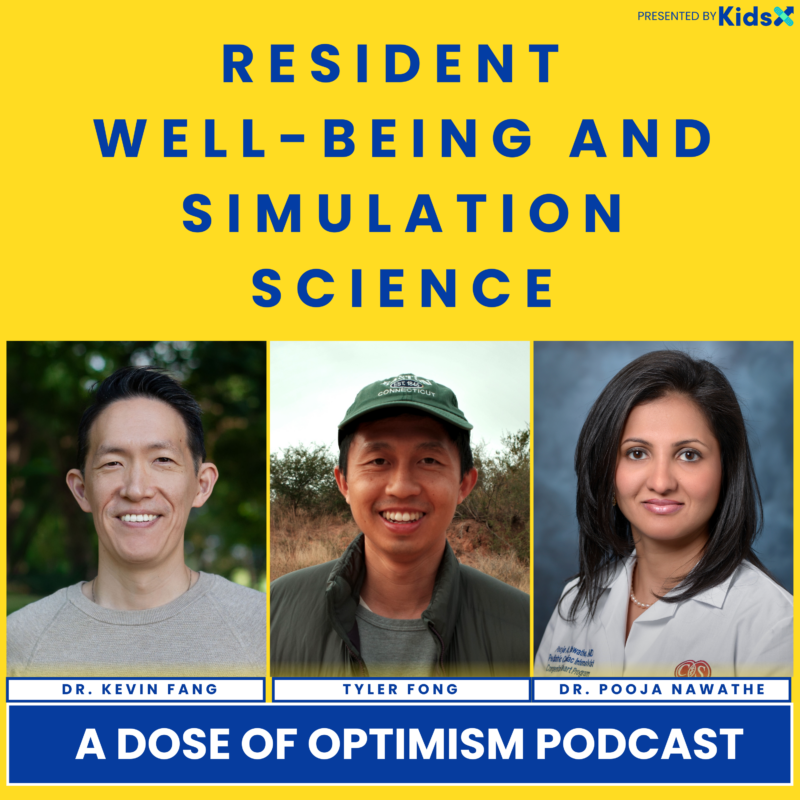
This week’s episode brings together three innovators working on very different parts of the same challenge: building better systems for the people who train, care for, and protect pediatric patients. One team built scheduling software to reduce the administrative burden on residency programs, and discovered they were also building a well-being tool. One physician is using simulation not just to train clinicians, but to redesign the systems they work in.
Oso Schedule: Kevin Fang and Tyler Fong
Pediatric residency is three years of some of the most demanding work in medicine. Long hours, emotional weight, caring for the sickest children at a quaternary center, and all of it happening while residents are also learning. Dr. Kevin Fang, who co-directs the IMPACT Advocacy Track at CHLA, describes it plainly: residency is a perfect storm.
One piece of that storm has historically been invisible in plain sight: the schedule. At CHLA, over 100 residents cycle through 13 rotation types each year, with each four-week block open to a wide range of ordering preferences. Factor in year-specific requirements, individual requests, and the unique constraints of a complex hospital system, and the number of possible schedule permutations runs into the billions, or potentially more. For years, a chief resident would spend two to three weeks doing nothing but trying to build the optimal schedule by hand, parsing free-text survey responses and moving blocks around a spreadsheet.
Tyler Fong saw this problem through his wife, who went through both residency and a chief resident year at CHLA. As a software engineer, the math was immediately obvious to him: someone reviewing 700-plus free-form requests and trying to create a schedule that satisfies as many as possible, by hand, cannot possibly do so efficiently. He reached out to the residency program office. Kevin’s reaction: “You had me at hello.”
What followed was a close collaboration between an engineer and a physician leader, meeting every few weeks to map the problem, understand the constraints, and design something that could actually handle the complexity. The result is Oso Schedule, now used by multiple institutions across different scheduling models, including CHLA’s block schedule and the X-plus-Y scheduling model used elsewhere.
More Than an Administrative Tool
The insight that has surprised both founders is how much the product has turned out to be about well-being, not just efficiency.
Tyler points out that resident preferences are far more nuanced than vacation requests. A third-year trying to match into a fellowship wants their fellowship rotation early so they can secure a letter of recommendation before interviews begin. Someone coming off a difficult rotation doesn’t want another hard one immediately after. People want to work with their friends. These preferences matter, and when they’re systematically surfaced and honored, the impact is measurable.
In CHLA’s first year using Oso, they saw a meaningful reduction in resident callouts. Kevin is careful to note that many factors affect callout rates year to year. But the logic holds: residents who get schedules that reflect their real lives, that account for a friend’s wedding, a family vacation, a preference for not being stretched across back-to-back grueling months, are residents who show up. And residents who show up mean better continuity of care, which means better outcomes for patients.
As Dr. Fang puts it: resident well-being means different things to different people. It’s not ice cream socials. It’s having a schedule that lets you live your life while doing one of the hardest jobs in medicine.
Medical Simulation: Dr. Pooja Nawathe
Dr. Pooja Nawathe‘s work at Cedars-Sinai Guerin Children’s starts with a premise that most people outside simulation don’t realize: the learning doesn’t happen in the simulation itself. It happens in the debrief after. And the most valuable thing that debrief can surface isn’t what an individual did wrong, it’s where the system failed.
Her work spans a wide range of applications, but a consistent thread runs through all of it: simulation as a tool for identifying and closing system gaps before they reach patients.
The ERTS Framework
One of her most distinctive contributions is the ERTS framework (Event Reporting Translated to Simulation) developed with human factors scientist Dr. Tara Cohen at Cedars-Sinai. The idea is to take adverse event reports from the hospital’s safety reporting system, apply human factors analysis, and design simulation scenarios that recreate the conditions in which those events occurred. Then, critically, bring back the clinicians who filed those reports to participate in the simulations and problem-solve alongside the stakeholders who can actually fix the underlying system issues.
The goal is to close a loop that most reporting systems leave open. People file safety reports and rarely hear what happens to them. ERTS makes the simulation the feedback mechanism, and in doing so, moves the work from reactive problem-solving to proactive hazard identification: finding latent safety threats in the simulation environment before they reach a patient.
Preparedness at Scale
Dr. Nawathe’s simulation work has expanded well beyond the walls of Cedars-Sinai. She contributed to the PEAK 2 multi-site study, led by Children’s Hospital of Philadelphia, on tracheostomy emergency preparedness across pediatric intensive care units, work that led to new process improvement protocols and made tracheostomy emergency response an annual competency requirement at participating institutions.
She also helped plan a 500-person tabletop exercise for World Cup preparedness in Los Angeles County, a six-month planning effort involving federal partners and regional centers. A pediatric-focused tabletop is coming in January 2026, jointly led by NTEC and the Pediatric Prevention Network (PPN).
CPR Research and Training Gaps
One of her most striking recent studies used a crossover randomized design to test CPR performance on female versus flat-chested mannequins. The finding: performance differed based not just on mannequin type but on the order of exposure. Since ACLS training almost universally uses flat-chested mannequins, providers may be reaching clinical environments without ever having practiced on a female mannequin. Her work is building the case for guidelines that specify how many female mannequins should be included in standard training programs.
In arguably the most niche study featured in this episode, her team used simulation to determine whether CPR is even feasible during a viral hemorrhagic fever scenario — with providers in full PPE, inside a biocontainment unit. The answer: yes, with two ICU nurses and a physician. The work won the FIRES Award at the International Meeting on Simulation in Healthcare, and remains the only published CPR paper conducted in a simulation setting for viral hemorrhagic fever.
The question that launched the study is worth sitting with. At her first summit with the special pathogens response network, Dr. Nawathe asked why CPR wasn’t on the institution scorecard for biocontainment readiness. The answer: nobody knew if it could be done. So she went and found out.
Key Topics Discussed:
- Why pediatric residency scheduling creates billions of permutations, and what it cost to solve manually
- How a physician-engineer partnership built Oso Schedule and what it has meant for resident well-being
- Why better scheduling leads to fewer callouts and better continuity of care
- Simulation as a system improvement tool, not just a training tool
- The ERTS framework: closing the loop between adverse event reporting and practice change
- CPR performance and female mannequins: what training programs may be missing
- Pediatric preparedness in special pathogen scenarios, tabletop, PPE, and biocontainment
- Moving from retroactive to proactive patient safety through simulation
About Dr. Kevin Fang:
Kevin Fang, MD, MPH, is a general pediatrician and the co-director of the IMPACT track for the Pediatric Residency Program. He also leads the Community Pediatrics and Mental Health curricula for the Residency Program.
Prior to medical school, Dr. Fang taught high school biology through Teach For America. This experience shaped his interests in community advocacy and school health. During medical school at Case Western Reserve University, he founded Horizons – a program that connected local public high school students with undergraduate and medical student mentors in order to learn about public health topics such as diabetes, sexually transmitted diseases and substance abuse. For this work, he received the 2013 United States Public Health Service award in Excellence in Public Health.
Dr. Fang completed his pediatric internship and residency at Children’s Hospital Los Angeles and then a fellowship in Community Medicine through Kaiser Permanente Los Angeles Medical Center. He joined the faculty of the Division of General Pediatrics in 2017, where he continues to work on projects encouraging collaboration between school systems and health systems. He is currently co-chair of the School Health Special Interest Group for the Academic Pediatric Association.
He is also a co-director of the IMPACT Advocacy Track at CHLA and co-founder of Oso Schedule.
About Tyler Fong:
Tyler is a Senior Engineer at Spotify and Co-Founder at Oso Schedule.
About Dr. Pooja Nawathe:
Dr. Pooja Nawathe is a Professor of Pediatrics, Cardiology and Computational Biomedicine, Assistant Director of Healthcare Simulation at Guerin Children’s, and Associate Director, Pediatric Intensive Care Unit at Cedars-Sinai Health Sciences University.
