
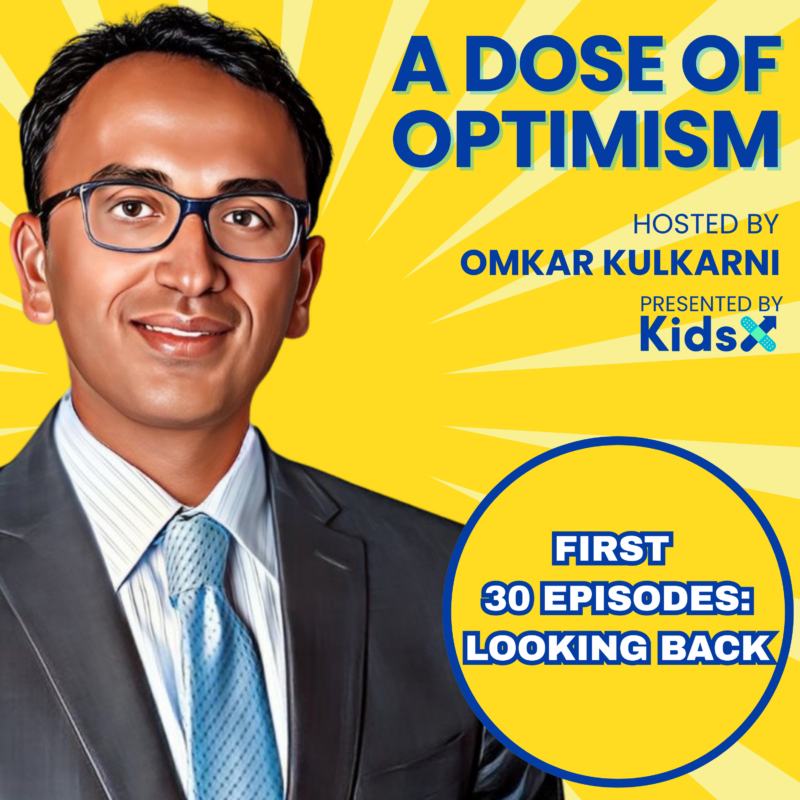
Thirty episodes is a milestone worth pausing for.
Over the first thirty conversations on A Dose of Optimism, Omkar Kulkarni has gathered an extraordinary collection of perspectives from the people working hardest to improve healthcare for children. This special episode brings together the moments that stayed with him longest, not just the most memorable quotes, but the ideas that continued to reverberate after the recording ended.
Here, briefly, is what those guests said.
Dr. Bimal Desai is asking the questions that come after the vision. His hope is a blended model, a little inpatient, a little outpatient, something in between, where remote patient monitoring follows medically complex children across the continuum of care rather than waiting for them to return to the hospital. He has seen it work. Other divisions are taking notice. Now come the adult-sized questions: how many nurses, what technology layer, who pays for it. The ones that separate a promising pilot from a program that actually scales.
Dr. Solfrid Raknes described children in conflict zones playing a digital mental health game called Magic Midnights, and what those children said about it. It’s a school break, they told her. A break from the war. That sentence, as much as any outcome data, captures what it means to give a child even a moment of relief in an impossible situation.
Andrew Post brought the numbers. Schools as a hub for children’s healthcare is an idea that sounds obvious in retrospect, but the data behind it is striking. Up to 11 fewer days of school absences following services. In one study, 41 to 44% of children who received services midway through the school year didn’t miss a single day for the rest of the year. And nearly $2,800 per year per child in reduced healthcare costs, a figure that makes the value of early, accessible intervention impossible to dismiss.
Dr. Sucheta Joshi is watching gene therapy arrive at the door of pediatric epilepsy. Not FDA-approved yet, but close, with clinical trials advancing. The shift she describes is profound: from treating seizures as symptoms to treating the underlying cellular, molecular, and biochemical mechanisms that cause epilepsy. For some children, that may mean disease modification, treatments that change not just seizure control, but development and quality of life.
John Brownstein is focused on what comes after the documentation wave in healthcare AI. The low-hanging fruit has been picked. What excites him now is the patient-facing opportunity: AI that helps families prepare for their healthcare journeys, navigate their records, understand their options, and take more control over their own health. Discharge notes in 120 languages. That’s just the beginning.
Carla Small made a case that stops you cold: 98% of the children in the United States who need high-dose, high-quality reading support are not getting it. The tutoring that works costs $150 an hour in cities like Boston. AI tutoring, adaptive, personalized, game-like, and available every day, is the most promising solution to that gap that has ever existed. It knows what a child knows, how long their attention span is, and whether they’re frustrated. It adjusts accordingly. And it’s there every day, which is what children who are two grade levels behind in reading actually need.
Dr. Jonathan Santoro is thinking about prevention. Not treating neurological disease after it happens, preventing it from happening at all. Genetics, family risk scores, transcranial doppler screening for stroke risk, early identification of who is at risk for what. Personalized medicine has delivered precision therapies in oncology. He believes the next application is prophylaxis: you take this for three years and you never develop this tumor. You never develop this neurological disease. That future, he believes, is closer than most people think.
David Feinberg closed with something simple and worth holding onto: he is wildly optimistic, by his own admission, possibly a character flaw, about a future where technology helps us care for more people at higher quality and lower cost. He believes we can get there.
Thirty episodes in, so does this podcast.
Key Topics Discussed:
- Pediatrics as the clearest mission in healthcare
- Mental health support for children in conflict zones
- Schools as hubs for health access and cost reduction
- Gene therapy and the coming shift in pediatric epilepsy treatment
- AI beyond documentation: patient-facing equity and access
- The reading crisis and AI tutoring as a democratizing force
- Preventive neurology and personalized medicine
- Sustained optimism as a professional and personal orientation
