
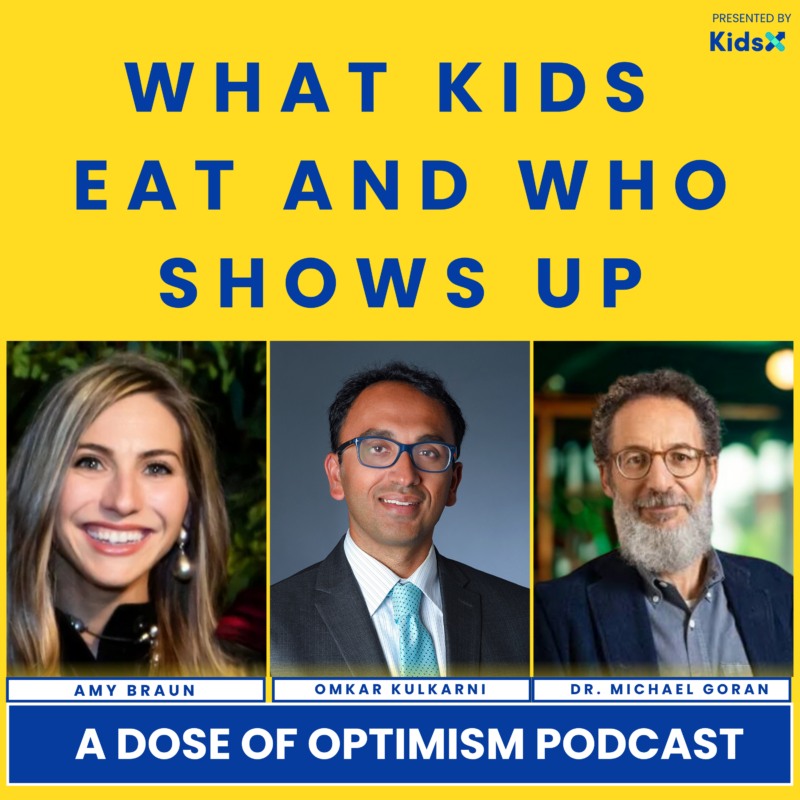
Two conversations. Two different lenses on the same underlying question: what does a child need to grow up healthy, and what is the current environment failing to provide?
The Near Peer: Amy Braun on HealthCorps
Amy Braun has a simple argument: the most powerful force for health behavior change in a teenager is not a doctor, not a parent, and not an app. It’s someone a little older than them who showed up.
HealthCorps is a national nonprofit operating in over 300 schools across 12 states. The model deploys college-age mentors, many of them pre-health students, into middle and high schools to facilitate health and wellness programming. The clubs meet at lunch, in classrooms, wherever there’s time and space. The curriculum covers mental health, physical health, and community health. And the mechanism for change is peer-to-peer: college students mentor high schoolers, high schoolers mentor each other, and the content is spread through the school not by a teacher from the front of the room, but by students who’ve taken ownership of it.
The outcome data is striking. 84% of HealthCorps students make at least one measurable health behavior change, drinking more water, reducing sugar intake, exercising more. Students in the program are 50% less likely to experience poor mental health days than their national peers. And 73% are more likely to connect with a trusted adult on campus, a metric that correlates with staying in school and graduating.
Those numbers come from over 3,000 surveys collected in a single school year. Amy is direct about data: if you’re going to spend time with young people, you’d better be able to prove it matters.
The college mentors benefit too. Their own health improves as their knowledge deepens. Their sense of purpose and confidence grows. And many of them will become the physicians, nurses, and allied health professionals of the next generation, people who have already absorbed, through practice, the upstream preventive perspective that clinical training often doesn’t teach.
At the heart of it, Amy argues, is something that predates any program, any technology, and any innovation: the human drive to be seen, to feel valued, and to have someone show up. The origin of the word “mentor” comes from Homer’s Odyssey, a character who guides a young person while their parent is away. The concept is thousands of years old. HealthCorps is applying it with data, structure, and scale.
What Children Are Eating and What It’s Doing to Their Brains: Dr. Michael Goran
60% of the calories that children consume in the United States come from ultra-processed foods.
That figure alone is striking. But Dr. Michael Goran’s most recent research goes further: a birth cohort study following several hundred children from birth to age six found significant associations between cumulative ultra-processed food consumption and smaller volumes in specific regions of the brain at six years of age.
The NOVA classification that Dr. Goran defines ultra-processed foods simply: if there is an ingredient in the food that you wouldn’t find in your kitchen, a preservative, an emulsifier, a sweetener, the product is likely ultra-processed. A plain yogurt is processed. A flavored yogurt with added sugars and emulsifiers is ultra-processed. Under this framework, 60% of what American children eat falls into the latter category.
The brain development finding was a chance discovery within a larger study funded to examine breastfeeding versus formula feeding and its effect on brain structure. Because the research team had carefully documented dietary records from the same children every six months, they were able to look back and analyze cumulative ultra-processed food consumption from birth through age six, then compare that against MRI brain imaging data.
What they found were significant associations between higher ultra-processed food consumption and smaller volumes in specific brain regions. Crucially, they did not find significant associations with functional measures like memory performance or cognitive ability at six years of age, suggesting the primary initial effect may be structural, and that functional consequences may emerge later. Dr. Goran is careful about the limitations: this is an association study, not an intervention trial, and causality has not been established. A major new grant to conduct a school-based intervention is now in preparation.
A second line of research is equally arresting. Over half of infant formula sold in the United States is now made with corn syrup rather than lactose, the natural sugar in breast milk. Corn syrup has a significantly higher glycemic impact. In a novel study placing continuous glucose monitors on babies at six months of age, Dr. Goran’s team found that babies consuming corn syrup-based formulas showed erratic, repeatedly spiking blood glucose levels throughout the day, in contrast to the stable blood glucose patterns seen in breastfed babies and babies consuming lactose-based formula.
On the policy front, Dr. Goran sees progress: the most recent US Dietary Guidelines recommended avoiding ultra-processed foods, the first time they have done so. Countries like Chile and Mexico have implemented food marketing restrictions and mandatory warning labels that have shown impact on consumer behavior. And school nutrition is emerging as a critical intervention point, since many children, particularly in lower-income communities, obtain most of their meals at school.
Key Topics Discussed:
- The loneliness epidemic among teenagers and the irreplaceable role of in-person human connection
- HealthCorps: near-peer mentorship model and health education in schools
- Health behavior change outcomes: 84% of students, 50% fewer poor mental health days
- College mentors as the next generation of healthcare professionals
- The evidence base for mentorship: reduced risky behavior, school retention, lifetime earnings
- Ultra-processed food definition: the NOVA classification
- 60% of children’s calories from ultra-processed foods in the United States
- Brain development study: associations between ultra-processed food consumption and brain volume at age 6
- Limitations of association studies and the need for intervention trials
- Corn syrup vs. lactose in infant formula: prevalence and blood glucose findings
- Continuous glucose monitoring in six-month-old infants
- Social determinants of diet: cost, access, and health equity
- International food policy: Chile, Mexico, Brazil as examples
- US Dietary Guidelines: first inclusion of ultra-processed food guidance
- School-based nutrition intervention and the Eat Real partnership
About Amy Braun:
As the President and CEO of HealthCorps., Amy is responsible for ensuring that 100,000+ students receive access to health and wellness education—with the goal of empowering them to live longer and healthier lives. Being fairly new to HealthCorps, Amy has experienced quite the change of operations as the company quickly pivoted from delivering their programming in-person to delivering it digitally (and tailoring the content to fit pandemic-related concerns). Despite a complete overhaul of their workforce and structure, Amy and her team conquered the challenge with open arms.
About Dr. Michael Goran:
Dr. Goran is Professor of Pediatrics and Vice Chair for Pediatric Research in the Keck School of Medicine at the University of Southern California. He is Program Director for Nutrition and Obesity at The Saban Research Institute and he holds the Dr. Robert C. and Veronica Atkins Endowed Chair in Childhood Obesity and Diabetes. Dr. Goran also serves as Co-Director of the USC Diabetes and Obesity Research Institute. Dr. Goran is a native of Glasgow, Scotland, and received his Ph.D. from the University of Manchester, UK (1986) prior to postdoctoral training in the US (1987 to 1991). He previously served on the faculty of Medicine at the University of Vermont (1991 to 1994), and the Department of Nutrition Sciences at UAB (1994 to 1999) prior to joining USC in 1999.
Dr. Goran’s research has focused on the causes and consequences of childhood obesity for 30 years. His work is focused on understanding the metabolic factors linking obesity to increased disease risk during growth and development and using this information as a basis for developing new clinical, behavioral and community approaches for prevention, treatment and risk reduction. He is also especially interested in ethnic disparities in obesity and obesity related diseases including type 2 diabetes and fatty liver disease, with a special interest on the effects of dietary sugar on obesity and metabolic diseases among Hispanic populations. His work also covers maternal-infant nutrition and identifying modifiable factors that can be targeted for interrupting the developmental programming of obesity, including bioactive elements of breastmilk and infant microbiome development. His research has been continuously funded by NIH and other Foundations for the past 25 years during which he has raised almost $50m in funding to support this work.
