
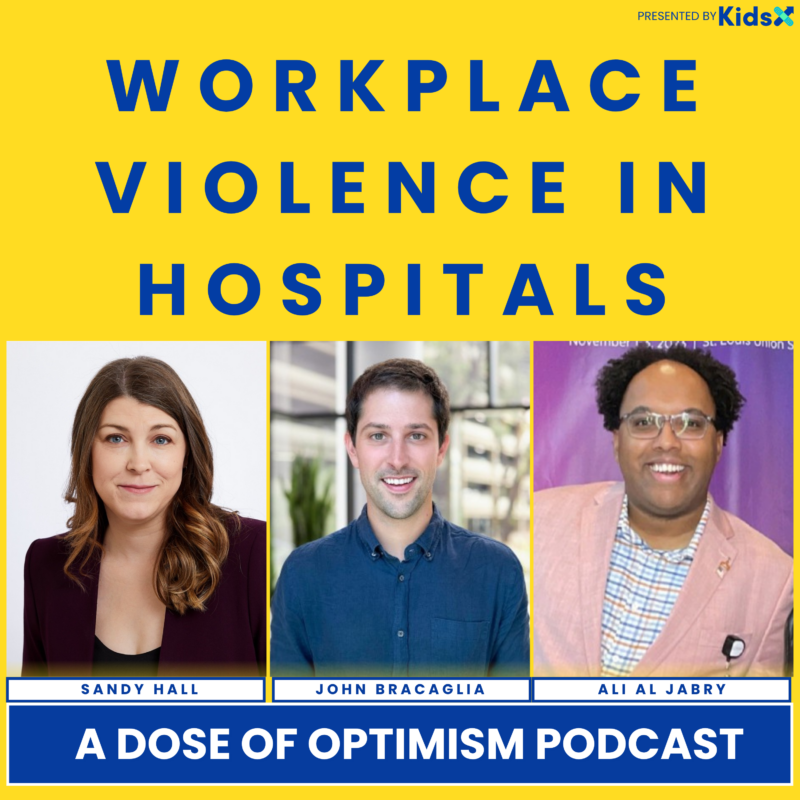
The people who take care of everyone else are not being taken care of. This episode is about what’s happening to healthcare workers, and what three different innovators are doing about it.
The Pediatric Pass: Sandy Hall on Workplace Violence in Nursing
Sandy Hall has been a nurse for 20 years. She experienced her first workplace violence incident in 2008. She hasn’t stopped thinking about it since.
The landscape she describes is layered. There is workplace violence that comes from families and visitors under extreme stress, verbal harassment, intimidation, and occasionally physical violence. Sandy is clear that she and her colleagues owe compassion to families going through what may genuinely be the worst day of their lives. But compassion does not mean accepting abuse. And increasingly, she is seeing family members who don’t just behave badly, but insist on their right to do so.
Then there is a second category, specific to pediatric settings, that is more complex and more frequently underreported: physical injury from patients who cannot control their behavior. Children who are neurodivergent, who have traumatic brain injuries, who are experiencing a behavioral health crisis. A nurse gets kicked in the stomach, spat on, bitten, hit hard enough to be concussed, and because the child didn’t mean to do it, it doesn’t get reported. Sandy calls it the “pediatric pass,” and it’s pervasive.
The data tells the broader story: 76% of healthcare workers think about their safety daily. 85% have experienced some form of workplace violence. At least one in three have left or are considering leaving the profession.
What isn’t being measured well, Sandy argues, is the psychological aftermath, the PTSD, the compassion fatigue, the leaves of absence that don’t show up in DART (days away, restricted, and transferred) statistics. Healthcare organizations are good at counting physical injuries. They are not yet good at counting what happens to a person’s mental health after years of absorbing this.
Her prescription is multidisciplinary and proactive: safety huddles before situations escalate, consistent messaging across care teams so families can’t play different staff members against each other, and an honest conversation about what behaviors will and will not be tolerated. She is also direct about the behavioral health patient population: de-escalation training is essential, but it is not enough for patients who cannot respond to it. The right supplementary team members, with the right specialized training, need to be part of the care model.
Help for the Helpers: John Bracaglia on Marvin
John Bracaglia is trying to solve a $70 billion problem: the healthcare workforce crisis driven by burnout, turnover, and a near-total absence of mental health support specifically designed for people who spend their careers supporting others.
Burnout rates among nurses hover above 50%. Among nurses in their first year, turnover can reach 30%. By year two, it approaches 60%. And most of those leaving are doing so in the absence of adequate support, from their employer and from a mental health system that isn’t designed to understand them.
Marvin’s model is built on a few key design decisions. First, the counselors, who are all fully licensed therapists, have an average of 15 or more years of experience and have typically spent significant time working with or within healthcare systems. When a nurse sits down with a Marvin counselor, they don’t have to explain what a PICU is, or what compassion fatigue feels like, or why losing a patient is different from losing a client. The counselor already knows.
Second, Marvin has worked hard on the language of access. The company uses the word “counseling,” not “therapy.” It never says “depression” or “anxiety”, only “stress,” which carries significantly less stigma. And its flagship access mechanism is an opt-out model: during Well-Being Week, a free 30-minute session is placed on every healthcare worker’s calendar. They don’t have to book it, identify themselves as struggling, or overcome the friction of asking for help. They just have to not cancel.
The outcome data is striking: among nurses who engage with Marvin’s care model, retention reaches 94.5%, compared to a national baseline of approximately 79%. Individual remission rates for anxiety and depression among those presenting with those diagnoses exceed 70%.
The business case, John argues, is not difficult to make to health systems. Replacing a nurse costs between $40,000 and $60,000. Burnout-related turnover is one of the most significant operational expenses a hospital faces. Supporting the mental health of nurses isn’t just the right thing to do. It pays for itself.
A Better Badge Reel: Ali Al Jabry on Kwema
The badge reel is one of the most universal objects in healthcare. Every clinical staff member wears one. It gets used 30 to 50 times a day. And it has been, until now, just a retractable holder for an ID card.
Ali Al Jabry built Kwema around a simple insight: if you put a panic button inside a badge reel, you can give every healthcare worker a silent, always-available way to call for help, without drawing attention to the fact that they’re calling for it.
In a situation where violence is beginning to escalate, a nurse or clinician can press the button on their badge reel. It vibrates silently to confirm the alert was sent. Security or colleagues receive a real-time notification with location data pulled from the hospital’s existing IT infrastructure, no new hardware installation required, in some cases live within five minutes of API access. Someone can then walk into the room and say, calmly, “Is everything okay in here?”, intercepting the situation before it becomes an incident.
The choice of form factor is deliberate and important. Healthcare workers already wear badge reels. They don’t need to add another device. And because the reel stays constant across ID card changes, which happen frequently as staff rotate between departments and clinics, it becomes a persistent safety feature, not an afterthought.
The clinical insight behind the design is also sound: in the early stages of a violent or threatening situation, the most important thing is to de-escalate without broadcasting distress. A visible panic button draws attention and may escalate. A silent button on a familiar object does not.
Key Topics Discussed:
- The landscape of workplace violence in pediatric nursing
- The “pediatric pass”: why injuries from pediatric patients go underreported
- The behavioral health crisis in pediatric inpatient settings
- Verbal harassment, intimidation, and physical violence from families and visitors
- What psychological aftermath of workplace violence isn’t being measured
- Proactive safety huddles and consistent multidisciplinary messaging
- Nurse burnout: statistics, causes, and workforce impact
- First and second-year nurse turnover rates
- Mental health support designed specifically for healthcare workers
- Opt-out mental health access and the Well-Being Week model
- Retention outcomes among nurses who engage with mental health support
- Language as a lever for reducing mental health stigma in healthcare
- Smart badge reels as a silent panic button for clinical staff
- Geolocation via existing hospital IT infrastructure
- Near-miss prevention versus incident response in workplace violence
About Sandy Hall:
Registered nurse with experience in a Level IV neonatal intensive care unit, management of acute care pediatric unit, leadership of nationally accredited RN Residency and Transition RN Fellowship programs, Magnet Program Director, system-level leadership of nursing professional development, clinical quality and safety, and patient experience. Expert in evidence-based practice, NPD, nursing outcomes, and EBP education. Past podium and poster presenter at local and national conferences. Board certified Nurse Executive-Advanced, and EBP.
About John Bracaglia:
Inspired by behavioral psychology, machine learning, and human-centered design. Working to build towards a brighter, healthier, happier future (with safe machine intelligence, too!)
About Ali Al Jabry:
I’m passionate about using technology to solve the world’s biggest problems, particularly in the realm of nurse advocacy and employee wellbeing. With a background that spans five continents and fluency in five languages, I bring a diverse perspective to our mission of improving workplace safety. Throughout my career, I’ve been driven by a commitment to innovation and a belief in the power of technology to make a positive impact on people’s lives.
