
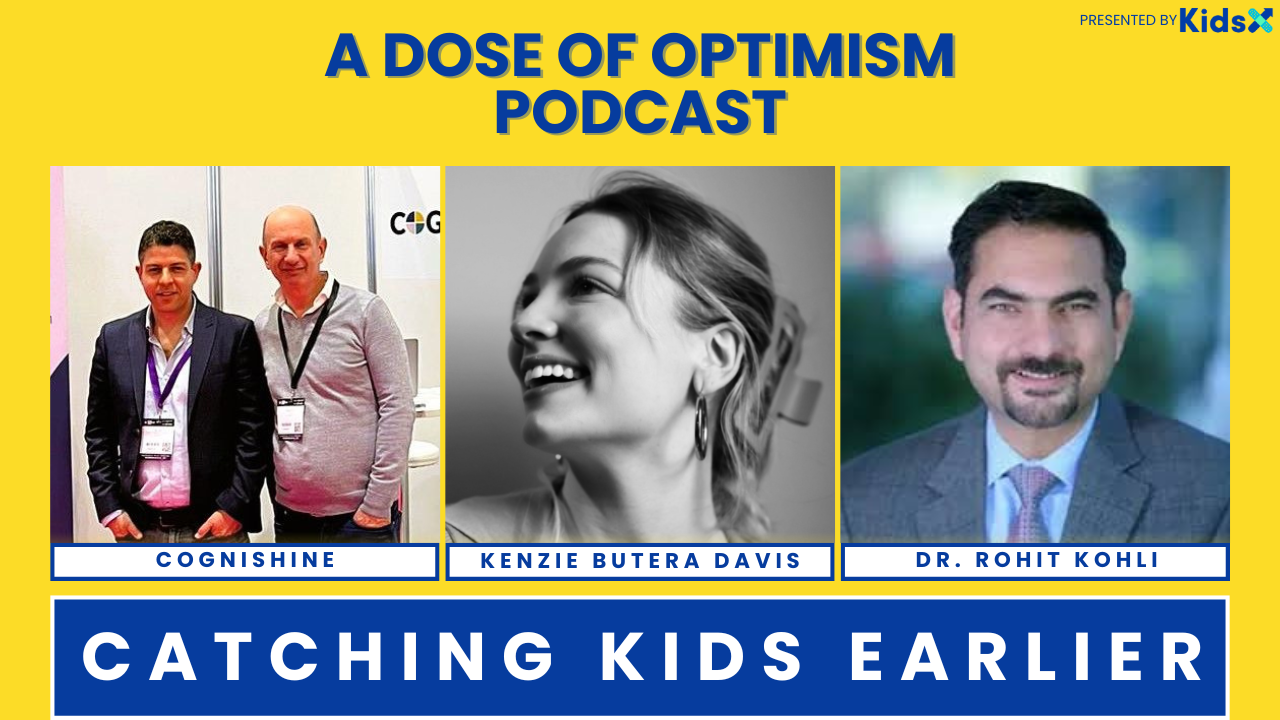
Three guests working in very different corners of pediatric healthcare, connected by a common belief: the time to act is earlier than the system currently acts.
Therapy That Goes Home With the Patient: George Frey of Cognishine and Arie Melamed from ALYN Hospital
Cognishine began as a tool for a pediatric rehabilitation hospital in Israel looking for ways to extend therapy beyond the walls of the clinic, particularly during COVID, when in-person sessions became impossible for many patients.
The platform gives occupational therapists, speech-language pathologists, and psychologists a digital environment for delivering therapeutic activities across multiple formats: synchronous sessions where therapist and patient work together in real time, asynchronous exercises that patients complete independently between sessions, and teletherapy that extends the reach of a clinical team geographically.
With more than 5,000 therapists across 10 countries and more than 100 hospital customers, Cognishine is already operating at a meaningful scale. And in pediatric settings, the engagement dynamic has proven favorable: children who are already comfortable with tablets and mobile devices find the platform intuitive, and parents are generally supportive when digital time serves a therapeutic purpose.
The AI development underway at Cognishine reflects a deliberate philosophy: technology should extend what the therapist can do, not bypass them. A forthcoming AI-powered activity generator will allow therapists to specify the type of activity they need, targeting articulation, cognition, concentration, or other areas, and receive a generated activity they can integrate, save, and share with patients. AI will also be used to help therapists build sessions with recommended sequences of activities tailored to individual patient profiles.
The personalization that results, Adi notes, reaches a level that would be difficult to achieve through any manual process: a therapy session calibrated to the specific patient, the specific therapist, and the specific moment in a patient’s therapeutic journey.
Eleven Years Is Too Long: Kenzie Butera Davis on Maro
The statistic that drives Kenzie Butera Davis’s work is simple and sobering: on average, 11 years pass between a child’s first mental health symptom and their first treatment. That figure comes from data compiled across 220 children’s hospitals nationwide.
In the meantime, one in five children have a diagnosable mental health disorder. Much of it goes unidentified. More goes untreated. And by the time many children receive support, they are at a point of crisis.
The policy environment is beginning to respond. Illinois recently passed legislation establishing universal mental health screening for students in grades 3 through 12, with full rollout expected in the 2027–28 school year. California’s Child and Youth Behavioral Health Initiative (CYBHI) is creating reimbursement pathways so schools can be paid for mental health screening and therapy services in the same way other healthcare providers are compensated.
Maro is designed to help schools implement this kind of screening effectively. The platform is agnostic to the specific screening tool used, a deliberate choice, because when a child screens positive, providers at a hospital or clinic need to be able to accept that data without rescreening the child from scratch. Maro works with clinically validated tools that translate across settings.
The platform also handles what Kenzie describes as the time-consuming back end of screening programs: parent consent, state-specific compliance, documentation, and referral pathways. And it connects schools to virtual care providers who have capacity, addressing what she sees as a supply-demand matching problem as much as a pure provider shortage.
One observation she shares that she didn’t expect: students want to be screened. A school told her recently that a student whose parent had declined consent said directly: “My mom said I can’t take this, but I really feel like I need to talk to somebody.” The screening instrument, a digital form asking structured questions about mental health, is becoming a channel through which some students feel they can express what they haven’t been able to say out loud.
For now, Maro is offering its platform free to schools in Illinois ahead of the state mandate.
Keeping the Pipeline Strong: Dr. Rohit Kohli on Pediatric Academic Medicine
Dr. Rohit Kohli has spent more than three decades in pediatric academic medicine, first learning the craft, then building a research program in fatty liver disease funded by NIH and published in Nature, and now investing his energy in the next generation of clinician-researchers.
His account of how academic pediatricians are developed is useful context: a system of protected time, structured research training during subspecialty fellowship, and support mechanisms from institutions, societies, foundations, and above all the National Institutes of Health that have historically created the conditions for new knowledge to be generated.
That system has worked. The pipeline of pediatric academic clinicians has produced device innovation, pharmaceutical development, quality improvement science, and implementation research, the workforce that translates discovery into care.
But Dr. Kohli sees headwinds. Financial pressures on health systems are squeezing protected time. Changes being proposed to subspecialty training structures, currently open for public comment from the American Board of Pediatrics, could affect the protections that have historically allowed pediatric trainees to develop as researchers. Time to think, he argues, is not a luxury in academic medicine. It is a precondition for the discoveries that improve care for children everywhere.
On the generational question, he is genuinely optimistic: today’s graduates have a much broader palette of tools and methodologies available to them than any previous generation. AI, quality improvement science, implementation science, clinical research, basic science, all of these are open to a trained pediatrician who wants to contribute to advancing the field. The conversation has never been more accessible to more people. The task is making sure the conditions that allow that contribution to happen are protected.
Key Topics Discussed:
- Digital therapy platforms for OT, SLP, and psychology: synchronous, asynchronous, and teletherapy
- AI-powered activity generation for therapeutic use
- Personalization in digital therapy, tailoring to patient, therapist, and session context
- The 11-year gap between first mental health symptom and first treatment
- Illinois SB 1560: universal mental health screening in schools
- California CYBHI: reimbursement for school-based mental health services
- Universal mental health screening platforms and interoperability
- Supply-demand matching in pediatric mental health access
- Parent consent, state compliance, and the operational challenges of school-based screening
- Students as willing participants in mental health screening
- Protecting the academic pediatric physician pipeline
- Mentorship, coaching, and sponsorship in pediatric academic medicine
- Financial and structural pressures on academic medicine
- AI and the expanding toolkit for pediatric research and QI
About Adi Topaz and George Frey:
Adi Topaz: As a COO and Managing Director for the United Kingdom and Ireland (UK&I) at Cognishine, I lead the company’s operations and growth. Cognishine is an intervention platform that serves speech-language pathologists, occupational therapists, and healthcare practitioners who specialize in clients facing challenges in cognition, language, speech, and social-emotional development. With over 10 years of experience in product leadership, AI, and digital marketing, I am passionate about creating and delivering impactful and personalised solutions that enhance therapeutic outcomes and customer satisfaction. I have developed a global consumer behavior dashboard to visualize the impact of various factors on shopping trends, and established a trusted guide to help customers adapt to Apple Mail Privacy Protection. I am also an external advisor to ExperiRace, a pioneering startup that aims to become the world’s premier collaborative broadcasting platform for outdoor events.
George Frey: Experienced Managing Director with a history of working in various industries, for the past 10 years in the hospital & health care market. Senior corporate manager who turned into a passionate entrepreneur, thriving in an informal, international and hugely dynamic work environment that our highly promising start-up Cognishine offers.
About Kenzie Butera Davis:
Kenzie has played a pivotal role in the growth of over 70 companies from idea to Series A—Digital Health, Edtech, and B2B SaaS—primarily in her role with The Company Lab startup accelerator and as an investor at The JumpFund. Her four-year thesis on the intersection of healthcare and K12 education, which included interviews with parents, schools, and providers, laid the groundwork for launching Maro.
About Dr. Rohit Kohli:
Rohit Kohli, MBBS, MS, received his medical degree from the Armed Forces Medical College, India in 1999 and his MS in clinical investigation from Northwestern University in 2006. While at Northwestern he first spent three years as a pediatric gastroenterology and hepatology fellow and then subsequently as a transplant hepatology trainee before relocating to the University of Cincinnati in 2007.
His research work has focused on the pathogenesis of obesity related fatty liver disease (NAFLD). In particular, he has focused upon the role of bile acid signaling as a mechanism for NAFLD resolution after weight loss surgery. His work has also shed light on reactive oxygen stress in the generation and regulation of the extreme stage of this disease; nonalcoholic steatohepatitis (NASH). He has published many peer-reviewed articles including articles in Nature, Nature Reviews, The Journal of Biological Chemistry, Hepatology, Journal of Pediatrics, and The American Journal of Physiology. He is the author of many book chapters and review articles. He also is the recipient of the 2007 George Ferry Young Investigator Award from the Children’s Digestive Health and Nutrition Foundation, a Fellowship award from the American Association for the Study of Liver Diseases, Takeda Research Innovation Award from the North American Society for Pediatric Gastroenterology, Hepatology and Nutrition Foundation.
